- Plants
- ›Vascular Plants
- ›flowering plants
- ›Dicots
- ›Legumes, Milkworts, and Allies
- ›Legumes
- ›Peacock Flower Subfamily
- ›Cassieae
- ›Cassiinae
- ›Senna
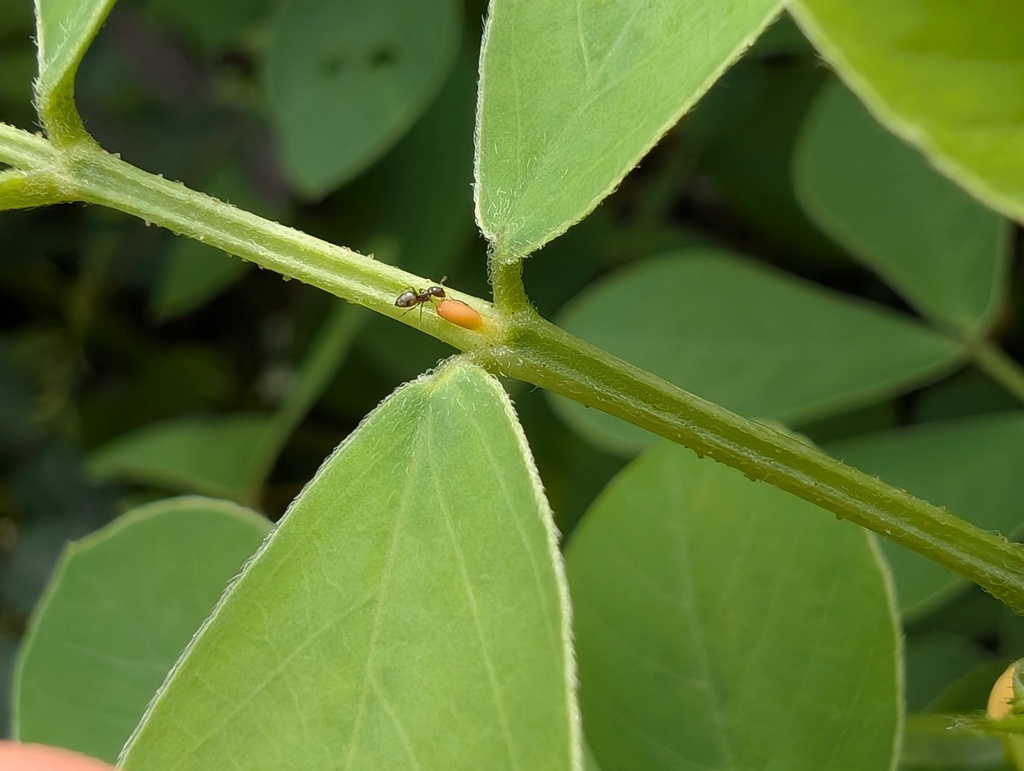
American Sicklepod
Senna obtusifolia
Senna obtusifolia, known by common names including Chinese senna, American sicklepod and sicklepod, is a plant in the genus Senna, sometimes separated in the monotypic genus Diallobus. It grows wild in North, Central, and South America, Asia, Africa, and Oceania, and is considered a particularly problematic weed in many places. It has a long-standing history of confusion with Senna tora and that taxon in many sources actually refers to the present species.
In the traditional medicine of Eastern Asia, the seeds are called jué míng zǐ in Chinese (simplified: 决明子; traditional: 決明子), gyeolmyeongja in Korean, and ketsumeishi in Japanese.
From the article Senna obtusifolia on Wikipedia (CC BY-SA), quoted section by section
Range & habitat
Senna obtusifolia naturally occurs in tropical and subtropical regions of the Americas, but has been introduced to Africa, parts of Europe, the Middle East, the Indian subcontinent, parts of Southeast Asia, New Guinea and parts of Australia. Its nativity in the North America disputed, but it is usually considered to be native to the Southeastern United States, while others also consider it to be native to the eastern and central U.S. north to New York. However, the earliest records in North America date to the early to mid 1800s. In its natural environment, it grows on the shores of lakes and rivers, but is also a weed of pastures and roadsides at altitudes up to 1,100 m (3,600 ft).
Wikipedia: “Distribution and habitat”
What it does
Senna obtusifolia is non-nodulating and does not have a symbiotic association with soil bacteria, unlike other members of the family Fabaceae. Senna obtusifolia is usually self pollinated as many flowers being fertilized before opening, though the flowers are heavily visited by bees. Senna obtusifolia has one (in Caribbean and North American forms) to two (in South American forms) extrafloral nectaries on the upper surface of the rachis that usually attract ants, but occasionally attracts wasps, flies and small bees. It serves as a host plant for several Lepidoptera and other insects including Eurema lisa, Eurema nicippe, Phoebis sennae cubule and Calycomyza malvae. Northern bobwhite and greater prairie chickens are known to feed on the seeds. Mammalian herbivory is rare due to the foliage's foul taste and toxicity, which is known to poison livestock.
Wikipedia: “Ecology”
In medicine
The materia medica name for the seeds in Chinese is jué míng zǐ (simplified: 决明子; traditional: 決明子). The medicinal seeds are also known by the equivalent Korean name gyeolmyeongja (결명자; 決明子) in traditional Korean medicine, and by the Japanese name ketsumei-shi (ケツメイシ, 決明子) in kampō medicine. The jue ming zi is used widely in Asia, including Southeast Asian countries such as Thailand, and its herbal sicklepod tea is drunk instead of regular tea as a preventative for hypertension. It is also purported to have the ability to clear the eye. In Korea also, medicinal gyeolmyeongja is usually prepared as tea (gyeolmyeongja-cha, "sickle pod tea"). Senna tora (Cassia tora) is used similarly, and though distinguished in the Chinese market as the "little/lesser" variety or shao jue ming 小決明) the Japanese government's [pharmacopoeia] (Nihon yakkyokuhō) officially acknowledges both S. obtusifolia and S. tora to be commerced as ketsumeishi. The Japanese beverage habu-cha (ハブ茶), as the name suggests, was originally brewed from the seeds of the habusō or S. occidentalis, but currently marketed habu-cha uses S. obtusifolia as substitute, since it is a higher-yielding crop.
Wikipedia: “Traditional Eastern medicine”
Toxicity
Ingested in larger quantities, Senna obtusifolia is toxic to cattle, sheep and goats. It is not readily palatable due to its bitter taste but may be consumed by livestock when other pasture forage is lacking. The main clinical signs are diarrhea, reluctance to move, muscular weakness and recumbency. Brown urine may be observed due to the presence of myoglobin from muscle breakdown. Macroscopic necropsy findings consist of pale discoloration of skeletal muscles. Microscopically, affected cattle show degeneration and necrosis of the skeletal and occasionally cardiac muscles. Some animals may develop centrilobular hepatic necrosis. Seasonal variation in toxicity of the plant has been reported.
Wikipedia: “Toxicity in cattle, sheep and goats”
Where it lives
Recorded sightings
—
geo-referenced records in GBIF, from museums, herbaria and field observers.
Drag the globe to turn it. Dots are where records exist, not a range map; darker means more records.
In the old herbals & bestiaries

In the stacks
Searching the stacks…
Every page naming Senna obtusifolia in the Biodiversity Heritage Library →
This page is assembled live from iNaturalist, GBIF, Wikipedia, the Source Library and the Internet Archive. It is not yet part of the hand-edited codex. iNaturalist taxon 62915.