- Fungi Including Lichens
- ›Basidiomycete Fungi
- ›Higher Basidiomycetes
- ›Mushrooms, Bracket Fungi, Puffballs, and Allies
- ›Agaricomycetidae
- ›Common Gilled Mushrooms and Allies
- ›Pluteineae
- ›amanita mushrooms and allies
- ›Amaniteae
- ›Amanita
- ›Amanita
- ›Vaginatae
- ›Amanita fulva
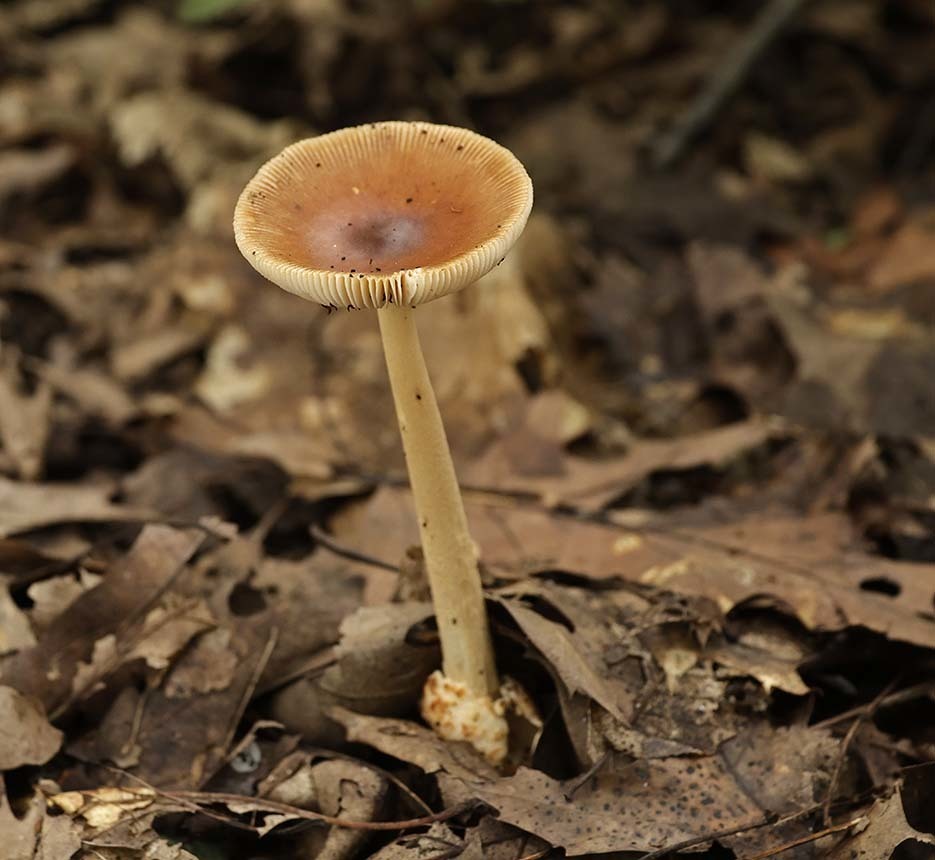
Tawny Grisette
Amanita fulva
Amanita fulva, commonly called the tawny grisette or the orange-brown ringless amanita, is a basidiomycete mushroom of the genus Amanita. It is found frequently in deciduous and coniferous forests of Europe and possibly North America.
From the article Amanita fulva on Wikipedia (CC BY-SA), quoted section by section
Description
A membranous universal veil initially encapsulates the fruiting body, which develops into a white, sacklike volva with rusty-brown blemishes. Whitish veil remnants rarely remain on the cap, which is otherwise smooth with a strongly striated margin. It is up to 10 centimetres (4 inches) in diameter, convex to plane or umbonate, and orange-brown to reddish-tan. It is viscid when moist. The gills are free, close, and broad. The flesh is white to cream. The stem or stipe is white and smooth or powdery, sometimes tinged with orange-brown and with very fine hairs. It is slender, ringless, hollow and quite fragile, tapering towards the top; up to 15 cm tall and 1–1.5 cm in thickness. The spores are white, 9 × 12 μm or (9.0-) 10.0–12.5 (-19.3) x (8.2-) 9.3–12.0 (-15.5) μm in size, globose; nonamyloid.
Range & habitat
Amanita fulva, distributed throughout Europe, occurs in a variety of forests. It is generally found with oak, birch, spruce, pine, chestnut and alder, forming mycorrhizae. It is often found with birch in Scandinavia, while collections from southern Europe are usually from forests of oak, chestnut and pine. It grows in acidic soils and fruits from summer to late autumn (May to November in the United Kingdom). It is a common to scarce fungus and is very common in Britain. Amanita fulva is considered to be widely distributed in North America in deciduous and coniferous forests, although collections could possibly be of a different, yet undescribed species. Additionally, the name A. fulva has previously been misapplied to other North American taxa, such as A. amerifulva and others. Adults of the pleasing fungus beetle Tritoma mimetica have been recorded from this mushroom (or perhaps from A. amerifulva), but it does not seem to be a regular food source for them.
Wikipedia: “Distribution and ecology”
At the table
Although this Amanita fulva is considered edible, it must be identified with care as some other members of the genus Amanita are poisonous and a few can be deadly. For this reason, consuming A. fulva can be dangerous and is not recommended. It is potentially toxic when raw and suitable for consumption only after cooking.
Wikipedia: “Edibility”
Where it lives
Recorded sightings
—
geo-referenced records in GBIF, from museums, herbaria and field observers.
Drag the globe to turn it. Dots are where records exist, not a range map; darker means more records.
In the stacks
Searching the stacks…
Every page naming Amanita fulva in the Biodiversity Heritage Library →
This page is assembled live from iNaturalist, GBIF, Wikipedia, the Source Library and the Internet Archive. It is not yet part of the hand-edited codex. iNaturalist taxon 63027.