- Plants
- ›Vascular Plants
- ›flowering plants
- ›Dicots
- ›Mints, Plantains, Olives, and Allies
- ›lopseed family
- ›Erythranthe
- ›Simiolus
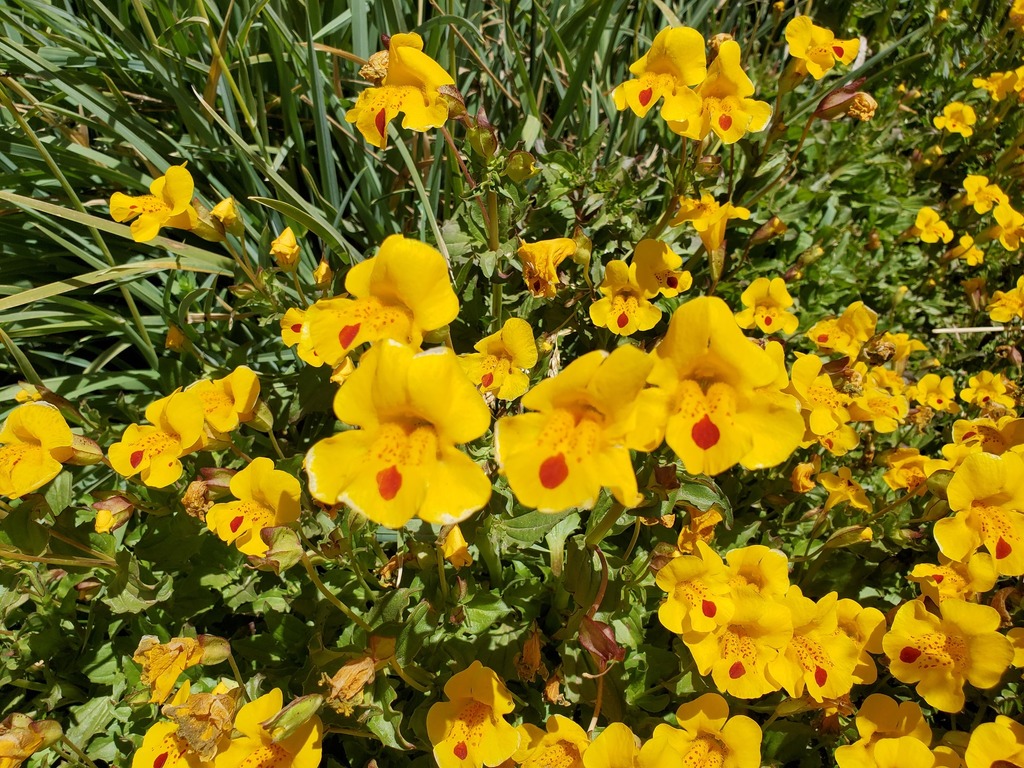
Blood-drop-emlets
Erythranthe lutea
Erythranthe lutea is a species of monkeyflower also known as yellow monkeyflower, monkey musk, blotched monkey flowers, and blood-drop-emlets. It was formerly known as Mimulus luteus. It is a perennial native to temperate South America, including Chile and western and southern Argentina.
From the article Erythranthe lutea on Wikipedia (CC BY-SA), quoted section by section
Description
E. lutea blooms in the summer and grows to about 30 centimetres (12 in) in height. The flowers are yellow with irregular red blotches and the leaves are hairy, paired, and round. Because of its yellow petals, E. luteus is in the "yellow monkeyflower" group, unlike most members of the genus, which have red or pink petals. Some sources list Erythranthe lutea separately due to chromosomal variations. Barker, etal (2012) proposes a new taxonomy for Phrymaceae, leaving only 7 species in Mimulus, none in Mimulus lutea, and placing 111 in Erythranthe. Barker also offers 4 different options for how to implement this new taxonomy. The luteus group consists of Erythranthe luteus var. variegatus, E. naiandinus and E. cupreus.
Range & habitat
Erythranthe lutea prefers to grow in wet habitats such as marshes and riverbanks. It is native to temperate South America, including Chile and western and southern Argentina. It has been naturalized in Britain, having been first cultivated there circa 1826.
Wikipedia: “Distribution and habitat”
Where it lives
Recorded sightings
—
geo-referenced records in GBIF, from museums, herbaria and field observers.
Drag the globe to turn it. Dots are where records exist, not a range map; darker means more records.
In the stacks
Searching the stacks…
Every page naming Erythranthe lutea in the Biodiversity Heritage Library →
This page is assembled live from iNaturalist, GBIF, Wikipedia, the Source Library and the Internet Archive. It is not yet part of the hand-edited codex. iNaturalist taxon 631312.