- Fungi Including Lichens
- ›Basidiomycete Fungi
- ›Higher Basidiomycetes
- ›Mushrooms, Bracket Fungi, Puffballs, and Allies
- ›Agaricomycetidae
- ›Common Gilled Mushrooms and Allies
- ›Agaricineae
- ›Brittlestems and Allies
- ›Coprinopsis
- ›Picaceae
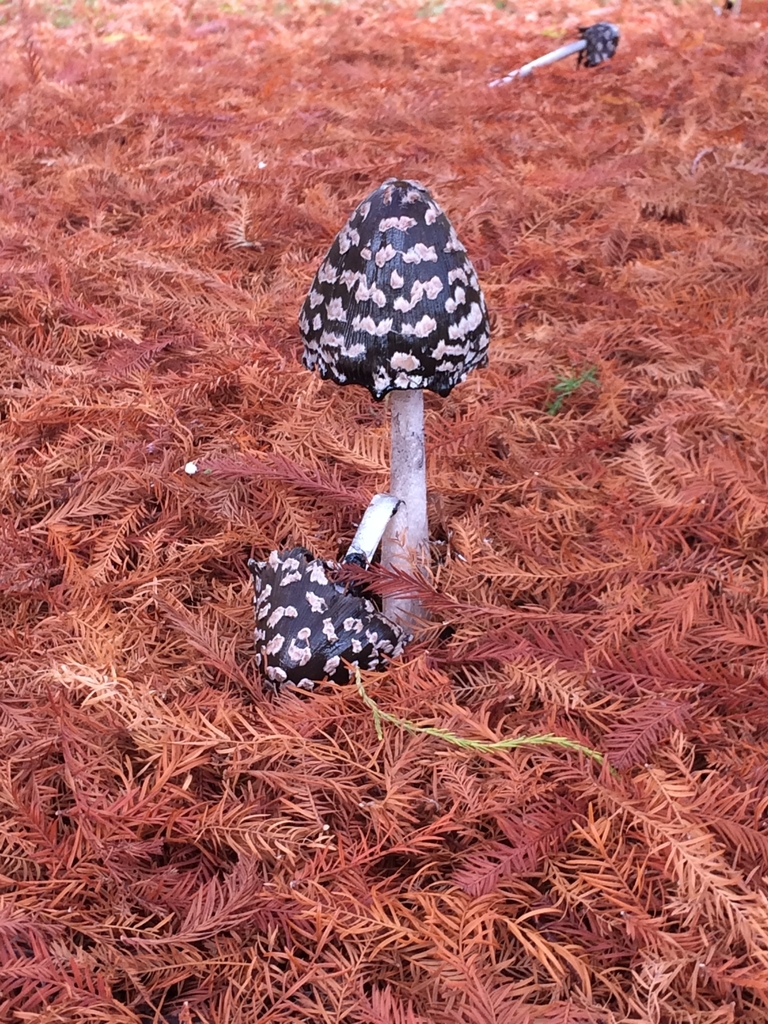
Magpie Inkcap
Coprinopsis picacea
Coprinopsis picacea is a species of fungus in the family Psathyrellaceae. It is commonly called magpie inkcap fungus. . It was first described in 1785 by French mycologist Jean Baptiste François Pierre Bulliard in 1785 as Agaricus picaceus.
From the article Coprinopsis picacea on Wikipedia (CC BY-SA), quoted section by section
Description
The cap is initially egg-shaped, then opens up to a bell shape up to 8 centimetres (3 in) wide. The cap is serrated and colored white on very young mushrooms. It breaks open with increasing age, revealing the dark brown background which becomes black. Remnants of the white, grayish to cream-colored velum remain on the cap as flakes, giving the impression of woodpecker or magpie plumage. With age, the brim of the cap rolls up and dissolves. The lamellae are mostly free, very close and are initially white, then reddening. Eventually they melt, dripping and black, hence the name inkcap. The stalk is whitish and 12–20 (–30) cm long and 6–15 mm thick. It is hollow and not very stable, slightly tapered towards the top and covered with scales or fine fibers. The flesh is whitish with a fibrous, watery consistency and sometimes has an unpleasant smell of moth powder. The taste is also unpleasant.
Microscopic features. The elliptical, dark brown spores are 14–18.5 × 10⁻¹³ μm in size. The cheilo- and pleuro-Zystiden are bubbles or bag-to tubular. They are up to 150 μm long and 50 μm wide.
Similar species. The species can sometimes be confused with the edible Coprinus comatus.
Range & habitat
The magpie inkcap is common in Europe and Australia, but it also exists in North America, though it is uncommon. In Europe, the area extends from Great Britain and France in the west to Poland, Hungary and Romania in the east and south to Spain and the Balearic Islands, Italy and Greece and to Germany and Denmark in the north.
Wikipedia: “Distribution”
Toxicity
The species is inedible and causes digestive upset, being regarded as poisonous to some people.
Where it lives
Recorded sightings
—
geo-referenced records in GBIF, from museums, herbaria and field observers.
Drag the globe to turn it. Dots are where records exist, not a range map; darker means more records.
In the stacks
Searching the stacks…
Every page naming Coprinopsis picacea in the Biodiversity Heritage Library →
This page is assembled live from iNaturalist, GBIF, Wikipedia, the Source Library and the Internet Archive. It is not yet part of the hand-edited codex. iNaturalist taxon 63224.