- Fungi Including Lichens
- ›Basidiomycete Fungi
- ›Higher Basidiomycetes
- ›Mushrooms, Bracket Fungi, Puffballs, and Allies
- ›Cantharellales
- ›Hydnaceae
- ›Clavulina
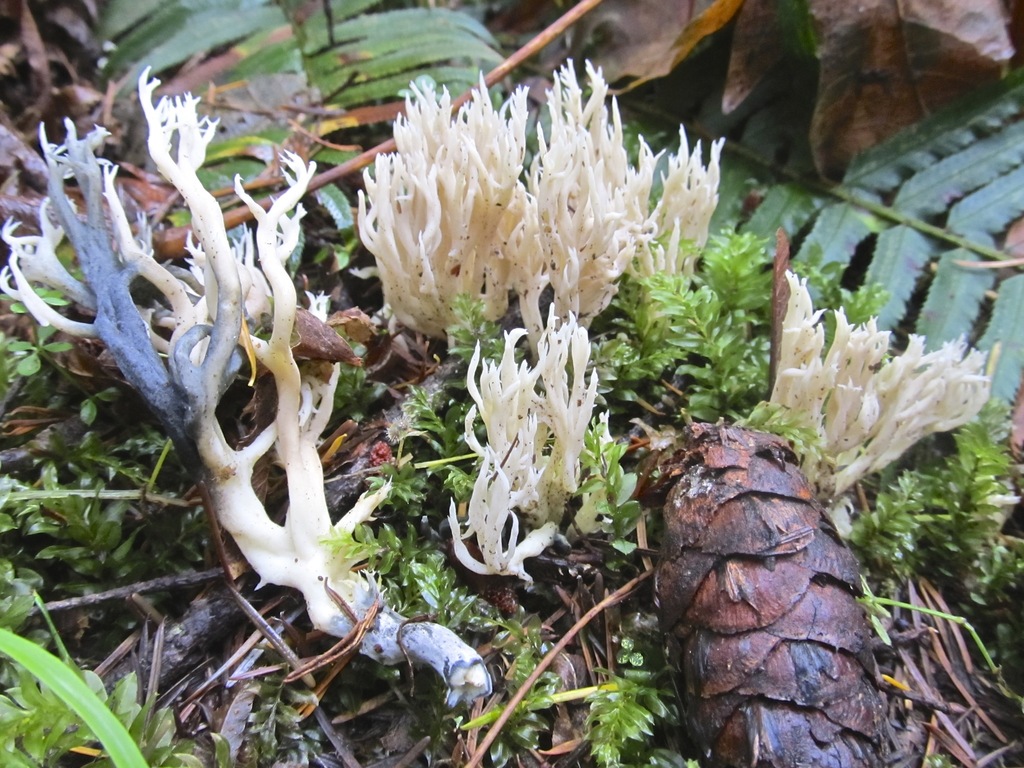
White Coral Fungus
Clavulina coralloides
Clavulina cristata, commonly known as the wrinkled coral fungus, white coral fungus or the crested coral fungus, is a white- or light-colored edible coral mushroom present in temperate areas of the Americas and Europe. It is the type species of the genus Clavulina.
From the article Clavulina cristata on Wikipedia (CC BY-SA), quoted section by section
Description
The fruit bodies, which are generally white- to cream-colored, can be up to 8 centimetres (3+1⁄8 in) tall, and 2.5–4 cm (1–1+5⁄8 in) broad. The coral "arms" are sparingly branched (3–4 times), 2–4 mm wide, smooth, and sometimes wrinkled longitudinally. The tips are cristate, having small pointed projections, and will often darken with age or in dry weather. The stems vary in form and can be 5–40 mm (1⁄4–1+1⁄2 in) long and 5–20 mm wide. The fruit bodies have no distinctive odor, and a mild taste. The fruit bodies may have a darker color either due to natural variation (whereby the appearance of this species may approach and be confused with C. cinerea) or because of infection by a microscopic fungus, Helminthosphaeria clavariarum.
Microscopic features. The spores are white, roughly spherical, thick-walled, non-amyloid, smooth, and have dimensions of 7–11 by 6–10 μm. Basidia are club-shaped, 60–80 by 6–8 μm, and 2-spored. Cystidia are absent. Sterigmata, the slender projections of the basidium that bear the spores, may be straight or curved, and up to 7–8 μm long. Microscopic and molecular analysis indicate that the species is related to chanterelles.
Chemistry. In addition to the major fatty acid components, palmitic acid, oleic acid and linoleic acid, C. …
Range & habitat
Clavulina cristata is found growing solitary or in clusters on the ground (sometimes on rotten wood) in both coniferous and hardwood forests in temperate areas of the Americas (October–March on the west coast of North America and July–October further inland) and Europe (June–November). It is a common mushroom, and typically fruits from late summer to winter.
Wikipedia: “Distribution and habitat”
At the table
This fungus is edible, but the tough flesh and insubstantial fruit bodies make it unappetizing to some individuals. It is considered excellent by some.
Wikipedia: “Uses”
Where it lives
Recorded sightings
—
geo-referenced records in GBIF, from museums, herbaria and field observers.
Drag the globe to turn it. Dots are where records exist, not a range map; darker means more records.
In the stacks
Searching the stacks…
Every page naming Clavulina coralloides in the Biodiversity Heritage Library →
This page is assembled live from iNaturalist, GBIF, Wikipedia, the Source Library and the Internet Archive. It is not yet part of the hand-edited codex. iNaturalist taxon 63260.