- Plants
- ›Vascular Plants
- ›flowering plants
- ›Dicots
- ›Mustards, Capers, and Allies
- ›mustard family
- ›Brassicoideae
- ›Camelinodae
- ›Lepidieae
- ›Lepidium
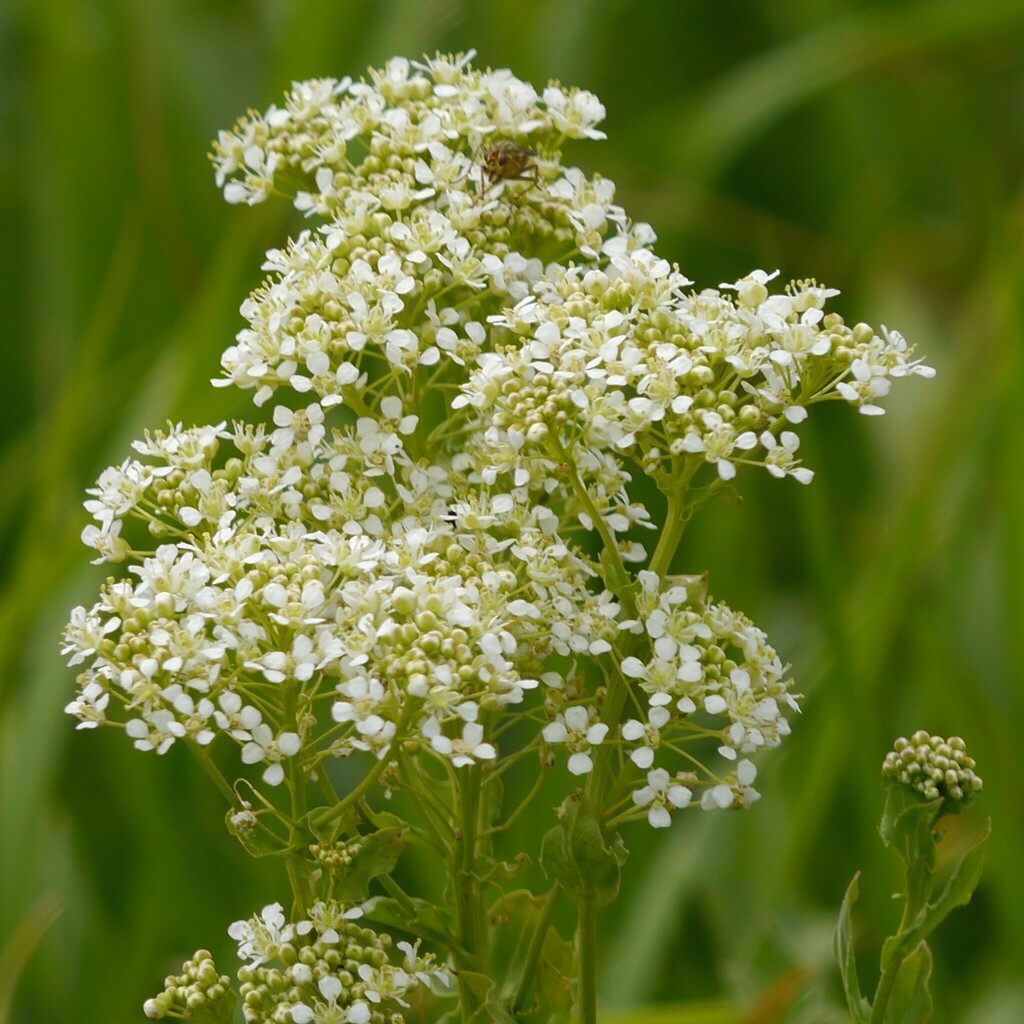
Heart-podded Hoary Cress
Lepidium draba
Lepidium draba, commonly known as hoary cress, whitetop, whiteweed, or peppergrass, is a perennial plant species in the mustard family, Brassicaceae. It is native to Eurasia, specifically regions of Europe and western to central Asia, but has become widely distributed across the globe, including most of the United States, as well as in Canada and parts of Mexico.
From the article Lepidium draba on Wikipedia (CC BY-SA), quoted section by section
Description
Whitetop is a perennial herb that reproduces by seeds and by horizontal creeping roots. The stem is stoutish, erect or spreading, 10 to 80 centimetres (4 to 31+1⁄2 inches) tall, branched, covered sparsely with grayish, soft hairs. The leaves are alternate, simple, and mostly toothed. The basal leaves measure 4–10 centimetres (1+1⁄2–4 inches) in length, have short petioles, and are lanceolate to ovate in shape. The upper stem leaves are sessile, 2–6.5 cm (3⁄4–2+1⁄2 in) long, and oblong to tapering, with broad bases that clasp the stem.
Flowering. Flowering usually occurs in the spring to early summer. The plant produces slightly domed, corymb-like clusters of white flowers, in which the individual flower stalks grow upward from various points off the branch to approximately the same height. Each flower typically has four white petals measuring 3–5 millimetres (1⁄8–1⁄4 in) in length, approximately twice as long as the sepals. After flowering, the plant forms heart-shaped seed pods called silicles, each containing two seeds.
Reproduction. Lepidium draba reproduces through both clonal (vegetative) and sexual (seed-based) methods, with clonal reproduction being the dominant method. The plant spreads via lateral rhizomes, allowing it to expand rapidly and form dense, interconnected patches. …
Range & habitat
Lepidium draba is native to Eurasia, specifically regions of Europe and western to central Asia, but has become widely distributed across the globe. In North America, it is now found throughout most of the United States, particularly in the central and western regions, as well as in Canada and parts of Mexico. It has been suggested that native Poa grasses may be able to outcompete whitetop in North America. The species was first recorded in the US around 1862, believed to have been unintentionally introduced through contaminated agricultural seed or ship ballast.
Wikipedia: “Distribution and habitat”
What it does
Lepidium draba is a highly competitive, disturbance‑adapted perennial whose success is driven by vigorous clonal growth, deep root reserves, and potent chemical defenses that suppress neighboring vegetation. Its ability to rapidly colonize disturbed soils allows it to dominate plant communities and outcompete both native and agricultural species. Genetic analyses from both native Eurasian populations and introduced North American populations reveal unexpectedly high genetic diversity, indicating that the species experienced multiple introduction events rather than a single founder effect or genetic bottleneck. This broad genetic base likely enhances its ecological flexibility and contributes to its strong competitiveness.
Generally, the plant thrives in disturbed, nutrient‑rich, and open habitats such as agricultural fields, roadsides, and abandoned lands, where reduced competition enables rapid establishment and spread. Its high seed production and efficient dispersal mechanisms allow it to colonize new sites quickly, reinforcing its invasive expansion across landscapes. In competitive settings, L. draba exerts strong dominance over native grasses and forbs, significantly reducing their biomass and recruitment when grown together. European plant species tend to show greater tolerance to the chemical and physical interference exerted by L. …
Wikipedia: “Ecology”
At the table
L. draba has been researched for its medicinal potential. Researchers have reported that L. draba extracts can protect the liver, kidneys, and intestines. In biotechnology, researchers have improved the stability and efficiency of L. draba peroxidase enzymes by attaching them to magnetic nanoparticles.
Wikipedia: “Potential uses”
Toxicity
L. draba contains chemical compounds known as glucosinolates, which can be toxic to livestock if consumed in large quantities.
Where it lives
Recorded sightings
—
geo-referenced records in GBIF, from museums, herbaria and field observers.
Drag the globe to turn it. Dots are where records exist, not a range map; darker means more records.
In the stacks
Searching the stacks…
Every page naming Lepidium draba in the Biodiversity Heritage Library →
This page is assembled live from iNaturalist, GBIF, Wikipedia, the Source Library and the Internet Archive. It is not yet part of the hand-edited codex. iNaturalist taxon 63352.