- Plants
- ›Vascular Plants
- ›flowering plants
- ›Dicots
- ›Mints, Plantains, Olives, and Allies
- ›figwort family
- ›Eremophila
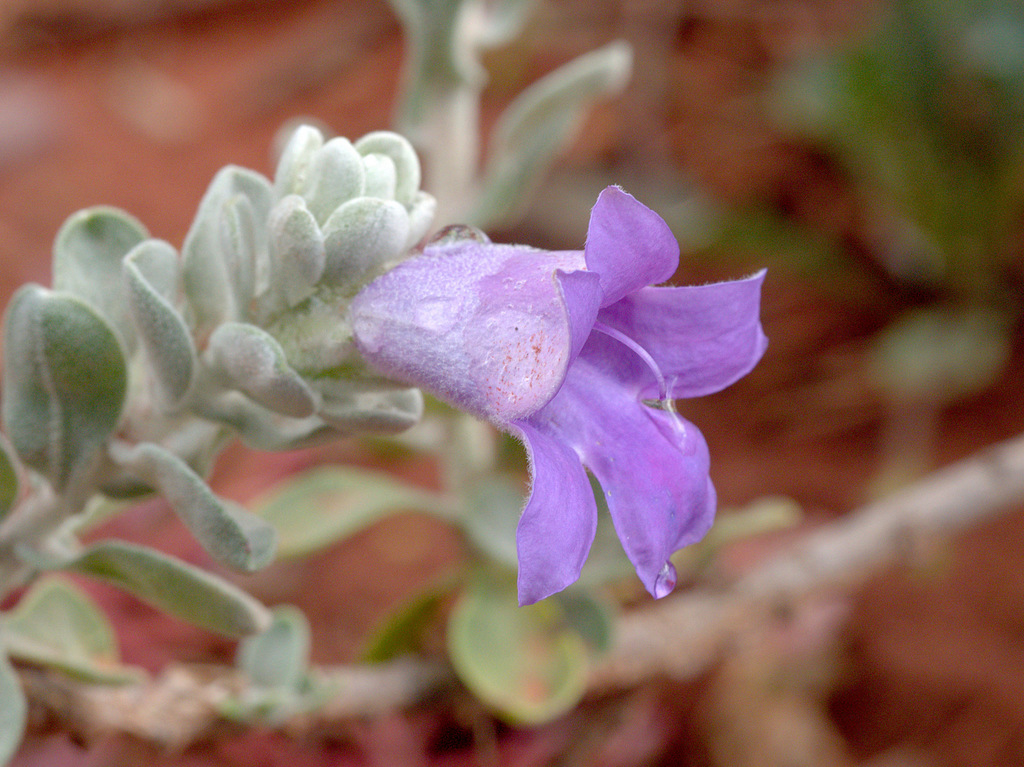
blue emu bush
Eremophila hygrophana
Eremophila hygrophana, also known as the blue emu bush, is a flowering plant in the figwort family, Scrophulariaceae and is endemic to Australia. It is an erect, compact shrub with crowded, grey leaves and violet to purple flowers and is found in South Australia and Western Australia.
From the article Eremophila hygrophana on Wikipedia (CC BY-SA), quoted section by section
Description
Eremophila hygrophana is an erect, compact, highly branched shrub which grows to a height of between 0.3 and 1.2 m (1 and 4 ft) and which has its leaves and branches covered with both glandular hairs and yellow or grey branched hairs. The older parts of the branches are rough due to persistent leaf bases. The leaves are densely clustered at the ends of the branches and are furry, thick, linear to lance-shaped and mostly 12–25 mm (0.5–1 in) long and 2.5–5 mm (0.1–0.2 in) wide. The flowers are borne singly in leaf axils and lack a stalk. There are 5 green, hairy, triangular to lance-shaped sepals which are 6.5–12 mm (0.3–0.5 in) long. The petals are 20–30 mm (0.8–1 in) long and are joined at their lower end to form a tube. The petal tube is pale violet to purple on the outside and paler, spotted purple inside the tube. As the flowers age, their colour changes to dark reddish brown. The outside of the tube and petal lobes are hairy but the inside of the lobes is glabrous and the inside of the tube is woolly. The 4 stamens are fully enclosed in the petal tube. Flowering occurs from July to December and is followed by fruits which are oval-shaped to cone-shaped with a hairy covering and 6–8 mm (0.2–0.3 in) long.
Range & habitat
This eremophila occurs mostly commonly in Western Australia where it is found from near Rawlinna to Mount Magnet, growing in the Gibson Desert, Little Sandy Desert, Murchison, Nullarbor Plain and Yalgoo biogeographic regions. It is also found in the extreme central west of South Australia. A single record from the Northern Territory may be a new, as yet undescribed species.
Wikipedia: “Distribution and habitat”
How it is grown
This small eremophila is one of the most attractive in cultivation with its sometimes golden, furry leaves and large purple flowers which are present through most months. It grows particularly well in Melbourne. It, especially the cultivar "Blue Bells", is well known in gardens in the drier parts of the United States. It can be propagated from cuttings taken in warm weather, or by grafting onto Myoporum rootstock. Grafted plants perform better in heavy soils. It is tolerant of drought but not humidity so a sunny, open position is preferred. It is tolerant of light frost, although may need a light pruning to remove frost damaged branches.
== References ==
Wikipedia: “Use in horticulture”
Where it lives
Recorded sightings
—
geo-referenced records in GBIF, from museums, herbaria and field observers.
Drag the globe to turn it. Dots are where records exist, not a range map; darker means more records.
In the stacks
Searching the stacks…
Every page naming Eremophila hygrophana in the Biodiversity Heritage Library →
This page is assembled live from iNaturalist, GBIF, Wikipedia, the Source Library and the Internet Archive. It is not yet part of the hand-edited codex. iNaturalist taxon 633573.