- Plants
- ›Vascular Plants
- ›flowering plants
- ›Dicots
- ›Sunflowers, Bellflowers, Fanflowers, and Allies
- ›Sunflowers, Daisies, Asters, and Allies
- ›Asteroideae
- ›stinkworts and allies
- ›Plucheinae
- ›Pechuel-loeschea
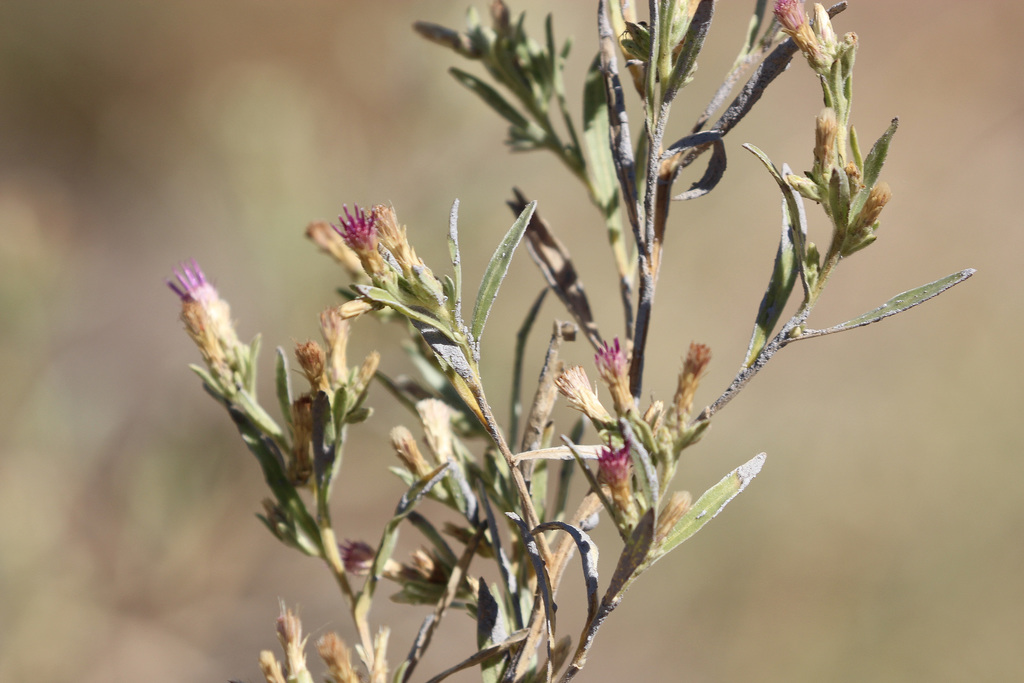
Wild Sage
Pechuel-loeschea leubnitziae
Pechuel-loeschea (common names: stinkbush, sweatbush, or bitterbos) is a monotypic genus of African plants in the elecampane tribe within the sunflower family, and named after the German plant collector and geographer Eduard Pechuël-Loesche (1840–1913).
The only known species is Pechuel-loeschea leubnitziae, (or 'wild sage') which is native to Angola, Botswana, Eswatini, Mozambique, Namibia, Zimbabwe and the Cape Provinces and the Northern Provinces, (in South Africa). The Latin specific epithet of leubnitziae refers to Leubnitzia, the maiden name of Pechuel-Loesche's wife.
From the article Pechuel-loeschea on Wikipedia (CC BY-SA), quoted section by section
Description
Strongly aromatic shrubby perennial herb. It grows up to 1.3 m (4 ft 3 in) tall. Most parts are densely grey-velvety and with short glandular hairs. It has alternately arranged leaves, which are (sub)sessile (without a leaf stalk). They are narrowly obovate-elliptic in shape and about 4.5 cm (2 in) long and 0.7 cm wide. They are velvety-grey on both leaf surfaces with a midrib prominent also on both surfaces. The margin is entire (smooth). It blooms between March and July. It has a capitula (a dense cluster of sessile or subsessile flowers) which are terminal (at the end) of 1–3 in the leaf axils. They more or less funnel-shaped and up to 1.3 cm long. The involucral scales (surround the flower head) are greyish glandular and hairy. The florets are purple with the central ray florets absent.
Range & habitat
It is found growing in alkaline and sandy soils in dry wooded grassland or open woodland. It is often found in large amount growing along roadsides and disturbed areas.
== References ==
Wikipedia: “Habitat”
Where it lives
Recorded sightings
—
geo-referenced records in GBIF, from museums, herbaria and field observers.
Drag the globe to turn it. Dots are where records exist, not a range map; darker means more records.
In the old herbals & bestiaries

Latin Herbal
1484 · p.51

Living Images of Plants
Otto Brunfels · 1532 · p.369

Herbarius
1485 · p.52

Latin Herbal with German Synonyms
1486 · p.52

Herbarius latinus (with Dutch synonyms)
1486 · p.49

The Book of Health: The Art of Distillation
Brunschwig, Hieronymus · 1505 · p.259

The Great Herbary with all the figures of the herbs
1532 · p.140

On the Names of Plants
Hieronymus Bock (Tragus) · 1552 · p.87

On the Names of Plants
Hieronymus Bock (Tragus) · 1552 · p.125

A New Herbal, or History of Plants
Rembert Dodoens (trans. Henry Lyte) · 1578 · p.277

Six Groups of the History of Plants
Rembert Dodoens · 1583 · p.310
In the stacks
This page is assembled live from iNaturalist, GBIF, Wikipedia, the Source Library and the Internet Archive. It is not yet part of the hand-edited codex. iNaturalist taxon 634052.