- Plants
- ›Vascular Plants
- ›flowering plants
- ›Dicots
- ›Sunflowers, Bellflowers, Fanflowers, and Allies
- ›Sunflowers, Daisies, Asters, and Allies
- ›Asteroideae
- ›asters and allies
- ›Brachyscominae
- ›Erodiophyllum
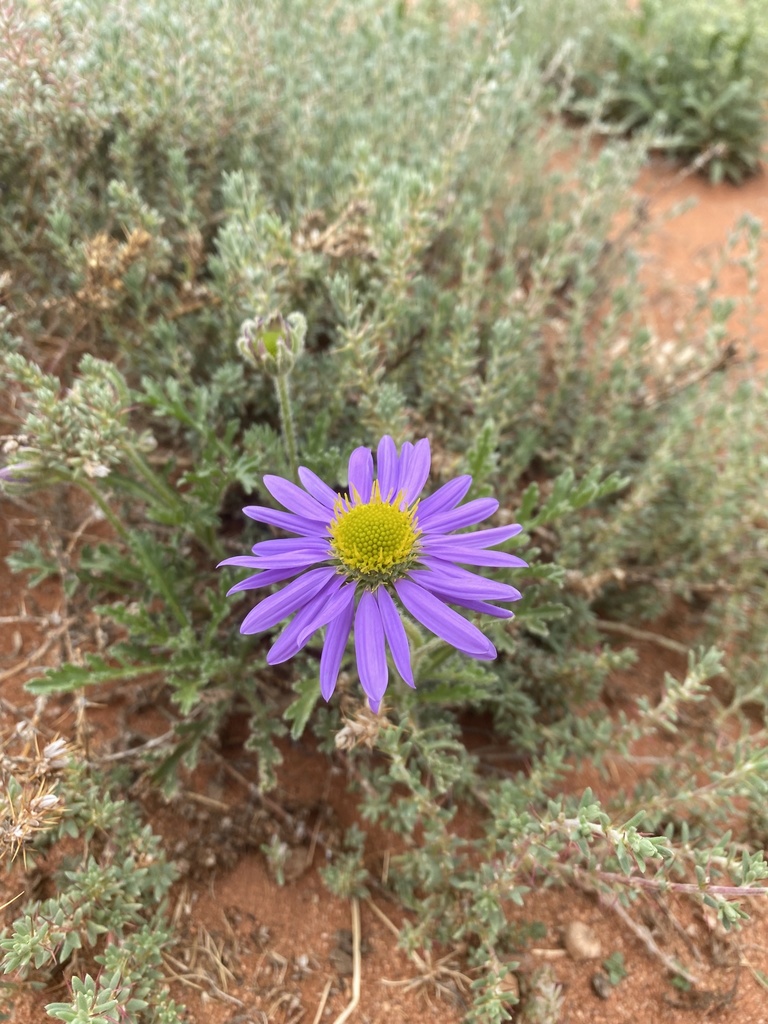
koonamore daisy
Erodiophyllum elderi
Erodiophyllum elderi, commonly known as Koonamore daisy, is a flowering plant in the family Asteraceae and is endemic to Australia. It is a small perennial herb with upright stems and purple daisy-like flowers.
From the article Erodiophyllum elderi on Wikipedia (CC BY-SA), quoted section by section
Description
Erodiophyllum elderi is a small, perennial, woody herb with upright, roughly hairy stems to 15–50 cm (5.9–19.7 in) high and 60 cm (24 in) wide. Leaves are bright green, hairy, spear-shaped, 4–10 cm (1.6–3.9 in) long, 2–3 cm (0.79–1.18 in) wide, broadly toothed and tapering to the petiole. The flower heads 5–7 cm (2.0–2.8 in) in diameter, purple or white, disc florets yellow, peduncles hairy, thick, 5–14 cm (2.0–5.5 in) long, bracts lance-shaped, about 1.5 cm (0.59 in) long, hairy, becoming woody and hard as they age. Flowering occurs from winter to early summer and the fruit is a woody achene about 3 mm (0.12 in) long.
Range & habitat
Koonamore daisy grows on sandy flats and clay loam soils in chenopod and mulga shrublands in New South Wales, Western Australia and South Australia.
== References ==
Wikipedia: “Distribution and habitat”
Where it lives
Recorded sightings
—
geo-referenced records in GBIF, from museums, herbaria and field observers.
Drag the globe to turn it. Dots are where records exist, not a range map; darker means more records.
In the stacks
Searching the stacks…
Every page naming Erodiophyllum elderi in the Biodiversity Heritage Library →
This page is assembled live from iNaturalist, GBIF, Wikipedia, the Source Library and the Internet Archive. It is not yet part of the hand-edited codex. iNaturalist taxon 634171.