- Plants
- ›Vascular Plants
- ›flowering plants
- ›Dicots
- ›Heathers, Balsams, Primroses, and Allies
- ›heath family
- ›typical heathers, azaleas, and allies
- ›Ericeae
- ›Erica
- ›Philippia
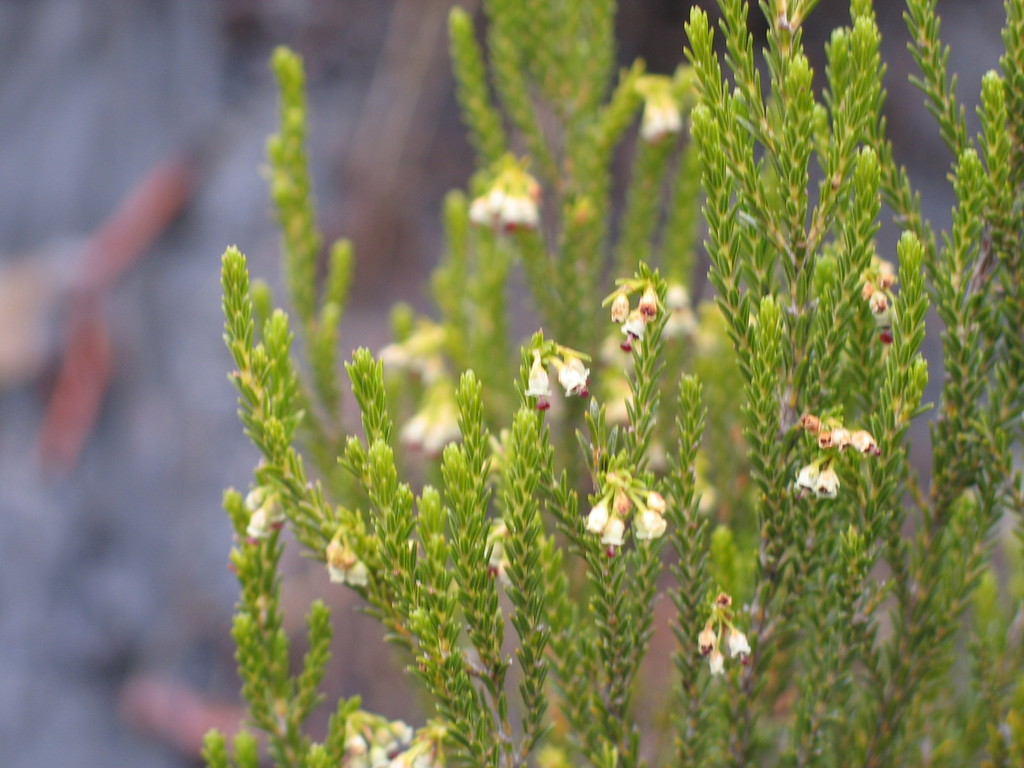
Erica trimera
Erica trimera is a species of flowering plant. It is a shrub or tree which grows in the mountains of eastern and central Africa.
From the article Erica trimera on Wikipedia (CC BY-SA), quoted section by section
Description
Erica trimera is an evergreen shrub or tree which grows from .4 to 12 meters in height, with a many-branching habit. It has small leaves, 1 to 7–10 mm long and 0.4 to 1.4 wide, which are generally smooth with tiny hairs along the margins. Flowers grow in clusters of 4 to 12 at branch ends.
Range & habitat
Erica trimera is native to the mountains of Eastern and Central Africa, ranging from Ethiopia through Kenya, Uganda, Tanzania, and the northeastern Democratic Republic of the Congo. It is native to high-elevation areas of the mountains, including the Ethiopian Highlands in Ethiopia, Mount Elgon and Mount Kenya in Kenya, Mount Meru and Mount Kilimanjaro in Tanzania, and the Rwenzori Mountains on the border of Uganda and the Democratic Republic of the Congo. It is typically found in the subalpine ericaceous belt, a transitional zone between the Afromontane forests and the higher-elevation Afroalpine grasslands and shrublands, from approximately 3000 to 4000 meters elevation. In the ericaceous belt it is often co-dominant with Erica arborea, and can form dense thickets or low forests.
Wikipedia: “Range and habitat”
Where it lives
Recorded sightings
—
geo-referenced records in GBIF, from museums, herbaria and field observers.
Drag the globe to turn it. Dots are where records exist, not a range map; darker means more records.
In the stacks
Searching the stacks…
Every page naming Erica trimera in the Biodiversity Heritage Library →
This page is assembled live from iNaturalist, GBIF, Wikipedia, the Source Library and the Internet Archive. It is not yet part of the hand-edited codex. iNaturalist taxon 637317.