- Animals
- ›Molluscs
- ›Gastropods
- ›Heterobranchs
- ›Euthyneura
- ›Tectipleura
- ›Sea Hares and Akera Snails
- ›Aplysioidea
- ›Seahares
- ›Aplysia
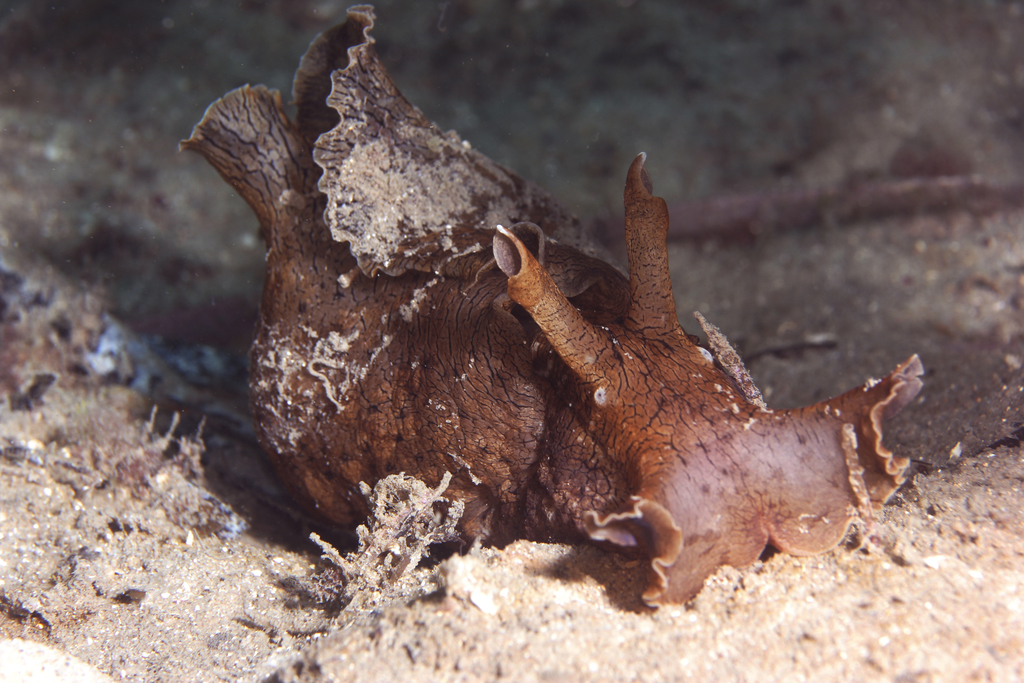
Sowerby's Seahare
Aplysia sowerbyi
Aplysia sowerbyi is a species of gastropod mollusc in the genus Aplysia, family Aplysiidae....
From the article Aplysia sowerbyi on Wikipedia (CC BY-SA), quoted section by section
Description
(Original description) The animal is olive-colored, mottled with black. The shell measures 22 x 16 mm. The shell is internal, thin, horn-colored, and oblong, produced and curved at the apex. The shell is oblong, thin, somewhat trigonal, pale, oblique, and hatchet-shaped. It is arched and swollen (tumid), with sinuous striations near the umbones. The interior is thinly testaceous. The apex is elevated and incurved, bearing a small, widely reflected callus. The upper margin slopes downward, being arched and excavated, and rounded at the extremity. The outer lip is sinuously produced anteriorly, while the dorsal margin is obliquely arched and excavated. The lower portion of the dorsal margin, corresponding to the siphonal canal in spiral shells, is deeply excavated. This species is believed to be the one to which Pliny first applied the name Lepus marinus— the "sea hare."
Range & habitat
This marine species is endemic to Australia and occurs off New South Wales, Northern Territory, Queensland and Victoria.
Wikipedia: “Distribution”
Where it lives
Recorded sightings
—
geo-referenced records in GBIF, from museums, herbaria and field observers.
Drag the globe to turn it. Dots are where records exist, not a range map; darker means more records.
In the stacks
Searching the stacks…
Every page naming Aplysia sowerbyi in the Biodiversity Heritage Library →
This page is assembled live from iNaturalist, GBIF, Wikipedia, the Source Library and the Internet Archive. It is not yet part of the hand-edited codex. iNaturalist taxon 637411.