- Plants
- ›Vascular Plants
- ›flowering plants
- ›monocots
- ›grasses, sedges, cattails, and allies
- ›grasses
- ›Reeds, Giant Canes, and allies
- ›Arundineae
- ›Arundo
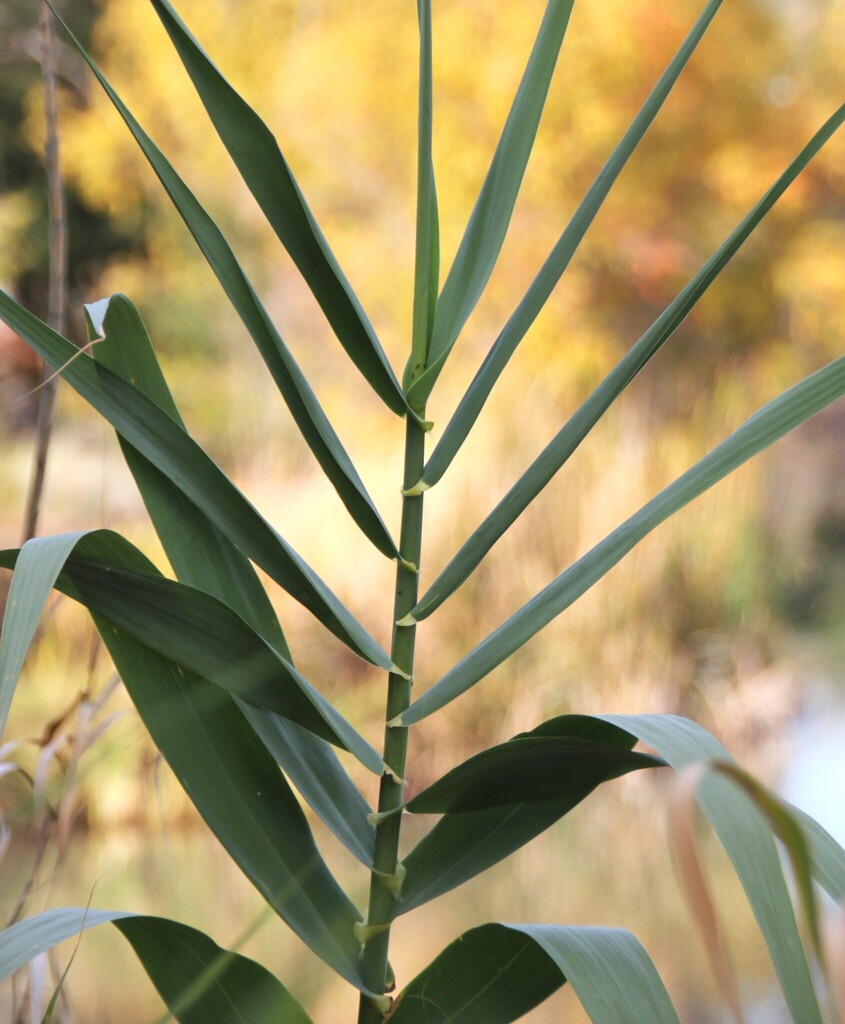
giant reed
Arundo donax
Arundo donax, the giant reed, is a tall perennial reed or cane species. Other vernacular names include giant cane, Spanish cane, wild cane, and in Spanish, carrizo. The scientific name Arundo and donax are respectively the old Latin and Greek names for reed.
Arundo donax grows in damp soils, either fresh or moderately saline, and is native to the eastern Mediterranean region and across southern Asia to Japan. It has been widely planted and naturalised in the mild temperate, subtropical and tropical regions of both hemispheres, especially in the Mediterranean, California, the western Pacific and the Caribbean and is considered invasive in North America and Oceania. It forms dense stands on disturbed sites, sand dunes, in wetlands and riparian habitats.
From the article Arundo donax on Wikipedia (CC BY-SA), quoted section by section
Description
Arundo donax generally grows to 6 metres (20 ft) in height (in ideal conditions can exceed 10 metres (33 ft)). The hollow stems are 1 to 3 centimetres (0.39 to 1.18 in) in diameter, either unbranched or with small bamboo-like side shoots. The grey-green swordlike leaves are alternate, 30 to 60 centimetres (12 to 24 in) long and 2 to 6 centimetres (0.79 to 2.36 in) wide with a tapered tip, and have a hairy tuft at the base. Overall, the plant resembles an outsize common reed (Phragmites australis) or a bamboo (Poaceae subfamily Bambusoideae). It flowers in late summer, bearing upright, white feathery plumes 30 to 60 centimetres (12 to 24 in) long, that are usually seedless or with seeds that are rarely fertile. Instead, it mostly reproduces vegetatively by tough, fibrous underground rhizomes that form knotty, spreading mats which penetrate deep into the soil, up to 1 metre (3.3 ft) deep. Stem and rhizome pieces less than 5 centimetres (2.0 in) long and containing a single node could sprout readily under a variety of conditions. This vegetative propagation appears well adapted to floods, which may break up individual A. donax clumps, spreading the pieces, which may sprout and colonise downstream.
What it does
Giant reed is adapted to a wide variety of ecological conditions, but is generally associated with riparian and wetland systems. It is distributed across the southern United States from Maryland to California. Plants can grow in a variety of soils, from heavy clays to loose sands and gravelly soils, but prefer wet drained soils, where they produce dense monotypic stands.
Invasiveness and management. Arundo is a highly invasive plant in southwestern North American rivers, and its promotion as a biofuel in other regions is of great concern to environmental scientists and land managers. Arundo donax was introduced from the Mediterranean to California in the 1820s for roofing material and erosion control in drainage canals in the Los Angeles area. Through spread and subsequent plantings as an ornamental plant, and for use as reeds in woodwind instruments, it has become naturalised throughout warm coastal freshwaters of North America, and its range continues to spread. It has also been planted widely through South America and Australasia and in New Zealand it is listed under the National Pest Plant Accord as an "unwanted organism". Despite its invasive characteristics in regions around the world where it is not native, Arundo is being promoted by the energy industry as a bio-fuel crop. …
Wikipedia: “Ecology”
At the table
When young, A. donax is readily browsed by ruminants, but it becomes unpalatable when maturing. A. donax has also been used in constructed wetlands for wastewater treatment.
Wikipedia: “Other uses”
How it is grown
Establishment is a critical point of cultivation. The Stem and rhizome have a great ability to sprout after removal from mother plant and both can be used for clonal propagation. The use of rhizomes was found to be the better propagation method for this species, achieving better survival rate. In this field study, it was noticed how the lowest density (12,500 rhizomes/ha) resulted in taller and thicker plants compared to denser plantation (25,000 rhizomes/ha). Seedbed preparation is conducted in the spring, immediately before planting, by a pass with a double-disk harrowing and a pass with a field cultivator. Giant reed has the possibility of adopting low plant density. The rhizomes were planted at 10–20 centimetres (3.9–7.9 in) of soil depth, with a minimum plant density of 10,000 plants per ha), while mature stems, with two or more nodes, can be planted 10–15 centimetres (3.9–5.9 in) deep. In order to ensure good root stand and adequate contact with the soil, sufficient moisture is needed immediately after planting. Pre-plant fertiliser is distributed according to the initial soil fertility, but usually an application of P at a rate of 80–100 kilograms (180–220 lb)/ha is applied. A. donax maintains a high productive aptitude without irrigation under semi-arid climate conditions. …
Wikipedia: “Cultivation”
Where it lives
Recorded sightings
—
geo-referenced records in GBIF, from museums, herbaria and field observers.
Drag the globe to turn it. Dots are where records exist, not a range map; darker means more records.
In the old herbals & bestiaries

In the stacks
Searching the stacks…
Every page naming Arundo donax in the Biodiversity Heritage Library →
This page is assembled live from iNaturalist, GBIF, Wikipedia, the Source Library and the Internet Archive. It is not yet part of the hand-edited codex. iNaturalist taxon 64017.