- Fungi Including Lichens
- ›Basidiomycete Fungi
- ›Higher Basidiomycetes
- ›Mushrooms, Bracket Fungi, Puffballs, and Allies
- ›Agaricomycetidae
- ›Common Gilled Mushrooms and Allies
- ›Marasmiineae
- ›Omphalotaceae
- ›Omphalotus
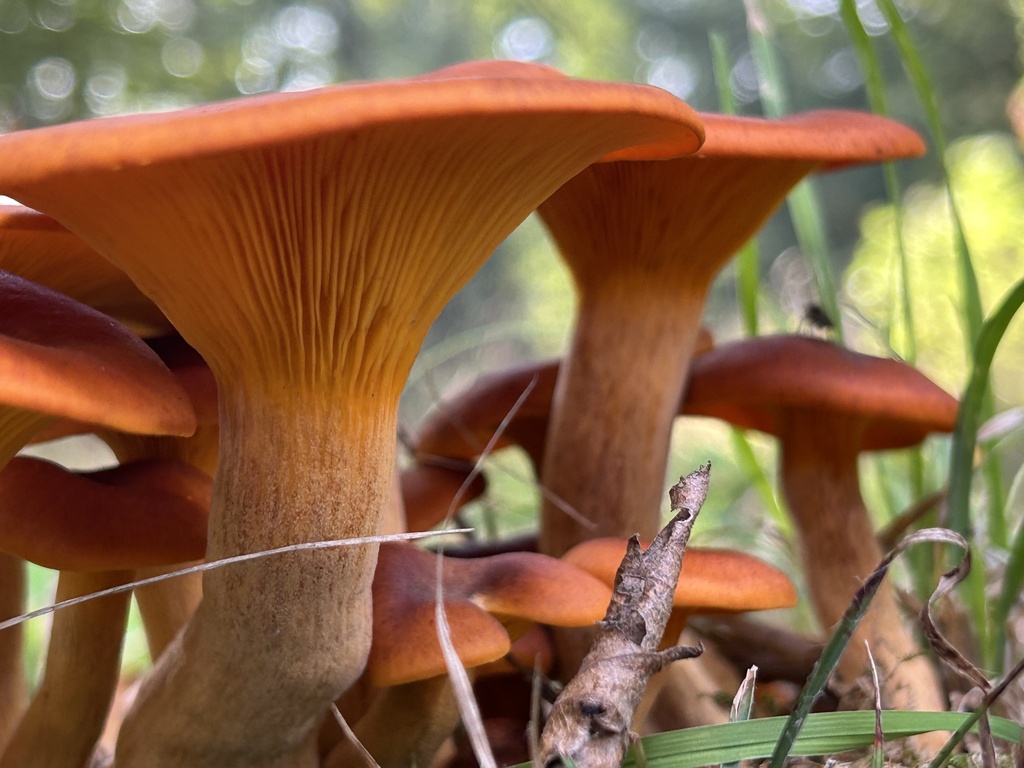
European jack-o'-lantern
Omphalotus olearius
Omphalotus olearius, commonly known as the jack-o'-lantern mushroom, is a poisonous orange gilled mushroom that to an untrained eye appears similar to some chanterelles. It is notable for its bioluminescent properties. It is found in woodland areas in Europe, where it grows on decaying stumps, on buried roots or at the base of hardwood trees. A similar, but phylogenetically distinct species found in eastern North America is Omphalotus illudens.
Unlike chanterelles, Omphalotus olearius and other Omphalotus species contain the toxin illudin S, and are poisonous to humans. While not typically lethal, consuming this mushroom leads to very severe cramps, vomiting, and diarrhea.
From the article Omphalotus olearius on Wikipedia (CC BY-SA), quoted section by section
Description
Omphalotus olearius is the same shade of orange internally and externally. It does not change color when bruised or sliced, a feature which helps to distinguish it from visibly similar species. Its bioluminescence, a blue-green color, can be observed in fresh specimens in low light conditions once the eye becomes dark-adapted. The whole mushroom does not glow—only the gills do so. This is due to an enzyme called luciferase, acting upon a compound called luciferin, leading to the emission of light much as fireflies do when glowing. Bioluminescence has been shown to aid in the reproduction of fungi by attracting insects to them to spread spores. However, the jack-o'-lantern mushroom does not use bioluminescence for the purpose of attracting insects, and studies on it have not yet determined the exact purpose of bioluminescence in this species. Identifiable characteristics of the jack-o'-lantern mushroom include true, sharp, decurrent, non-forking gills. The smell of these mushrooms is non-distinctive. Cap size can range from 4–12 cm in diameter. The jack-o'-lantern stem can vary between 1–2 cm (0.39–0.79 in) in thickness and 3.5–9 cm (1.4–3.5 in) in total length from attachment to cap to base of stem.
Range & habitat
Omphalotus olearius are an uncommon find and can be seen in the summer and fall seasons (July–October) in regions of southern Europe. This range includes southern France, the Iberian Peninsula, and other Mediterranean countries. This species has also been reported from the Western Cape Province, South Africa. Clusters of jack-o'-lantern mushrooms can be found in forests that contain primarily deciduous trees. The roots, decaying stumps, and bases of hardwoods are their preferred habitat, particularly on the decaying roots of olive trees.
Wikipedia: “Distribution and habitat”
Where it lives
Recorded sightings
—
geo-referenced records in GBIF, from museums, herbaria and field observers.
Drag the globe to turn it. Dots are where records exist, not a range map; darker means more records.
In the stacks
Searching the stacks…
Every page naming Omphalotus olearius in the Biodiversity Heritage Library →
This page is assembled live from iNaturalist, GBIF, Wikipedia, the Source Library and the Internet Archive. It is not yet part of the hand-edited codex. iNaturalist taxon 64021.