- Plants
- ›Vascular Plants
- ›flowering plants
- ›Dicots
- ›Roses, Elms, Figs, and Allies
- ›buckthorn family
- ›Ceanothus
- ›Ceanothus
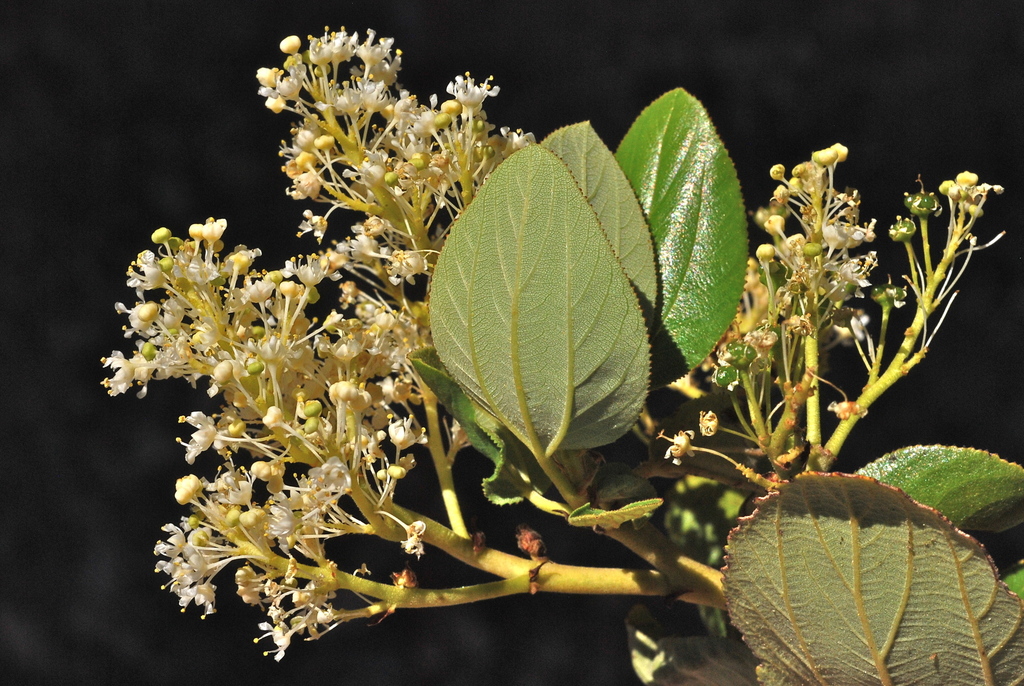
Snowbrush Ceanothus
Ceanothus velutinus
Ceanothus velutinus, with the common names snowbrush ceanothus, red root, and tobacco brush, is a species of shrub in the family Rhamnaceae. It is native to western North America from British Columbia to California to Colorado, where it grows in several habitat types including coniferous forest, chaparral, and various types of woodland.
From the article Ceanothus velutinus on Wikipedia (CC BY-SA), quoted section by section
Description
Ceanothus velutinus grows up to 4 metres (13 feet) tall but generally remains under 3 metres, and forms colonies of individuals which tangle together to form nearly impenetrable thickets. The aromatic evergreen leaves are alternately arranged, each up to 8 centimetres (3 inches) long. The leaves are oval in shape with minute glandular teeth along the edges, and shiny green and hairless on the top surface. The plentiful inflorescences are long clusters of white flowers. The fruit is a three-lobed capsule a few millimeters long which snaps open explosively to expel the three seeds onto the soil, where they may remain in a buried seed bank for well over 200 years before sprouting. The seed is coated in a very hard outer layer that must be scarified, generally by wildfire, before it can germinate. Like most other Ceanothus, this species fixes nitrogen via actinomycetes in its root nodules.
Range & habitat
Ceanothus velutinus is native to western North America from British Columbia to California to Colorado, where it grows in hills and mountains in several habitat types including open coniferous forest and chaparral, often in rocky soils.
Wikipedia: “Distribution and habitat”
At the table
Deer and elk browse the plant during winter. Some Plateau Indian tribes drank a boil of this plant to induce sweating as a treatment for colds, fevers, and influenza. Leaves were also used when rinsing to help prevent dandruff. Ceanothus velutinus was known as "red root" by many Native American tribes due to the color of the inner root bark, and was used as a medicine for treating lymphatic disorders, ovarian cysts, fibroid tumors, and tonsillitis.
Wikipedia: “Uses”
Where it lives
Recorded sightings
—
geo-referenced records in GBIF, from museums, herbaria and field observers.
Drag the globe to turn it. Dots are where records exist, not a range map; darker means more records.
In the stacks
Searching the stacks…
Every page naming Ceanothus velutinus in the Biodiversity Heritage Library →
This page is assembled live from iNaturalist, GBIF, Wikipedia, the Source Library and the Internet Archive. It is not yet part of the hand-edited codex. iNaturalist taxon 64043.