- Plants
- ›Vascular Plants
- ›flowering plants
- ›Dicots
- ›sandalwoods, mistletoes, and allies
- ›sandalwood family
- ›viscaceous mistletoes
- ›Arceuthobium
- ›Campylopoda
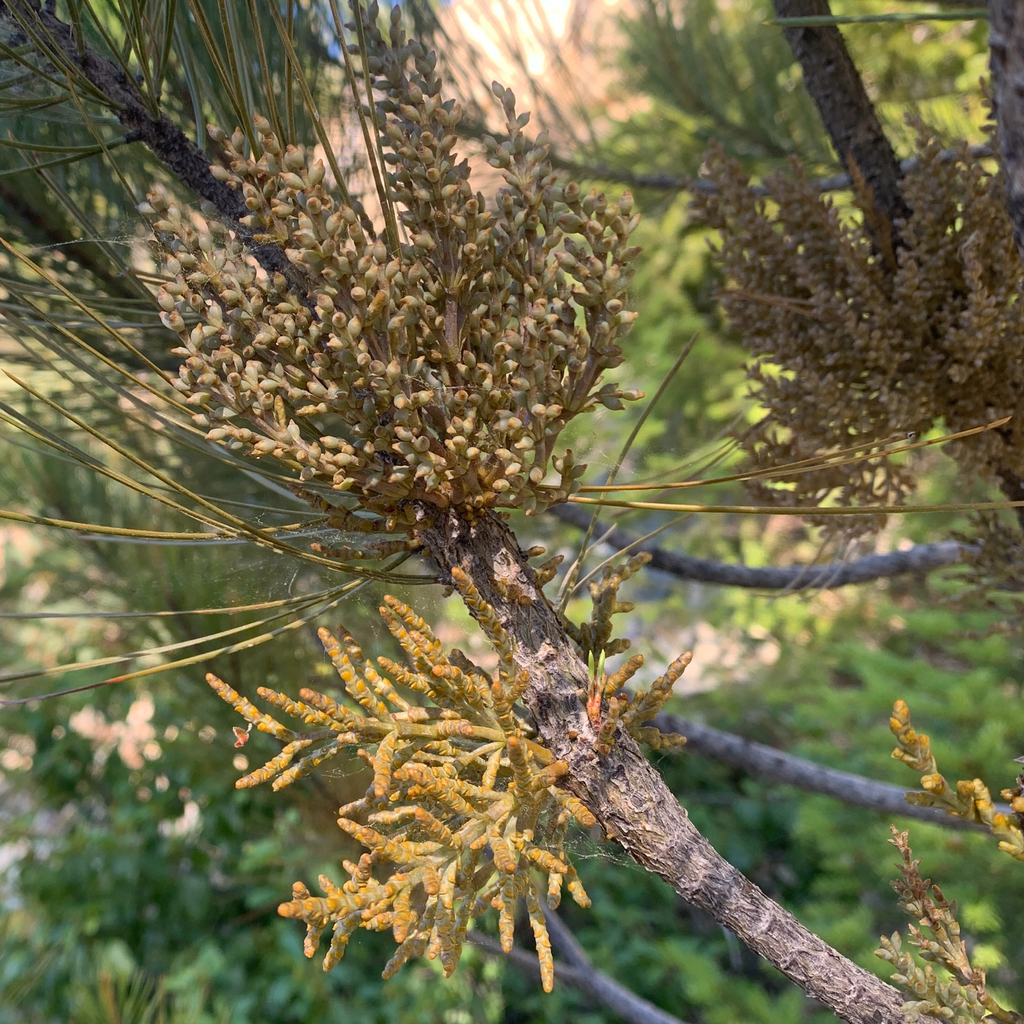
Knobcone Pine Dwarf-Mistletoe
Arceuthobium siskiyouense
Arceuthobium siskiyouense is a species of dwarf mistletoe commonly known as knobcone pine dwarf mistletoe and as Arceuthobium campylopodum subsp. siskiyouense. It is endemic to the Klamath Mountains of northern California and southern Oregon, where it parasitizes a number of species of hard pines in the subgenus Pinus. Its ecological impact on the coniferous forests where it is found is significant, both because of its negative impact on the health of infected trees and because it provides food and microhabitats (by inducing witch's brooms) for other wildlife.
From the article Arceuthobium siskiyouense on Wikipedia (CC BY-SA), quoted section by section
Description
As with other species of dwarf mistletoe, A. siskiyouense is a parasitic shrub that attaches to a host tree, from which it extracts water and nutrients. For the first few years of its life, the mistletoe develops an endophyte system inside a young branch of the host tree consisting of tissue called haustoria, which invade the host's xylem and phloem systems. Aerial stems eventually emerge from the bark of the host tree, and though these stems contain chlorophyll and can photosynthesize, A. siskiyouense obtains most of its sugar from the host plant. The stems of this species of mistletoe are reddish-brown or brownish, slender, 5-17 cm long, and bear reduced, scale-like leaves. This species is dioecious, meaning that plants produce either male (staminate) or female (pistillate) flowers. The male flowers are 3- or 4-petaled and 3 mm in diameter. The fruit is an oblong berry that is approximately 5 mm long, typically light green, and slightly glaucous. Anthesis occurs between late July and early September, with peak flowering in late July; seed dispersal peaks in late October and extends to late November. As with other species of dwarf mistletoe, the fruit discharges its seed at an initial velocity of nearly 27 m/s (89 ft/s) after building up significant hydrostatic pressure. Seeds can be launched a distance of up to 10 meters. …
Range & habitat
A. siskiyouense has one of the narrowest distributions in its genus, occurring only in the extreme northwest of California and the extreme southwest of Oregon. It is one of three dwarf mistletoe taxa endemic to the Klamath Mountains, the others being A. monticola and A. abietinum subsp. wiensii. The region has been identified as a center for dwarf mistletoe diversity, with 11 species present. It grows in coniferous forests where knobcone and Jeffrey pines are abundant, at elevations between 400 and 1200 meters. A large population system can be found near Oregon Mountain on the border between Josephine County, Oregon and Del Norte County, California.
Wikipedia: “Distribution”
What it does
A. siskiyouense induces abnormal growth and swelling in its hosts; a high proportion of infected knobcone and Jeffrey pines produce witch's brooms, as do a more modest proportion of infected Pinus contorta. Abnormal growth in Jeffrey pines caused by mistletoe infection is often severe enough to result in the death of the host tree, perhaps compounded by the effects of the Jeffrey pine bark beetle, Dendroctonus jeffreyi. Moreover, brooms often break off and provide fuel for fires, making heavily-infected stands of pine more susceptible to wildfire. While A. siskiyouense negatively impacts the health and longevity of its hosts, its creation of brooms provides valuable habitat for birds and small mammals. For example, several species of birds and small mammals have been documented using brooms induced by dwarf mistletoes as nesting sites or for cover; other species of birds, invertebrates, and mammals use dwarf mistletoes as a food source.
Wikipedia: “Ecology”
Where it lives
Recorded sightings
—
geo-referenced records in GBIF, from museums, herbaria and field observers.
Drag the globe to turn it. Dots are where records exist, not a range map; darker means more records.
In the stacks
Searching the stacks…
Every page naming Arceuthobium siskiyouense in the Biodiversity Heritage Library →
This page is assembled live from iNaturalist, GBIF, Wikipedia, the Source Library and the Internet Archive. It is not yet part of the hand-edited codex. iNaturalist taxon 64048.