- Animals
- ›Arthropods
- ›Hexapods
- ›Insects
- ›Winged and Once-winged Insects
- ›True Bugs, Hoppers, Aphids, and allies
- ›True Bugs
- ›Semiaquatic Bugs
- ›Water Striders and Ripple Bugs
- ›Water Striders
- ›Typical Water Striders
- ›Gerrini
- ›Gerris
- ›Gerris
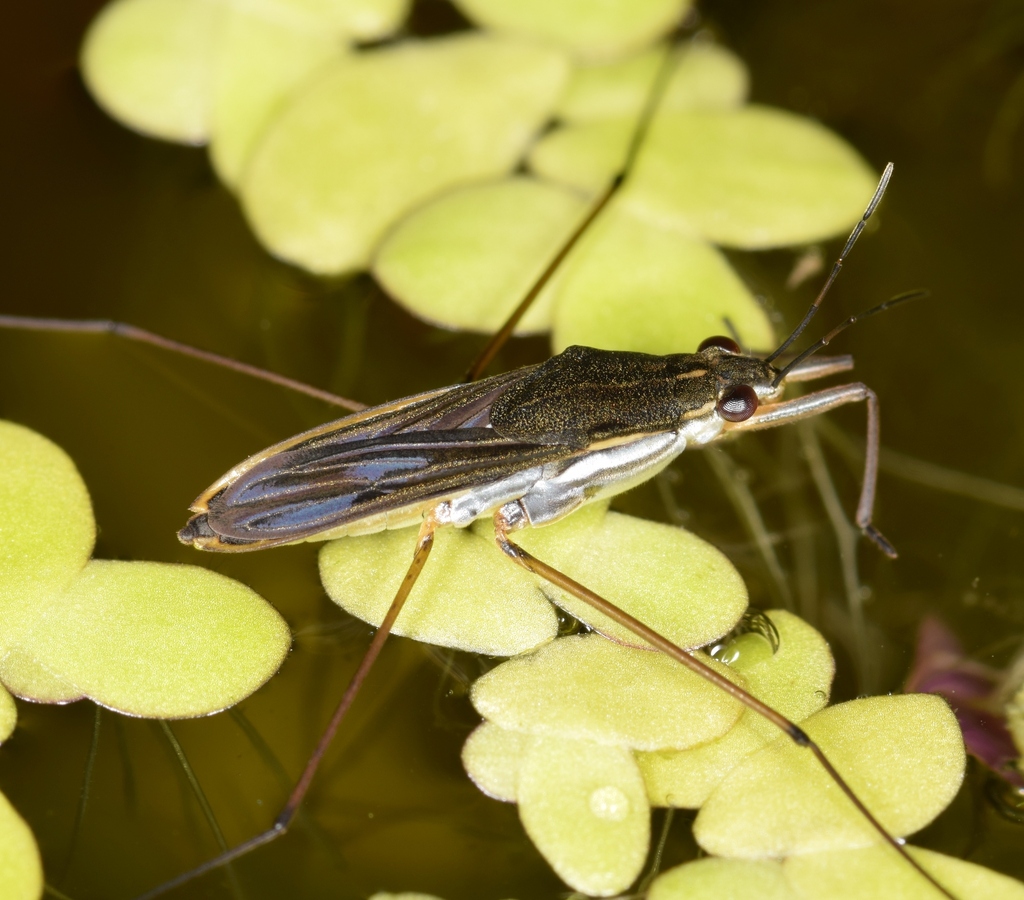
Eurasian common pond skater
Gerris lacustris
Gerris lacustris, commonly known as the common pond skater or common water strider, is a species of water strider, found across Europe.
From the article Gerris lacustris on Wikipedia (CC BY-SA), quoted section by section
Description
Water striders vary in length ranging between 8 millimetres (0.31 in) and 10 mm (0.39 in) in size. Their body shape is very slender and elongated. They have six legs; the first pair is short and stubby while the other two pairs are thin and elongated which are used for moving over the water surface which we call "walking on water". The first pair of legs is used for holding its prey, the middle pair propels the bug along the surface of the water with either a rowing or jumping motion, and the hind pair of legs is used as rudders. The entire body of G. lacustris including its legs is covered with many tiny hairs that have a wax-like coating. G. lacustris are dark brown in colour. Water striders have very strong sucking mouthparts known as a rostrum or beak.
What it does
G. lacustris females are usually significantly larger than the males and the egg production rate is limited by the amount of food resources that are available to the female; the more food there is the more eggs the female lays. The adult water striders emerge around April and May. It is around this time that females lay eggs where the eggs undergo a process that takes about 12 to 14 days to develop before they are able to hatch. Hatching doesn't necessarily follow the eggs when their development is complete; hatching heavily depends on the temperature that the egg is exposed to in its environment. After hatching, G. lacustris go through another separate development process known as incomplete metamorphosis. In this process, the larvae or nymphs progress through a series of moults which basically are stages known as instars. There are five instars in the developmental process, with each one progressively longer than the last. The incomplete metamorphosis process usually lasts about 24 to 30 days for larvae to become an adult. G. lacutris males prolong their mating in the presence of other males because they are guarding their female against harassment from the other males. It was found that males influence the duration of copulation while the females influence the copulation frequency.
Wikipedia: “Reproduction”
At the table
G. lacustris is a predatory insect. The species hunts on or below water surface for insects and other small invertebrates using their strong forelegs which end with claws. They also have piercing and sucking mouthparts in order to consume other small insects that fall into the water surface and to feed on live and dead insects such as Culiseta annulata, non-biting midge, and other water invertebrates. With their front pair of legs they’re able to detect ripples and sense vibrations in the surface film from struggling insects and handle or grasp their prey. G. lacustris eat other small invertebrates and digest them internally.
Wikipedia: “Food and nutrients”
Listen
Looking for field recordings…
Where it lives
Recorded sightings
—
geo-referenced records in GBIF, from museums, herbaria and field observers.
Drag the globe to turn it. Dots are where records exist, not a range map; darker means more records.
In the stacks
Searching the stacks…
Every page naming Gerris lacustris in the Biodiversity Heritage Library →
This page is assembled live from iNaturalist, GBIF, Wikipedia, the Source Library and the Internet Archive. It is not yet part of the hand-edited codex. iNaturalist taxon 64581.