- Animals
- ›Arthropods
- ›Hexapods
- ›Insects
- ›Winged and Once-winged Insects
- ›Flies
- ›Brachyceran Flies
- ›Cyclorrhaphan Flies
- ›Schizophoran Flies
- ›Calyptrate Flies
- ›Bot Flies, Blow Flies, and Allies
- ›Blow Flies
- ›Chrysomyinae
- ›Chrysomya
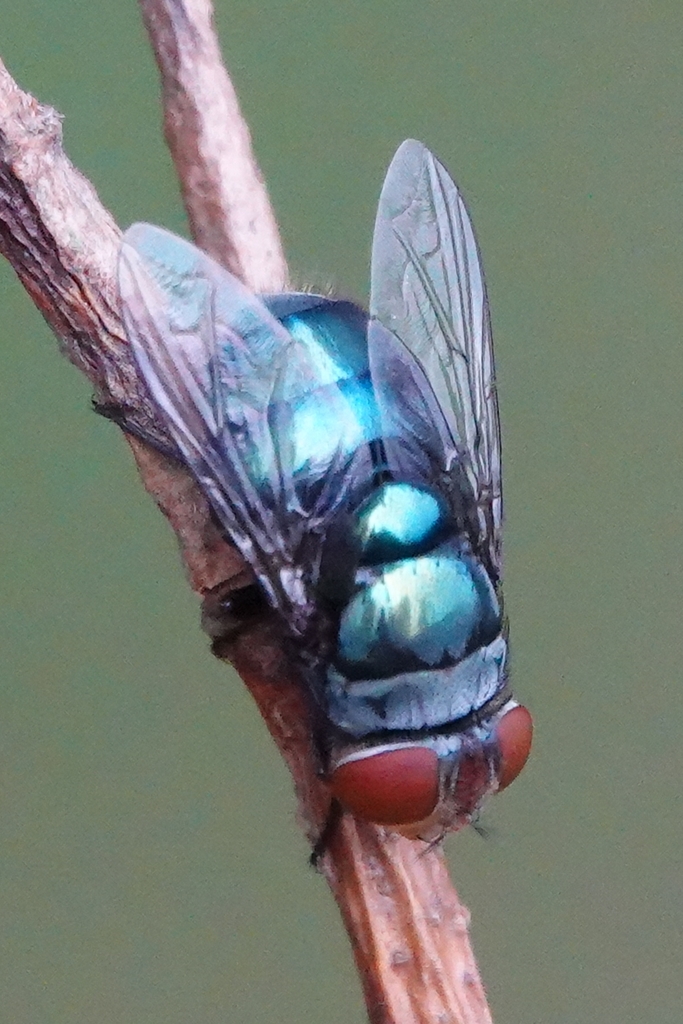
Old World Screw-worm Fly
Chrysomya bezziana
Chrysomya bezziana, also known as the Old World screwworm fly or screwworm, is an obligate parasite of mammals. Obligate parasitic flies require a host to complete their development. Named to honor the Italian entomologist Mario Bezzi, this fly is widely distributed in Asia, tropical Africa, India, and Papua New Guinea. The adult can be identified as metallic green or blue with a yellow face, and the larvae are smooth, lacking any obvious body processes except on the last segment.
The screwworm adult feeds on decaying organic matter, while the fly larvae feed on the living tissue of warm-blooded mammals as opposed to necrotic tissue on which many other fly larvae feed. Since the larvae can cause permanent tissue damage, C. bezziana has caused much public concern. Management procedures include both prevention of colonization of the fly and treatment of a current infestation.
From the article Chrysomya bezziana on Wikipedia (CC BY-SA), quoted section by section
Description
Chrysomya bezziana belongs to the fly family Calliphoridae. This family comprises blow flies, carrion flies, and cluster flies. Other parasitic screwworms are found in this family, such as Cochliomyia hominivorax and Cochliomyia macellaria.
Adult. The body of the C. bezziana adult is typically metallic green or blue. The face of this species is typically yellow with soft, fine, yellow hairs. The length of an adult fly ranges between 8 and 12 mm. The abdominal tergites (the segments of the dorsal portion of the fly) have narrow darker bands and the legs are black or dark brown. Only the bases of the wings are infuscated; the wings have a glassy appearance. The anterior spiracles (small openings on the surface for the respiratory system) range from dark brown to orange. Another close relative, Chrysomya megacephala, occurs in many of the same regions as C. bezziana, so being able to distinguish between the flies is important. The male fly can be distinguished from C. megacephala by its eye facets. C. bezziana does not have a boundary dividing the upper and lower eye facets, while C. megacephala does have a boundary distinguishing them. The female does not have as distinct differences and cannot be as easily distinguished from C. megacephala, but can be identified by analyzing the frons (the uppermost part of the head of an insect). The frons of C. …
Wikipedia: “Characteristics”
Range & habitat
Chrysomya bezziana is widely distributed throughout tropical areas in the Old World. It is most prevalent in Southeast Asia, tropical and subtropical Africa, some countries in the Middle East, India, the Malay Peninsula, the Indonesian and Philippine Islands, and Papua New Guinea. C. bezziana is not found at altitudes higher than 2500 meters above sea level. In countries where C. bezziana does not exist, scientists and those in agriculture are worried that commercial flights, boats, or vehicles could distribute the fly. The climates in which C. bezziana thrives are present in Australia and the Americas; the fly requires climates similar to its New World relative, Cochliomyia hominivorax. Spread of the pest from Papua New Guinea to Australia has become a concern for Australia, as the presence of C. bezziana could cost livestock industries up to $500 million a year.
Wikipedia: “Geographical distribution”
What it does
The female lays around 150–200 eggs at a time, in wounds and mucous membranes of a live mammal, and will hatch after 24 hours. The larvae feed on living tissue and are especially attracted to blood. The larvae feed on the host tissue for 5–7 days while they complete their development, then they fall to the ground to pupate. The pupal stage is temperature-dependent with warm weather favoring growth. Depending on the temperature, the pupal stage can last from 1 week to 2 months. The males become sexually mature after 24 hours of leaving their puparium (the hardened shell in which the pupae mature), while females take about 6–7 days to become fully sexually mature. If the weather is tropical (29 °C or 84.2 °F), the entire lifecycle will last about 24 days, but at cooler temperatures (below 22 °C or 71.6 °F), the life ycle can take 2–3 months to complete.
Wikipedia: “Life cycle”
In medicine
Chrysomya bezziana usually infects livestock, causing myiasis, which is the infestation of tissue (living or dead) on a living mammal by fly larvae. Mammals such as sheep, dogs, cattle, pigs, and even humans can become infested. The adult female lays her eggs on superficial wounds in live animals, preferring wounds that are several days old. Eggs of C. bezziana are commonly laid in the navel of newborn livestock species or on castration wounds in cattle. Eggs are also laid on open sores, ulcers, scratches externally, or mucous membranes throughout the body. Wounds as small as a tick bite are large enough for a female to lay her eggs. When the eggs hatch, the larvae burrow into the animal's living tissue and feed on it. Their common name, "screwworms", is derived from the maggots that embed themselves into the flesh of their host in a screw-like fashion. The larvae can burrow as deep as 15 cm (5.9 in) into the host's living tissue. As the maggots feed and cause tissue damage, the wound produces a characteristic odor, which can go unnoticed by humans. However, this odor entices more female flies to the wound and encourages them to lay their eggs there, as well, causing further infestation. C. bezziana is different from other fly species because tissue infestation can occur in the absence of necrotic tissue. The C. bezziana maggots may cause serious and permanent tissue damage. …
Wikipedia: “Medical importance”
Listen
Looking for field recordings…
Where it lives
Recorded sightings
—
geo-referenced records in GBIF, from museums, herbaria and field observers.
Drag the globe to turn it. Dots are where records exist, not a range map; darker means more records.
In the stacks
Searching the stacks…
Every page naming Chrysomya bezziana in the Biodiversity Heritage Library →
This page is assembled live from iNaturalist, GBIF, Wikipedia, the Source Library and the Internet Archive. It is not yet part of the hand-edited codex. iNaturalist taxon 657663.