- Animals
- ›Arthropods
- ›Crustaceans
- ›Typical Crustaceans
- ›Malacostracans
- ›Decapods, Isopods, and allies
- ›Decapods and Krill
- ›Decapods
- ›Crabs, Lobsters, Shrimps, and Allies
- ›True Crabs
- ›Eubrachyuran Crabs
- ›Thoracotrematan Crabs
- ›Shore and marsh crabs
- ›Shore Crabs
- ›Grapsus
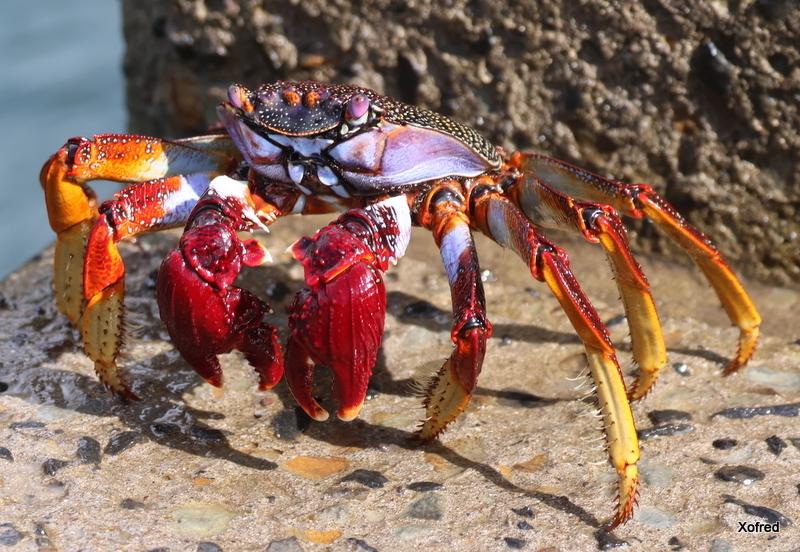
East Atlantic Sally Lightfoot Crab
Grapsus adscensionis
The West African lightfoot crab, Grapsus adscensionis, is a species of rocky shore crab found along the coast of the eastern Atlantic Ocean. It is also known as the east Atlantic Sally lightfoot crab.
From the article Grapsus adscensionis on Wikipedia (CC BY-SA), quoted section by section
Description
The carapace varies in color from reddish-brown to brown-spotted to nearly black and often feature white spots or marbling. The legs may be the same color as the carapace or may have brighter yellow or orange coloration. Coloration varies according to locality and season. West African lightfoot crabs in general have rounded abdomens, though the shape of the abdomen varies somewhat between the sexes; those of female crabs being rounder while those of males are more triangular. Juveniles are dark brown, black, or gray. Shcherbakova et al. note that this enables them to camouflage against black lava coasts. Like other crustaceans, West African lightfoot crabs grow by molting. Surveys at different localities on Ascension Island and the Canary Islands have recorded adult sizes as varying between 1.17 - 8.43cm. Crabs from Tenerife appear to be smaller overall and reach reproductive maturity at a smaller size than those from other Canary Islands and Ascension Island. A publication by The Food and Agriculture Organization of the United Nations gives the maximum carpace dimensions of G. adscensionis as 7.7cm in length and 8.7cm in width.
Wikipedia: “Morphology”
Range & habitat
Grapsus adscensionis lives along the Atlantic coast of Africa and along the coasts of several groups of Atlantic islands including Macaronesia, Saint Helena, Ascension Island, São Tomé and Príncipe and Fernando de Noronha. The crabs demonstrate a preference for rougher terrain with easy access to hiding spots and often congregate around cliffs.
Wikipedia: “Distribution”
What it does
West African lightfoot crabs inhabit rocky areas of shoreline and spend most of their time in the supratidal zone. They retreat into the water when threatened. Juveniles spend more time hiding than adult crabs. Hartnoll (2007) noted that the crabs are difficult to catch during the day but have a tendency to freeze when confronted at night with a flashlight and thus become easy to collect. West African lightfoot crabs are diurnal. They spend high tide resting on rocks above the water and descend onto the shore at low tide to feed on exposed algal films. West African lightfoot crabs are opportunistic feeders. In addition to grazing on algae, they feed on worms, mollusks, other crustaceans, turtle hatchlings, and dead animals.
Wikipedia: “Behavior and Ecology”
Where it lives
Recorded sightings
—
geo-referenced records in GBIF, from museums, herbaria and field observers.
Drag the globe to turn it. Dots are where records exist, not a range map; darker means more records.
In the stacks
Searching the stacks…
Every page naming Grapsus adscensionis in the Biodiversity Heritage Library →
This page is assembled live from iNaturalist, GBIF, Wikipedia, the Source Library and the Internet Archive. It is not yet part of the hand-edited codex. iNaturalist taxon 67578.