- Plants
- ›Vascular Plants
- ›flowering plants
- ›Dicots
- ›Sunflowers, Bellflowers, Fanflowers, and Allies
- ›Sunflowers, Daisies, Asters, and Allies
- ›Asteroideae
- ›asters and allies
- ›Solidagininae
- ›Solidago
- ›Pleiactila
- ›Unilaterales
- ›Triplinerviae
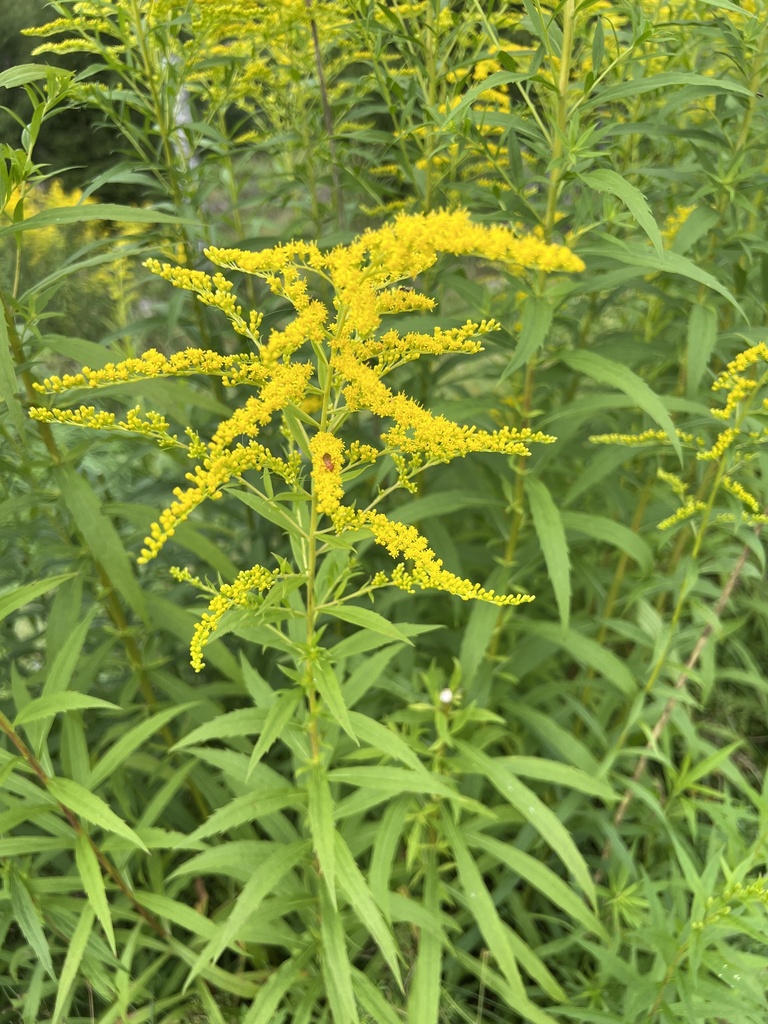
Canada goldenrod
Solidago canadensis
Solidago canadensis, known as Canada goldenrod or Canadian goldenrod, is an herbaceous perennial plant of the family Asteraceae. It forms colonies of upright growing plants, with many small yellow flowers in a branching inflorescence held above the foliage. It is native to northeastern and north-central North America and is an invasive plant in other parts of the continent and several areas worldwide, including Eurasia.
From the article Solidago canadensis on Wikipedia (CC BY-SA), quoted section by section
Description
Solidago canadensis is a herbaceous perennial plant with stems that grow 2–4 feet (60–120 centimeters) and sometimes to 6 ft (180 cm) tall. It has a wide distribution with several varieties, which have significant variability. The lanceolate to broadly linear shaped leaves are alternately arranged on the stems. The leaves are 4–6 inches (10–15 centimeters) long and 1 in (2.5 cm) wide. The stems have lines of white hairs, while the undersides of the leaves are pubescent. The leaves are often prominently toothed. The flowers have yellow rays and are arranged into small heads on branched pyramidal shaped inflorescences, flowering occurs from July to October. It has a rhizomatous growth habit, which can produce large colonies of clones.
Range & habitat
Solidago canadensis is native to northeastern and north-central North America. It is winter hardy in USDA hardiness zones 3–9. It is found in a variety of habitats. It typically is one of the first plants to colonize an area after a disturbance (such as fire) and rarely persists once shrubs and trees become established. It is found in very dry locations (e.g. road sides) and also waterlogged ones (e.g. moist thickets). Canada goldenrod is visited by a wide variety of insects for its pollen and nectar, including bees, wasps, flies, beetles, butterflies, and moths. It is especially strongly favored as a nectar source by bumblebees and paper wasps, such as Polistes parametricus and P. fuscatus. Aside from wasps, it is also visited frequently by honeybees and some butterflies, such as monarchs. Solidago canadensis is sometimes browsed by deer and is good to fair as food for domestic livestock such as cattle or horses. It can be extremely aggressive and tends to form monocultures and near-monocultures in parts of its native range, such as in southwest Ohio clay loam. It not only seeds a great deal, but also spreads rapidly via running rhizomes. Its root system is very tough, and plants that have been pulled out of the ground prior to freezing and left exposed atop soil have survived winter temperatures down to -26 °C (-14 °F).
Galls. …
Wikipedia: “Distribution, habitat and ecology”
Where it lives
Recorded sightings
—
geo-referenced records in GBIF, from museums, herbaria and field observers.
Drag the globe to turn it. Dots are where records exist, not a range map; darker means more records.
In the stacks
Searching the stacks…
Every page naming Solidago canadensis in the Biodiversity Heritage Library →
This page is assembled live from iNaturalist, GBIF, Wikipedia, the Source Library and the Internet Archive. It is not yet part of the hand-edited codex. iNaturalist taxon 67808.