- Animals
- ›Arthropods
- ›Hexapods
- ›Insects
- ›Winged and Once-winged Insects
- ›Beetles
- ›Water, Rove, Scarab, Long-horned, Leaf, and Snout Beetles
- ›Scarabaeiform Beetles
- ›Scarabs, Stag Beetles, and Allies
- ›Scarabs
- ›Dung Beetles
- ›Onitini
- ›Onitis
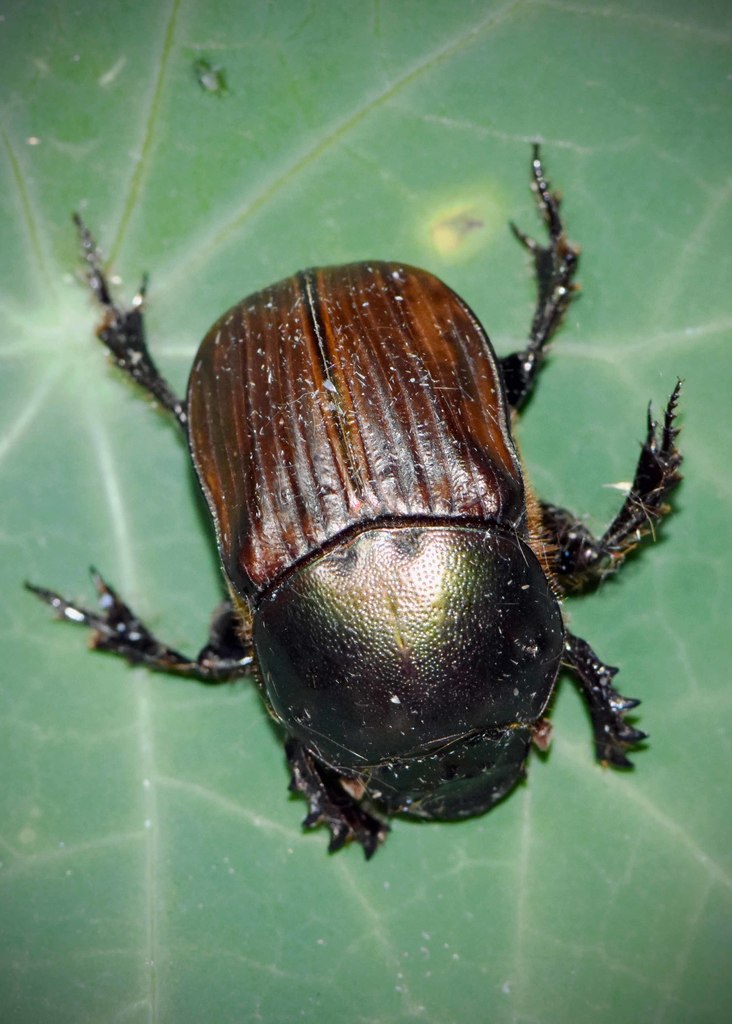
Onitis aygulus
Dung beetles are beetles that feed on feces. All species of dung beetle belong to the superfamily Scarabaeoidea, most of them to the subfamilies Scarabaeinae and Aphodiinae of the family Scarabaeidae (scarab beetles). As most species of Scarabaeinae feed exclusively on feces, that subfamily is often dubbed true dung beetles. There are dung-feeding beetles which belong to other families, such as the Geotrupidae (the earth-boring dung beetle). The Scarabaeinae alone comprises more than 5,000 species.
As they do not belong to a single group sharing a common ancestor, there is a diversity in the behavior of dung beetles, including the iconic dung-rolling behavior revered by Ancient Egyptians as the god Khepri rolling the sun across the sky.
From the article Dung beetle on Wikipedia (CC BY-SA), quoted section by section
What it does
Dung beetles live in many habitats, including desert, grasslands and savannas, farmlands, and native and planted forests. They are highly influenced by the environmental context, and do not prefer extremely cold or dry weather. They are found on all continents except Antarctica. They eat the dung of herbivores and omnivores, and prefer that produced by the latter. Many of them also feed on mushrooms and decaying leaves and fruits. The Neotropical Deltochilum valgum, D. kolbei and D. viridescens are carnivores with a strong preference for preying upon millipedes. Two other species from Brazil, Canthon dives and Canthon virens, prey on queens and other winged forms of leafcutter ants. One species from the Iberian Peninsula, Thorectes lusitanicus, feeds on acorns. The behavior of the beetles was poorly understood until the studies of Jean Henri Fabre in the late 19th century. For example, Fabre corrected the myth that a dung beetle would seek aid from other dung beetles when confronted by obstacles. By observation and experiment, he found the seeming helpers were in fact awaiting an opportunity to steal the roller's food source. In 1991, Ilkka Cambefort and Yves Hanski classified dung beetles into three functional types based on their feeding and nesting strategies: Rollers, Tunnelers, and Dwellers. …
Wikipedia: “Ecology and behavior”
At the table
Some dung beetles are used as food in South East Asia and a variety of dung beetle species have been used therapeutically (and are still being used in traditionally living societies) in potions and folk medicines to treat a number of illnesses and disorders.
Wikipedia: “As food and folk medicine”
How it is grown
Dung beetles play a role in agriculture and tropical forests. By burying and consuming dung, they improve nutrient recycling and soil structure. Dung beetles have been further shown to improve soil conditions and plant growth on rehabilitated coal mines in South Africa. They are also important for the dispersal of seeds present in animals' dung, influencing seed burial and seedling recruitment in tropical forests. They can protect livestock, such as cattle, by removing the dung which, if left, could provide habitat for pests such as flies. Therefore, many countries have introduced the creatures for the benefit of animal husbandry. The American Institute of Biological Sciences reports that dung beetles save the United States cattle industry an estimated US$380 million annually through burying above-ground livestock dung. In Australia, the Commonwealth Scientific and Industrial Research Organisation (CSIRO) commissioned the Australian Dung Beetle Project (1965–1985) which, led by George Bornemissza, sought to introduce species of dung beetles from South Africa and Europe. The successful introduction of 23 species was made, most notably Digitonthophagus gazella and Euoniticellus intermedius, which has resulted in improvement of the quality and fertility of Australian cattle pastures, along with a reduction in the population of pestilent Australian bush flies by around 90%. …
Wikipedia: “Agriculture”
Listen
Looking for field recordings…
Where it lives
Recorded sightings
—
geo-referenced records in GBIF, from museums, herbaria and field observers.
Drag the globe to turn it. Dots are where records exist, not a range map; darker means more records.
In the stacks
Searching the stacks…
Every page naming Onitis aygulus in the Biodiversity Heritage Library →
This page is assembled live from iNaturalist, GBIF, Wikipedia, the Source Library and the Internet Archive. It is not yet part of the hand-edited codex. iNaturalist taxon 679550.