- Animals
- ›Molluscs
- ›Bivalves
- ›Autobranchia
- ›Heteroconchia
- ›Euheterodonta
- ›Imparidentia
- ›True Cockles, Tellins, and Allies
- ›Cardioidea
- ›true cockles
- ›Giant Clams
- ›Hippopus
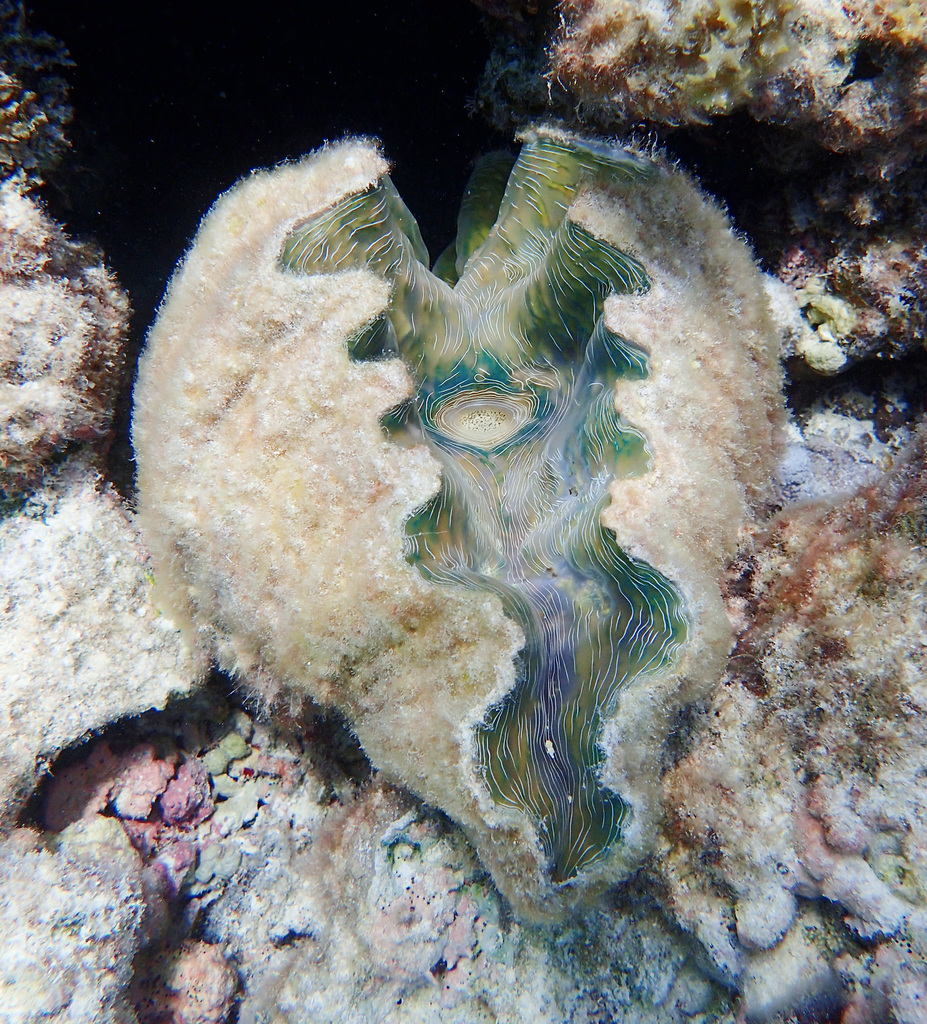
Bear Paw Clam
Hippopus hippopus
Hippopus hippopus, also known as the Horse Hoof clam and Strawberry clam, is a species of giant clam in the Subfamily Tridacninae and the genus Hippopus. Hippopus is a delicacy in many Southeast Asian countries due to its high quality meat.
The scientific name hippopus comes from Ancient Greek for "horse foot" (ἵππος, hippos, "horse", and πούς, pous, "foot").
From the article Hippopus hippopus on Wikipedia (CC BY-SA), quoted section by section
Description
The H. hippopus shell is characterized as having strawberry blotches in the shape of bands on the exterior of the shell. Their mantle is a green-yellow color, with tightly fitting interlocking ridges. The shape of the shell is sub-rhomboidal and bears deeps ridges that stretch vertically across the surface of the shell. In comparison to its cousins, H. hippopus is relatively average in size among the tridacnines, averaging 22 cm (8.7 in) and reaching maximums lengths of 45 cm (18 in). Unlike with other bivalves, the hinge of H. hippopus is adjacent to the substrate, with the inhalant siphon and mantle tissues facing towards the surface of the water. This maximizes the photosynthetic capapbilities of the photosynthetic dinoflagellates that harvest the sun's rays, producing the clam's distinct vibrant pigmentation.
Wikipedia: “Anatomy and morphology”
Range & habitat
H. hippopus is found in tropical waters of the Indian and Pacific Oceans. It is commonly found on the coast of Indonesia and Palau. Its range extends as far as India in the Indian Ocean, and Kiribati in the Pacific Ocean. H. hippopus frequently inhabits the shallow waters of fringing, barrier reefs, and seagrass beds. Because H. hippopus inhabits the shallow water, its symbiotic inhabitants can use sunlight to perform photosynthesis for the clam. H. Hippopus does not attach to rocks in the reef, instead, they settle on sandy patches, detached from any reef rocks.
Wikipedia: “Distribution and habitat”
What it does
H. hippopus also acquires nutrients through filter feeding, using its inhalant siphon to eat marine microorganisms such as phytoplankton and zooplankton by catching them on ciliated tracts on their gill plates. The amount of carbon a clam acquires using this mechanism is determined by the size of the clam, with smaller clams acquiring approximately 60% of their carbon from this method, and larger clams receiving approximately 34% from filter feeding plankton.
Wikipedia: “Filter feeding”
Where it lives
Recorded sightings
—
geo-referenced records in GBIF, from museums, herbaria and field observers.
Drag the globe to turn it. Dots are where records exist, not a range map; darker means more records.
In the stacks
Searching the stacks…
Every page naming Hippopus hippopus in the Biodiversity Heritage Library →
This page is assembled live from iNaturalist, GBIF, Wikipedia, the Source Library and the Internet Archive. It is not yet part of the hand-edited codex. iNaturalist taxon 67973.