- Plants
- ›Vascular Plants
- ›conifers
- ›conifers
- ›pine family
- ›pines, spruces, larches, and allies
- ›Pinus
- ›Strobus
- ›Quinquefoliae
- ›Strobus
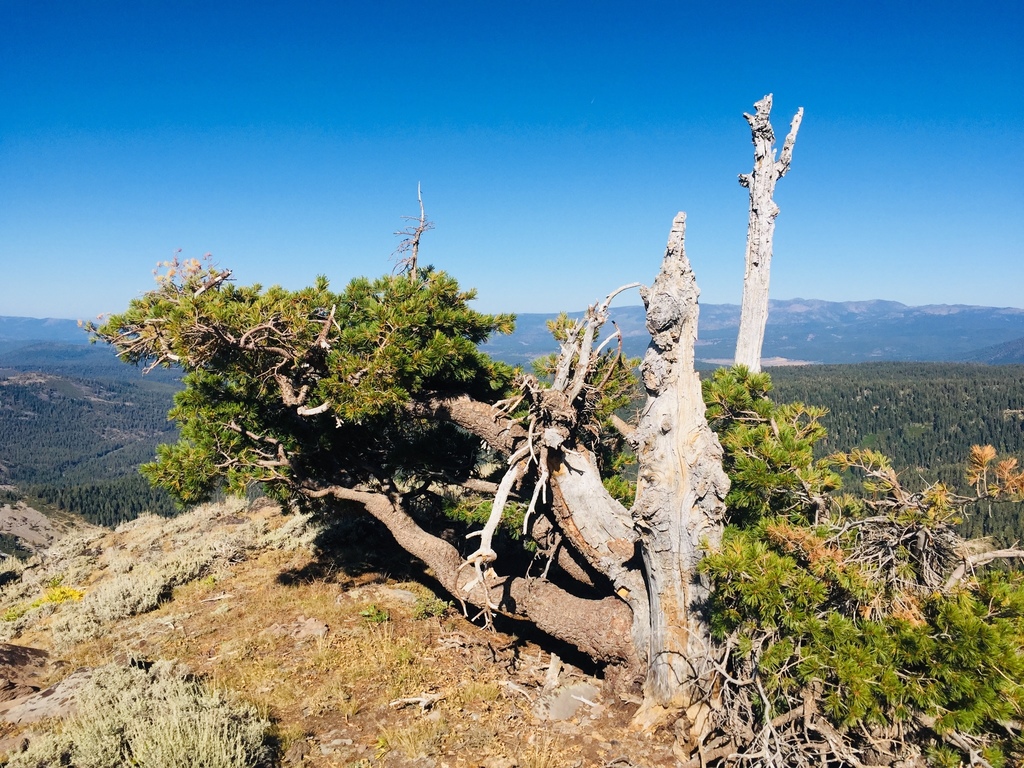
Whitebark Pine
Pinus albicaulis
Pinus albicaulis, known by the common names whitebark pine, white bark pine, white pine, pitch pine, scrub pine, and creeping pine, is a conifer tree native to the mountains of the western United States and Canada, specifically subalpine areas of the Sierra Nevada, Cascade Range, Pacific Coast Ranges, Rocky Mountains, and Ruby Mountains. It shares the common name "creeping pine" with several other plants.
The whitebark pine is typically the highest-elevation pine tree found in these mountain ranges and often marks the tree line. Thus, it is often found as krummholz, trees growing close to the ground that have been dwarfed by exposure. In more favorable conditions, the trees may grow to 29 meters (95 ft) in height.
From the article Pinus albicaulis on Wikipedia (CC BY-SA), quoted section by section
Range & habitat
Whitebark pine (Pinus albicaulis) can be found at high elevation in the Rocky Mountains from central British Columbia to western Wyoming. It occurs in the timberline zone of the Cascades and coastal ranges from British Columbia to the Sierra Nevada, as well as most high ranges between the Rockies and Cascades, such as the Blue Mountains. It is also populous in subalpine forests of Montana and Idaho.
Wikipedia: “Distribution”
What it does
The whitebark pine is an important source of food for many granivorous birds and small mammals, including most importantly the Clark's nutcracker (Nucifraga columbiana), the major seed disperser of the pine. Clark's nutcrackers each cache about 30,000 to 100,000 seeds each year in small, widely scattered caches, usually under 2 to 3 cm (3⁄4 to 1+1⁄4 in) of soil or gravelly substrate. Nutcrackers retrieve these seed caches during times of food scarcity and to feed their young. Cache sites selected by nutcrackers are often favorable for germination of seeds and survival of seedlings. Those caches not retrieved by the time the snow melts contribute to forest regeneration. Consequently, whitebark pine often grows in clumps of several trees, originating from a single cache of two to 15 or more seeds. Other animals also depend upon the whitebark pine. Douglas squirrels cut down and store whitebark pine cones in their middens. Grizzly bears and American black bears often raid squirrel middens for whitebark pine seeds, an important pre-hibernation food. Squirrels, northern flickers, and mountain bluebirds often nest in whitebark pines, and elk and blue grouse use whitebark pine communities as summer habitat. Fallen needles under these trees serve as beds that are used by deer and wild sheep seeking shelter during stormy weather.
Threats. …
Wikipedia: “Ecology”
At the table
Interior Salish peoples harvested seeds from this tree's cones for food. They were roasted, made into porridge, and mixed with dry berries. Whitebark pine plays a key hydrological role in the ecosystem by regulating runoff, enhancing and retaining snowpack, and reducing soil erosion. Habitat loss due to climate change could lead to downstream flooding and increased soil erosion, impacting agriculture, ranching, and drinking water supply.
Wikipedia: “Uses”
Where it lives
Recorded sightings
—
geo-referenced records in GBIF, from museums, herbaria and field observers.
Drag the globe to turn it. Dots are where records exist, not a range map; darker means more records.
In the stacks
Searching the stacks…
Every page naming Pinus albicaulis in the Biodiversity Heritage Library →
This page is assembled live from iNaturalist, GBIF, Wikipedia, the Source Library and the Internet Archive. It is not yet part of the hand-edited codex. iNaturalist taxon 68083.