- Plants
- ›Vascular Plants
- ›conifers
- ›conifers
- ›cypress family
- ›Cypresses, Cedars, Junipers, and Allies
- ›Juniperus
- ›Sabina
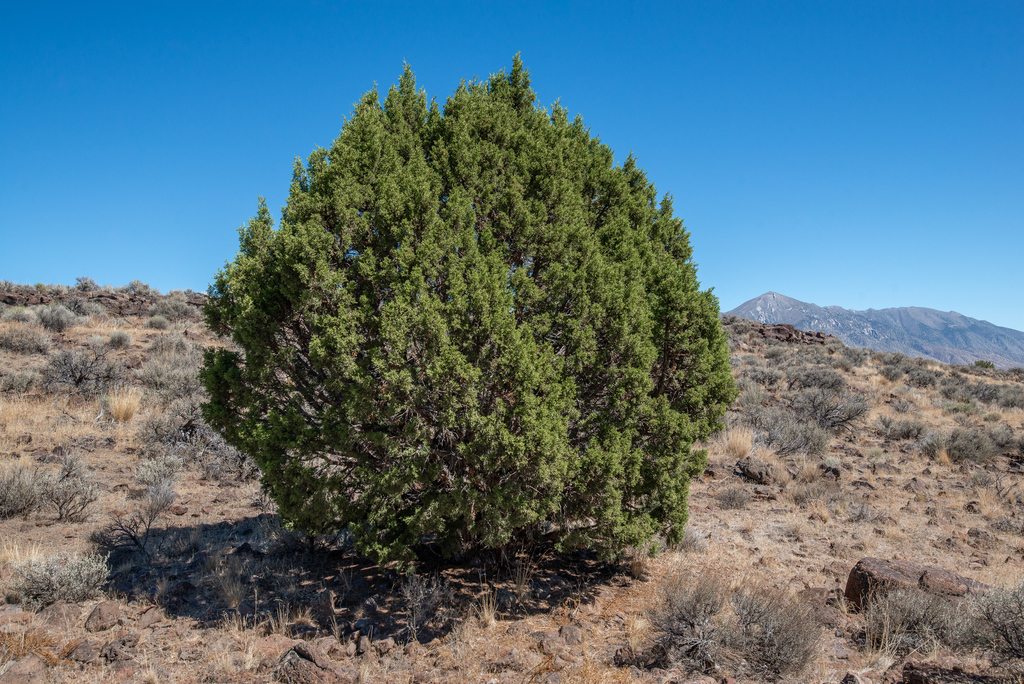
western juniper
Juniperus occidentalis
Juniperus occidentalis, known as the western juniper, is a shrub or tree native to the Western United States, growing in mountains at altitudes of 800–3,000 meters (2,600–9,800 ft) and rarely down to 100 m (330 ft). It is listed as Least Concern on the IUCN Red List because it is a widespread species with an increasing population.
From the article Juniperus occidentalis on Wikipedia (CC BY-SA), quoted section by section
Description
Juniperus occidentalis is a shrub or small tree 4–15 meters (13–49 ft) tall. Exceptionally tall specimens can be found in the John Day area of Oregon in excess of 26–28 m (85–92 ft) tall. The shoots are of moderate thickness among junipers, at 1–1.6 millimeters (1⁄32–1⁄16 in) diameter. The juvenile leaves (on young seedlings only) are needle-like and 5–10 mm (3⁄16–13⁄32 in) long. Arranged in opposite decussate pairs or whorls of three, the adult leaves are scale-like, 1–2 mm long (5 mm on lead shoots) and 1–1.5 mm broad. The cones are berry-like, 5–10 mm in diameter, blue-brown with a whitish waxy bloom, and mature in about 18 months. The male cones are 2–4 mm long and shed their pollen in early spring. The plants are about half monoecious (with both sexes on the same plant) and half dioecious (producing cones of only one sex). The cones contain 1–3 seeds, the majority of which germinate in springtime. In Oregon, where most of the species resides, seeds germinate in April and the foliage emerges in June. Seed dispersal is conducted by water runoff, gravity, and animals.
Range & habitat
J. occidentalis can be found in the Western United States—specifically southeast Washington, eastern and central Oregon, southwest Idaho, northeastern California and extreme northwest Nevada, north of 40° 30' N latitude, east of the Cascade Range. It usually occurs on dry, rocky sites where there is less competition from larger species like ponderosa pine and coast Douglas-fir. Annual precipitation can be as low as 20 centimetres (7+7⁄8 in). In very exposed positions at high altitude, it can assume a krummholz habit, growing low to the ground even when mature with a wide trunk. Hybrids with J. osteosperma are occasionally found. In the John Day area of Oregon, it competes for sunlight among ponderosa pines at the bottom of some deep side canyons. However, it more commonly reaches 4–15 m (13–49 ft) with a bushier growth habit on open and barren ground.
Wikipedia: “Distribution and habitat”
What it does
The cones are an important food for several birds, including American robin, Clark's nutcracker, phainopepla and cedar waxwing; these digest the fleshy cone scales and disperse the seeds in their droppings. The plants often bear galls caused by the juniper tip midge, Oligotrophus betheli. These are violet-purple fading to brown, 1–2 cm (3⁄8–13⁄16 in) in diameter, with dense modified spreading scale-leaves 6–10 mm (1⁄4–3⁄8 in) long and 2–3 mm broad at the base.
Fire ecology. In the past two decades, sagebrush steppe ecosystems have witnessed an expansion of juniper throughout the western U.S. This alteration of vegetation change can be associated with the decreased fire frequency, overgrazing of livestock, and an alteration of climate that transformed into a more wet and mild climate. Fire scar data was collected and dated to display the expansion of western juniper. It started between 1875 and 1885, with a pinnacle rate of development between approximately 1905 and 1924. Since the 1990s use of prescribed fires to control expansion of the species has increased. The results of increased prescription fires show a positive effect on plant communities.
Wikipedia: “Ecology”
At the table
Like other junipers, J. occidentalis produces a crop of cones called a juniper berry. While original European gins used berries from J. communis, several distilleries—particularly in Bend, Oregon—have used local western juniper to flavor their gin. While not common as a lumber source, Oregon State University has sponsored research into the use of western juniper for commercial applications such as sign posts and guard rails. Western juniper lumber is noted for its durability and high compression strength.
Wikipedia: “Uses”
Where it lives
Recorded sightings
—
geo-referenced records in GBIF, from museums, herbaria and field observers.
Drag the globe to turn it. Dots are where records exist, not a range map; darker means more records.
In the stacks
Searching the stacks…
Every page naming Juniperus occidentalis in the Biodiversity Heritage Library →
This page is assembled live from iNaturalist, GBIF, Wikipedia, the Source Library and the Internet Archive. It is not yet part of the hand-edited codex. iNaturalist taxon 68088.