- Animals
- ›Arthropods
- ›Crustaceans
- ›Typical Crustaceans
- ›Malacostracans
- ›Decapods, Isopods, and allies
- ›Decapods and Krill
- ›Decapods
- ›Penaeid and sergestid shrimps
- ›Penaeoid Prawns
- ›Penaeid Prawns
- ›Penaeus
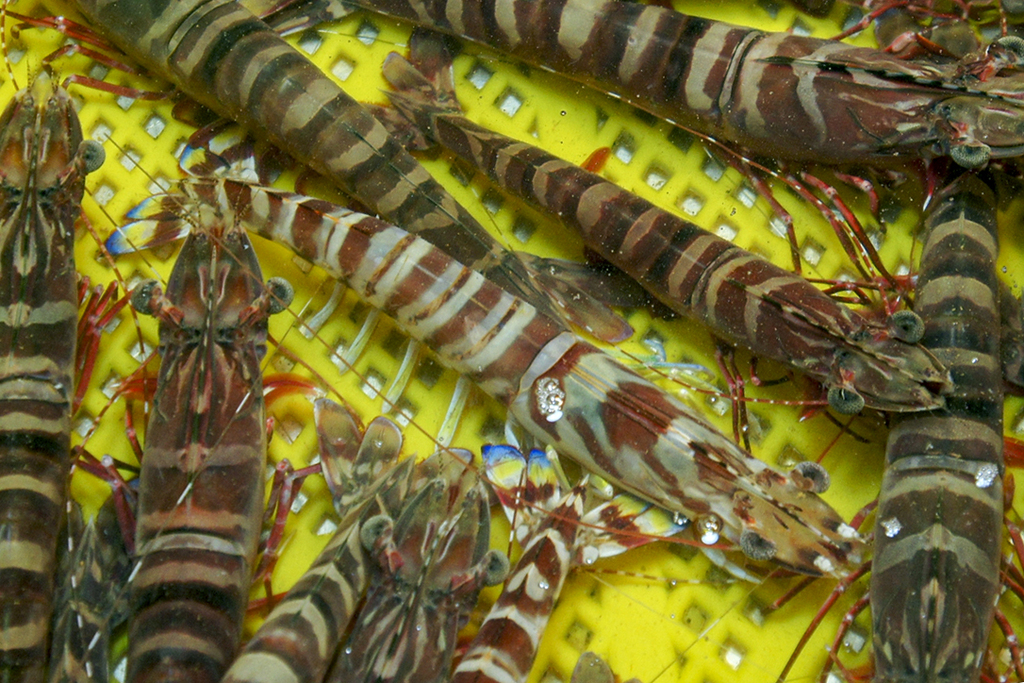
Kuruma Prawn
Penaeus japonicus
Marsupenaeus is a monotypic genus of prawn. It contains a single species, Marsupenaeus japonicus, known as the kuruma shrimp, kuruma prawn, or Japanese tiger prawn. It occurs naturally in bays and seas of the Indo-West Pacific, but has also reached the Mediterranean Sea as a Lessepsian migrant. It is one of the largest species of prawns, and is accordingly one of the most economically important species in the family.
From the article Marsupenaeus on Wikipedia (CC BY-SA), quoted section by section
Description
Males of M. japonicus can reach a total length of 17 cm (6.7 in), while females may reach 27 cm (11 in) and a mass of 130 grams (4.6 oz), making it one of the largest species in the family Penaeidae. The body is pale, with brown bands across the back, while the pereiopods and pleopods (walking and swimming legs, respectively) are pale yellow near their bases, and blue near the tips. The rostrum bears 8–10 spines on the top, and one or two below.
Range & habitat
The natural distribution of M. japonicus extends from the coast of East Africa and the Red Sea as far east as Fiji and Japan. M. japonicus has entered the Mediterranean Sea as a Lessepsian migrant, through the Suez Canal. It was first observed in Egypt in 1924, and has since spread through the Levant and around the coast of Turkey. Further populations have been established after the species was released at various sites around France, Italy, and Greece.
Wikipedia: “Distribution and invasiveness”
What it does
M. japonicus lives in bays and inland seas, particularly where warm currents occur. It is nocturnal, remaining buried in the substrate during the day. Its predators include bony fishes and cartilaginous fishes. When the sea temperature exceeds 20 °C (68 °F), spawning can begin. During copulation, the male transfers a spermatophore to the female, which she stores in a seminal receptacle. She travels to deep water, where she then releases around 700,000 eggs. These hatch as nauplii, and pass through further five nauplius stages, three zoeae, and three mysis stages by moulting before reaching the postlarval stage.
Wikipedia: “Ecology and behavior”
Where it lives
Recorded sightings
—
geo-referenced records in GBIF, from museums, herbaria and field observers.
Drag the globe to turn it. Dots are where records exist, not a range map; darker means more records.
In the stacks
Searching the stacks…
Every page naming Penaeus japonicus in the Biodiversity Heritage Library →
This page is assembled live from iNaturalist, GBIF, Wikipedia, the Source Library and the Internet Archive. It is not yet part of the hand-edited codex. iNaturalist taxon 682523.