On eBird ↗
Blue-and-white Swallow
Live sightings near you, the range map, bar charts of when it is seen, and Macaulay Library photos and recordings.
Blue-and-white Swallow
Pygochelidon cyanoleuca
The blue-and-white swallow (Notiochelidon cyanoleuca) is a passerine bird that breeds from Nicaragua south throughout South America, except in the deserts and the Amazon Basin. The southern race is migratory, wintering as far north as Trinidad, where it is a regular visitor. The nominate northern race may have bred on that island.
From the article Blue-and-white swallow on Wikipedia (CC BY-SA), quoted section by section
Description
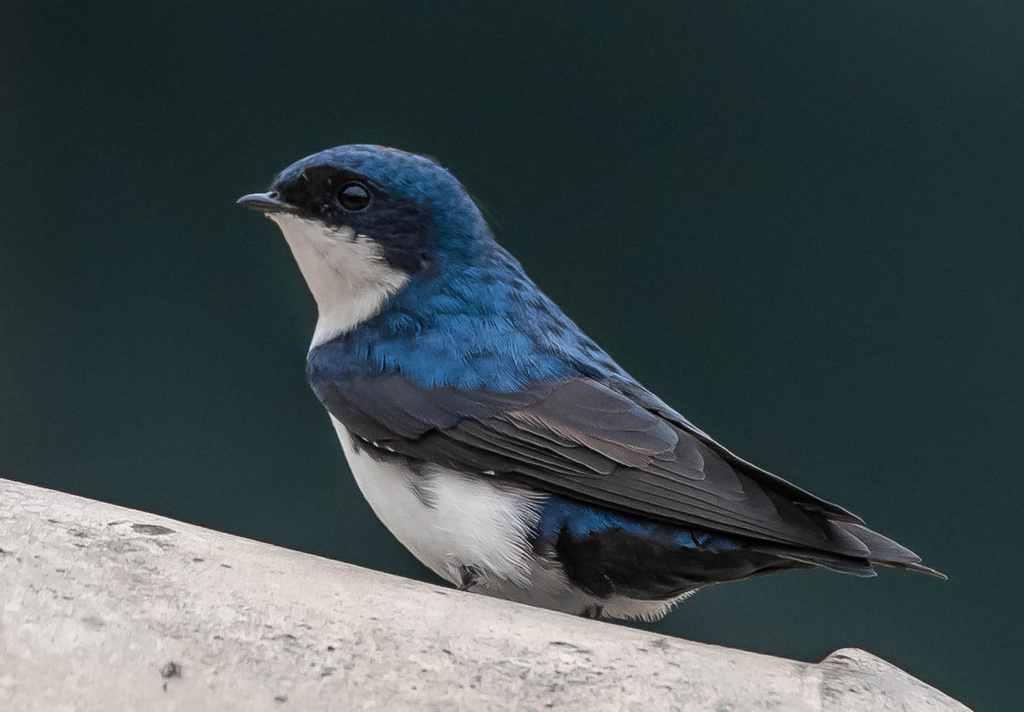
The adult blue-and-white swallow averages 11–12 cm (4.3–4.7 in) long and weighs about 10 g (0.35 oz). It has dark blue upperparts and white underparts, and its underwings and the undersurface of its short forked tail are blackish. The juvenile is brown above, buff-tinted below, and has a less forked tail. The call is a buzzing dzzzhreeee. There are three subspecies. The nominate N. c. cyanoleuca occurs from Nicaragua and Trinidad south to northwestern Argentina, Paraguay and Uruguay. The migratory southern race N. c. patagonica is larger, 13.5 cm (5.3 in), has paler underwings, and white basal undertail coverts. N. c. peruviana is restricted to coastal Peru up to 2,500 m (8,200 ft) altitude. It is smaller than patagonica, has less white in the undertail, darker underwings and duskier flanks.
Range & habitat
This is a swallow of open areas including villages and towns, farms, and forest clearings. In Central America, it is a highland bird, but elsewhere in its range it can occur from the lowlands to an altitude of 4,000 m (13,000 ft).
Wikipedia: “Distribution and habitat”
What it does
This species is often found in small flocks when not breeding. The blue-and-white swallow subsists primarily on a diet of insects, caught in the air; they have been seen to gather where termites swarm. The flight is typically fluttery, and this swallow frequently perches on wires or branches.
Breeding. The blue-and-white swallow's shallow straw nest is built by both adults in a wide range of natural or man-made cavities include tree holes, rock crevices and bridges. The clutch is up to six white eggs in the south of the range, two or three in the north, which are incubated by both parents for 15 days to hatching. The nestlings are fed by both parents for 26 days to fledging, but return to the nest to sleep with the parents for up to two months. There may be two broods.
Wikipedia: “Behaviour and ecology”
Listen
Looking for field recordings…
Where it lives
Recorded sightings
—
geo-referenced records in GBIF, from museums, herbaria and field observers.
Drag the globe to turn it. Dots are where records exist, not a range map; darker means more records.
In the stacks
Searching the stacks…
Every page naming Pygochelidon cyanoleuca in the Biodiversity Heritage Library →
This page is assembled live from iNaturalist, GBIF, Wikipedia, the Source Library and the Internet Archive. It is not yet part of the hand-edited codex. iNaturalist taxon 68826.