- Plants
- ›Vascular Plants
- ›flowering plants
- ›Dicots
- ›Legumes, Milkworts, and Allies
- ›Legumes
- ›Faboideae
- ›brooms, lupines, and allies
- ›Lupinus
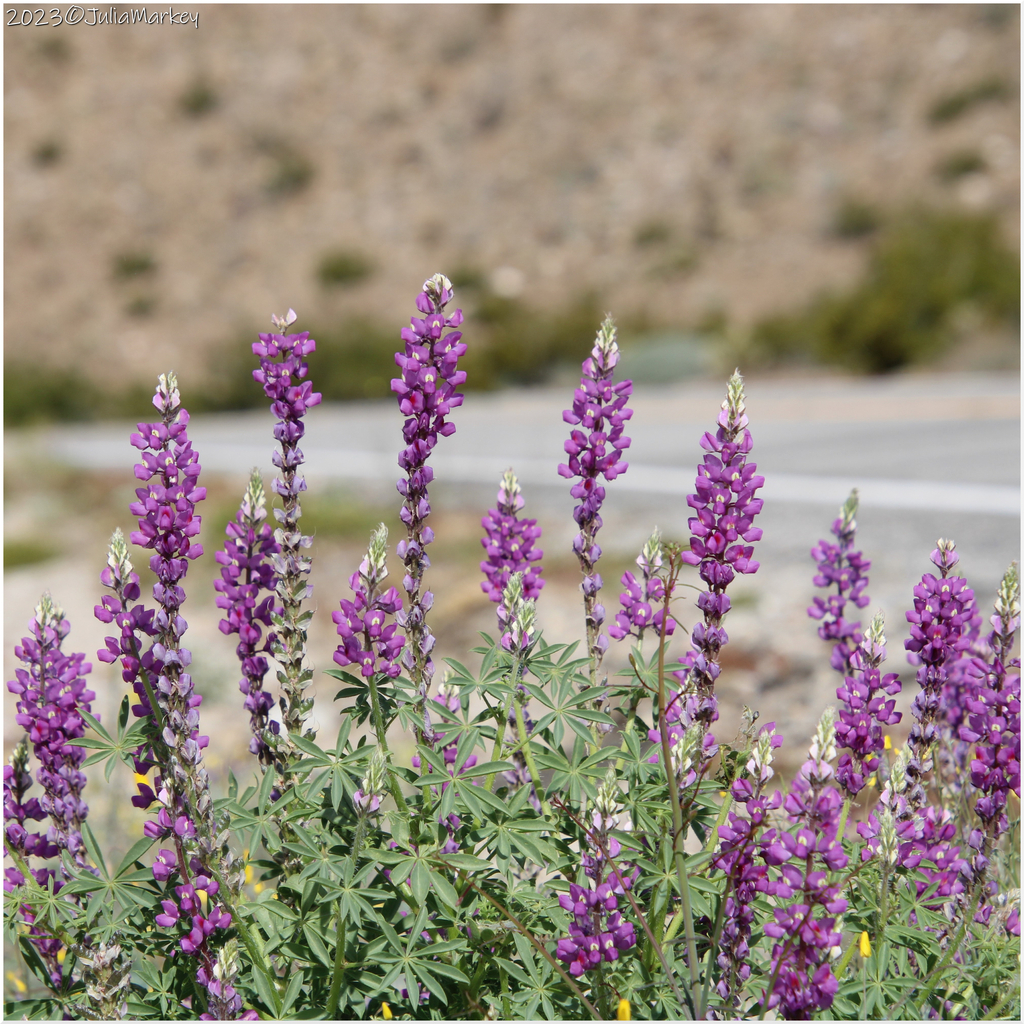
Arizona lupine
Lupinus arizonicus
Lupinus arizonicus, the Arizona lupine, is a flowering plant in the legume family Fabaceae, native to the Mojave and Sonoran Deserts of North America, where it can be found growing in open places and sandy washes below 1,100 metres (3,600 ft) elevation. It is common around Joshua Tree National Park and Death Valley National Park in California.
From the article Lupinus arizonicus on Wikipedia (CC BY-SA), quoted section by section
Description
It is an annual plant growing to 10–50 centimetres (3.9–19.7 in) in height. The leaves are palmately compound with 6–10 leaflets, each leaflet 1–4 centimetres (0.39–1.57 in) long and 5–10 millimetres (0.20–0.39 in) broad, on a 2.5–7 centimetres (0.98–2.76 in) long petiole. The flowers are magenta to dark pink, 7–10 mm long, with 20–50 or more flowers in a tall spike. It is a host of the moth species, Helicoverpa zea.
Where it lives
Recorded sightings
—
geo-referenced records in GBIF, from museums, herbaria and field observers.
Drag the globe to turn it. Dots are where records exist, not a range map; darker means more records.
In the stacks
Searching the stacks…
Every page naming Lupinus arizonicus in the Biodiversity Heritage Library →
This page is assembled live from iNaturalist, GBIF, Wikipedia, the Source Library and the Internet Archive. It is not yet part of the hand-edited codex. iNaturalist taxon 69421.