- Animals
- ›Arthropods
- ›Hexapods
- ›Insects
- ›Winged and Once-winged Insects
- ›Grasshoppers, Crickets, and Katydids
- ›Grasshoppers, Locusts, and Allies
- ›Grasshoppers
- ›Short-horned Grasshoppers and Locusts
- ›Short-horned Grasshoppers
- ›Bird Grasshoppers
- ›Cyrtacanthacridini
- ›Schistocerca
- ›Schistocerca americana
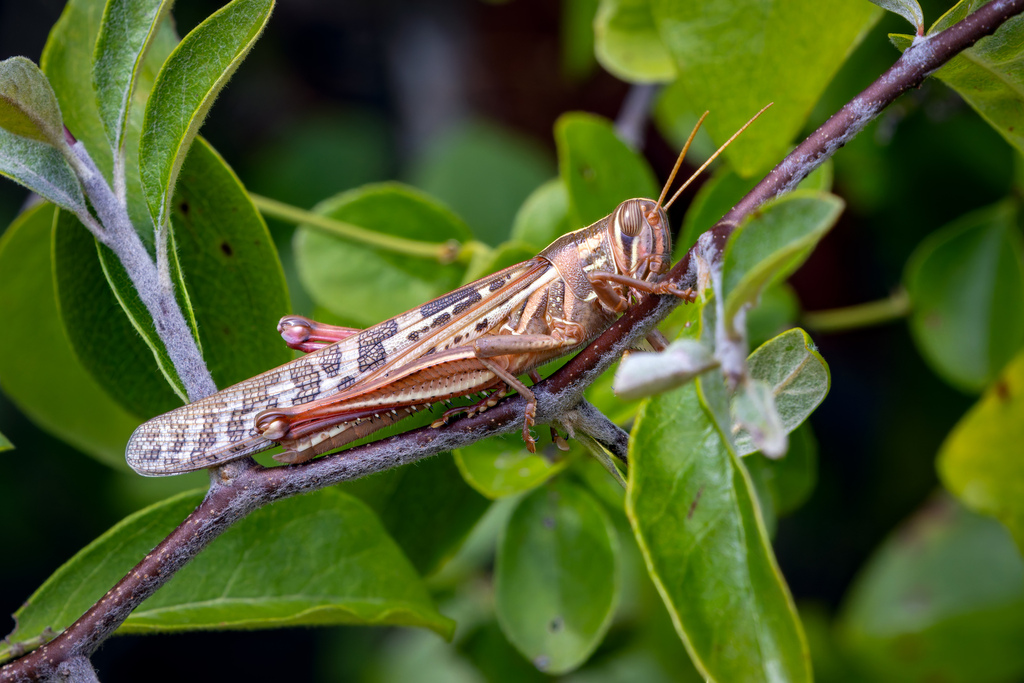
American Bird Grasshopper
Schistocerca americana
Schistocerca americana is a species of grasshopper in the family Acrididae known commonly as the American grasshopper and American bird grasshopper. It is native to North America, where it occurs in the eastern United States, Mexico, and the Bahamas. Occasional, localized outbreaks of this grasshopper occur, and it is often referred to as a locust, though it lacks the true swarming form of its congener, the desert locust (S. gregaria).
From the article Schistocerca americana on Wikipedia (CC BY-SA), quoted section by section
Description
The adult male of the species is up to 4.5 cm (1.8 in) long, and the adult female may reach 5.5 cm (2.2 in). The body of the adult is generally yellow-brown in color and the wings are pale with large brown spots. The nymphs are different in appearance. They change color as they mature and their coloration is a polyphenic trait – influenced by environmental conditions, producing multiple forms from one genotype. This is not uncommon among grasshoppers. In this species, the coloration of the nymphs is especially influenced by temperature. Nymphs are various shades of green, yellow, or red, usually with a pattern of black markings. They are often red at lower temperatures, but at higher temperatures, only green and yellow shades occur. Black patterning is also influenced by temperature, with lower temperatures inducing darker markings. Density is also a common factor in color polyphenism, but it is less important in this species than in many other grasshoppers. Nymphs reared in crowded conditions develop darker black markings, but density has little effect on their background colors.
Listen
Looking for field recordings…
Where it lives
Recorded sightings
—
geo-referenced records in GBIF, from museums, herbaria and field observers.
Drag the globe to turn it. Dots are where records exist, not a range map; darker means more records.
In the stacks
Searching the stacks…
Every page naming Schistocerca americana in the Biodiversity Heritage Library →
This page is assembled live from iNaturalist, GBIF, Wikipedia, the Source Library and the Internet Archive. It is not yet part of the hand-edited codex. iNaturalist taxon 69736.