- Plants
- ›Vascular Plants
- ›flowering plants
- ›Dicots
- ›Roses, Elms, Figs, and Allies
- ›rose family
- ›Amygdaloideae
- ›Maleae
- ›Pyrus
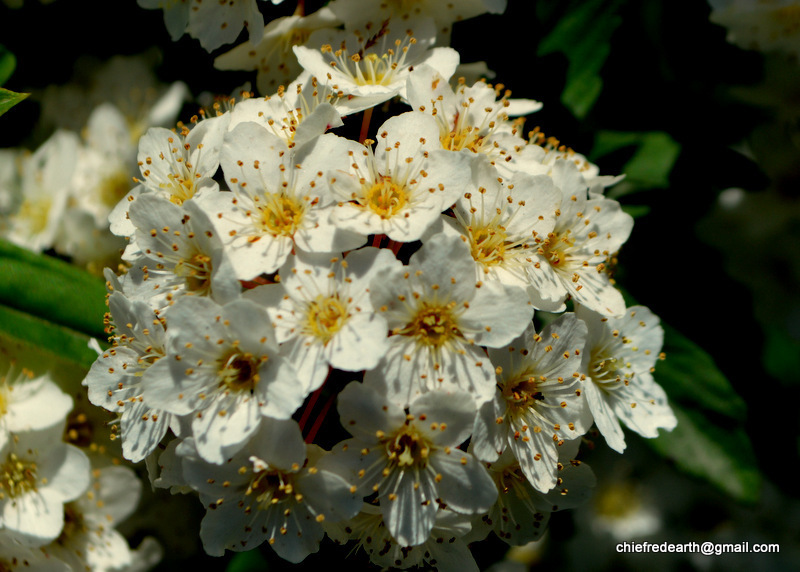
Himalayan Pear
Pyrus pashia
Pyrus pashia, the wild Himalayan pear, is a small to medium size deciduous tree of the small and oval shaped crown with ovate, finely toothed leaves, attractive white flowers with red anthers and small pear-like fruits. It is a fruit bearing tree that is native to southern Asia. Locally, it is known by many names such as batangi (Urdu), tangi (Kashmiri), mahal mol (Hindi) and passi (Nepal).
From the article Pyrus pashia on Wikipedia (CC BY-SA), quoted section by section
Description
Pyrus pashia commonly occurs in mid-hill regions from the Caucasus to the Himalaya, between 750 and 2,600 metres (2,460 and 8,530 ft) above sea-level. The trees themselves, unlike the fruit, are not much sold in the retail trade, and beyond those growing wild the species can be found almost exclusively in local home gardens. The average tree is 6 to 10 metres (20 to 33 ft) tall and 6 metres (20 ft) wide. Wooly or fuzzy leaves and young branchlets are a primary identification characteristic on young trees; both become smoother as the tree ages. The leaves of a mature tree are characterized as simple, long-pointed, toothed, hairless and shining with an ovate to ovate-lanceolate shape the length of which ranges from 5 to 10 centimetres (2.0 to 3.9 in). Mature trees can have spiny branches with bark that is rough and quite dark, almost black in some cases. This can provide a dramatic backdrop to the tree's mass of bright white blooms in the spring and intense yellow foliage in the autumn.
Wikipedia: “Morphology”
Range & habitat
Pyrus pashia is distributed across the Himalayas, from Pakistan to Vietnam and from southern province of China to the northern region of India. It is also found in the Indian Union Territory of Kashmir, Iran and Afghanistan.
Wikipedia: “Distribution”
What it does
Pyrus pashia is a tolerant tree that grows on sandy loamy soil that is well drained. It is adapted to a precipitation zone that ranges from 750 to 1500mm/yr or more, and a temperature that ranges from -10 to 35 C.
Wikipedia: “Habitat and ecology”
At the table
The nutritive contents of fruit are about 6.8% sugars, 3.7% protein, 1% ash, 0.4% pectin. It also contains a low content of Vitamin C, about 1.2 mg per 100g. The percentage contents of some of the mineral elements in the fruit are phosphorus, 0.026 percent, potassium, 0.475 percent, calcium, 0.061 percent, magnesium, 0.027 percent, and iron, 0.006 percent.
Wikipedia: “Nutrition”
In medicine
Locals use the juice of the ripened fruit to treat conjunctivitis by putting it in the eye of the diseased animal. They also use this juice, about 6 teaspoons twice a day, to treat diarrhea.
Wikipedia: “Medicinal”
Where it lives
Recorded sightings
—
geo-referenced records in GBIF, from museums, herbaria and field observers.
Drag the globe to turn it. Dots are where records exist, not a range map; darker means more records.
In the stacks
Searching the stacks…
Every page naming Pyrus pashia in the Biodiversity Heritage Library →
This page is assembled live from iNaturalist, GBIF, Wikipedia, the Source Library and the Internet Archive. It is not yet part of the hand-edited codex. iNaturalist taxon 698148.