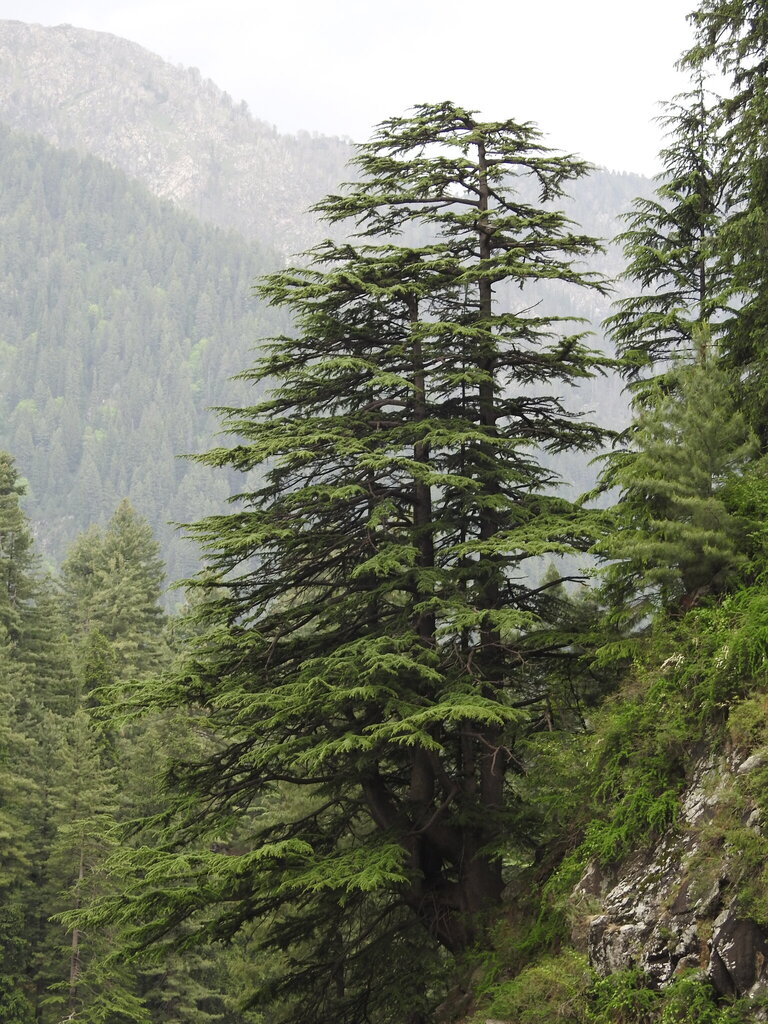
Deodar cedar
Cedrus deodara
Cedrus deodara, the deodar cedar, Himalayan cedar, or deodar/devdar/devadar/devadaru, is a species of cedar native to the western Himalayas in Eastern Afghanistan, Northern Pakistan (especially in Khyber Pakhtunkhwa) and India (Jammu and Kashmir, Himachal Pradesh, Uttarakhand, Sikkim and, Arunachal Pradesh states and the Darjeeling Region of West Bengal), Southwestern Tibet and Western Nepal, occurring at 1,500–3,200 m (4,921–10,499 ft) altitude. It is a large evergreen coniferous tree reaching 40–50 m (131–164 ft) tall, exceptionally 60 m (197 ft) with a trunk up...
From the article Cedrus deodara on Wikipedia (CC BY-SA), quoted section by section
Description
It is a large coniferous tree reaching 40–50 metres (131–164 feet) tall, exceptionally 60 m (197 ft) with a trunk up to 3 m (10 ft) in diameter. It has a conic crown with level branches and drooping branchlets. The leaves are needle-like, mostly 2.5–5 centimetres (1–2 inches) long, occasionally up to 7 cm (3 in) long, slender (1 millimetre or 1⁄32 in thick), borne singly on long shoots, and in dense clusters of 20–30 on short shoots; they vary from bright green to glaucous blue-green in colour. The female cones are barrel-shaped, 7–13 cm (2+3⁄4–5 in) long and 5–9 cm (2–3+1⁄2 in) broad, and disintegrate when mature (in 12 months) to release the winged seeds. The male cones are 4–6 cm (1+1⁄2–2+1⁄4 in) long, and shed their pollen in autumn.
Chemistry. The bark of Cedrus deodara contains large amounts of taxifolin. The wood contains cedeodarin, ampelopsin, cedrin, cedrinoside, and deodarin (3′,4′,5,6-tetrahydroxy-8-methyl dihydroflavonol). The main components of the needle essential oil include α-terpineol (30.2%), linalool (24.47%), limonene (17.01%), anethole (14.57%), caryophyllene (3.14%), and eugenol (2.14%). The deodar cedar also contains lignans and the phenolic sesquiterpene himasecolone, together with isopimaric acid. …
Range & habitat
The species natively occurs in East-Afghanistan, South Western Tibet, Western Nepal, Northern Pakistan, and North-Central India. It grows at elevations of 1,500–3,200 m (5,000–10,000 ft).
Wikipedia: “Distribution and habitat”
In medicine
C. deodara is used in Ayurvedic medicine. The inner wood is aromatic and used to make incense. Inner wood is distilled into essential oil. As insects avoid this tree, the essential oil is used as insect repellent on the feet of horses, cattle and camels. It also has antifungal properties and has some potential for control of fungal deterioration of spices during storage. The outer bark and stem are astringent. Because of its antifungal and insect repellent properties, rooms made of deodar cedar wood are used to store meat and food grains like oats and wheat in Shimla, Kullu, and Kinnaur district of Himachal Pradesh. Cedar oil is often used for its aromatic properties, especially in aromatherapy. It has a characteristic woody odour which may change somewhat in the course of drying out. The crude oils are often yellowish or darker in colour. Its applications include soap perfumes, household sprays, floor polishes, and insecticides, and is also used in microscope work as a clearing oil.
Wikipedia: “Herbal Ayurveda”
How it is grown
It is widely grown as an ornamental tree, often planted in parks and large gardens for its drooping foliage. General cultivation is limited to areas with mild winters, with trees frequently killed by temperatures below about −25 °C (−13 °F), limiting it to USDA zone 7 and warmer for reliable growth. It can succeed in rather cool-summer climates, as in Ushuaia, Argentina. The most cold-tolerant trees originate in the northwest of the species' range in Kashmir and Paktia Province, Afghanistan. Selected cultivars from this region are hardy to USDA zone 7 or even zone 6, tolerating temperatures down to about −30 °C (−22 °F). Named cultivars from this region include 'Eisregen', 'Eiswinter', 'Karl Fuchs', 'Kashmir', 'Polar Winter', and 'Shalimar'. Of these, 'Eisregen', 'Eiswinter', 'Karl Fuchs', and 'Polar Winter' were selected in Germany from seed collected in Paktia; 'Kashmir' was a selection of the nursery trade, whereas 'Shalimar' originated from seeds collected in 1964 from Shalimar Gardens, Kashmir and propagated at the Arnold Arboretum. C. deodara and the three cultivars 'Feelin' Blue', 'Pendula' and 'Aurea' have gained the Royal Horticultural Society's Award of Garden Merit (confirmed 2021).
Wikipedia: “Cultivation”
In human culture
The botanical name, which is also the English common name, is derived from the Sanskrit term devadāru, which means "wood of the gods", a compound of deva "god" and dāru "wood and tree".
Wikipedia: “Etymology”
Where it lives
Recorded sightings
—
geo-referenced records in GBIF, from museums, herbaria and field observers.
Drag the globe to turn it. Dots are where records exist, not a range map; darker means more records.
In the stacks
Searching the stacks…
Every page naming Cedrus deodara in the Biodiversity Heritage Library →
This page is assembled live from iNaturalist, GBIF, Wikipedia, the Source Library and the Internet Archive. It is not yet part of the hand-edited codex. iNaturalist taxon 69820.