- Animals
- ›Arthropods
- ›Hexapods
- ›Insects
- ›Winged and Once-winged Insects
- ›Beetles
- ›Water, Rove, Scarab, Long-horned, Leaf, and Snout Beetles
- ›Cucujiform Beetles
- ›Darkling Beetles and Allies
- ›Blister Beetles
- ›Meloinae
- ›Eupomphini
- ›Tegrodera
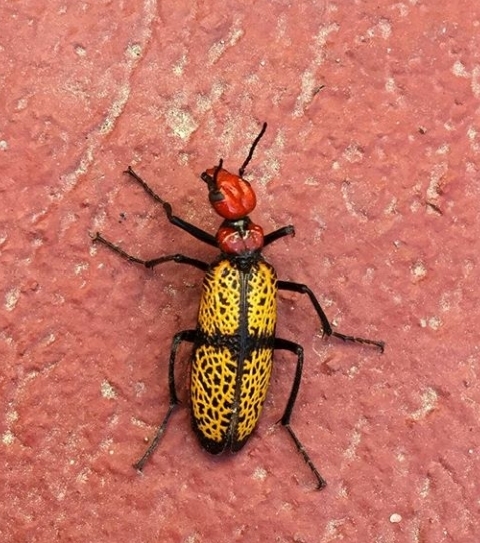
Iron Cross Blister Beetle
Tegrodera aloga
Tegrodera aloga, the iron cross blister beetle, is a species of blister beetle in the family Meloidae. It is found in Arizona, California, and Sonora.
The common name refers to the black cross on the wing covers. The scientific name T. aloga was coined by Skinner in 1903.
From the article Tegrodera aloga on Wikipedia (CC BY-SA), quoted section by section
Description
Tegrodera aloga is generally about 2 cm long; it has a long, narrow and cylindrical body and a wide head. The beetle is easily recognizable due to its contrasting yellow and red spots found on its black body. The brightness of the spots warns of the cantharidin toxins the beetle carries; this coloration is known as aposematism, and it works as a warning signal to protect itself from predators. It is more common to find these beetles in larger groups rather than individually.
What it does
In Tegrodera aloga, the males fight among themselves for the ability to mate with a female. Mating takes place actively, with the male on the female's back. Together they climb among flowers and leaves. The adults feed on spring blossoms of Nama hispida and Eriastrum, alfalfa, and other desert plants. They will drink nectar as well. The hosts of the parasitic larvae are unknown, but assumed to be ground-nesting bees.
Wikipedia: “Behavior”
Listen
Looking for field recordings…
Where it lives
Recorded sightings
—
geo-referenced records in GBIF, from museums, herbaria and field observers.
Drag the globe to turn it. Dots are where records exist, not a range map; darker means more records.
In the stacks
Searching the stacks…
Every page naming Tegrodera aloga in the Biodiversity Heritage Library →
This page is assembled live from iNaturalist, GBIF, Wikipedia, the Source Library and the Internet Archive. It is not yet part of the hand-edited codex. iNaturalist taxon 69886.