- Fungi Including Lichens
- ›Basidiomycete Fungi
- ›Higher Basidiomycetes
- ›Mushrooms, Bracket Fungi, Puffballs, and Allies
- ›Shelf Fungi
- ›Bracket Polypores
- ›Fomitopsis
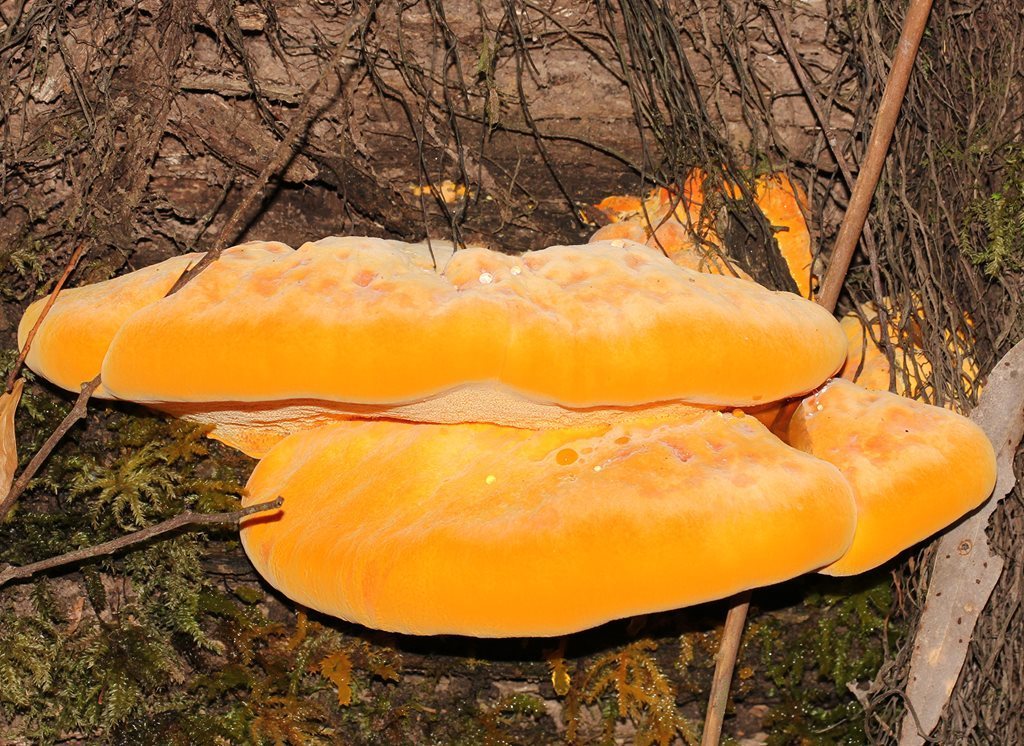
Curry Punk
Piptoporus australiensis
Piptoporus australiensis, commonly known as curry punk, is a polyporous bracket fungi. It is found in Australia. Often found on dead eucalypt trees and logs, often favouring fire-damaged wood. Curry Punk is named for its persistent curry smell which develops with age. The white top of this large, thick bracket becomes stained pale cream to orange by the orange flesh. Deep orange-yellow pores exude copious amounts of saffron-yellow juice.
From the article Piptoporus australiensis on Wikipedia (CC BY-SA), quoted section by section
Description
The cap is up to 20 centimetres (8 in) wide and 8 cm (3+1⁄4 in) tall, projecting up to 17 cm (6+1⁄2 in); it is irregular to semicircular, flat to convex; white then staining yellow, orange to brown; soft but tough, smooth, ridged or pitted, greasy when wet; margin smooth, incurved. There are 1–10 pores per mm; round, angular or irregular; saffron-yellow, aging to orange, rusty-brown; weeps saffron-yellow juice when wet. There is no stem, instead being laterally attached to substrate by a broad base. There is a strong persistent curry smell when old or dry. Bruce A. Fuhrer describes the species:
Piptoporus australiensis is usually called Curry Punk because of its persistent curry-like odour, even when old and dry. In contrast to other spongy polypores, this species appears to be immune to insect attack. The large brackets occur on logs, particularly those that have been charred by fire, causing a brown cubical rot.
== References ==
Where it lives
Recorded sightings
—
geo-referenced records in GBIF, from museums, herbaria and field observers.
Drag the globe to turn it. Dots are where records exist, not a range map; darker means more records.
In the stacks
Searching the stacks…
Every page naming Piptoporus australiensis in the Biodiversity Heritage Library →
This page is assembled live from iNaturalist, GBIF, Wikipedia, the Source Library and the Internet Archive. It is not yet part of the hand-edited codex. iNaturalist taxon 699640.