- Animals
- ›Molluscs
- ›Cephalopods
- ›Octopuses, Squids, and Cuttlefishes
- ›Squids and Cuttlefishes
- ›Inshore Squids
- ›Pencil Squids
- ›Doryteuthis
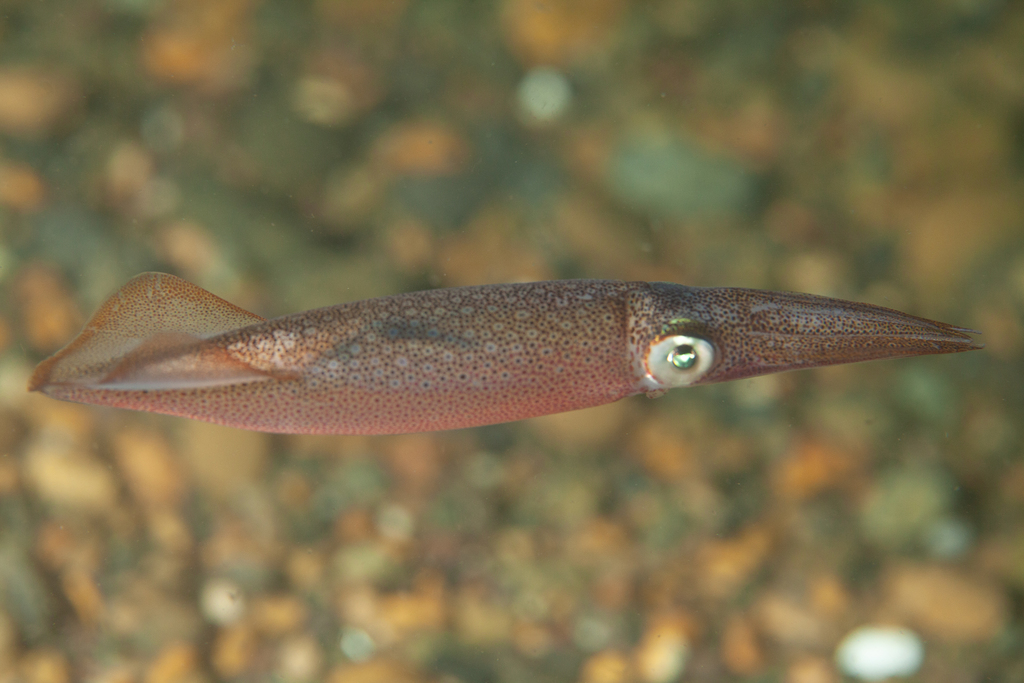
São Paulo Squid
Doryteuthis sanpaulensis
Doryteuthis sanpaulensis, commonly known as the São Paulo squid, is a species of squid in the family Loliginidae. It is found in the southwestern Atlantic Ocean, along the eastern coast of South America, up to northern Patagonia.
From the article Doryteuthis sanpaulensis on Wikipedia (CC BY-SA), quoted section by section
Description
D. sanpaulensis have a moderately long mantle, averaging 16 cm in length for females and 20 cm for males, but has been recorded up to 22 cm in length. It has long tentacles with expanded clubs and large suckers with about 25 teeth each. Arms are moderately long, suckers with 5-7 teeth. The left ventral arm is hectocotylised in the distal 45%. Gladius long and slender, without lateral thickening. Spermatophores are small and slender in shape and have a smooth body, and eggs are about 1.3 mm in length and ovular. Females have a sperm-storing organ inside the mantle cavity, as males transfer spermatophores to the region during mating. As a hatchling, D. sanpaulensis range in length between 1.4 to 1.7 mm. Chromatophores vary across the body; the ventral side is largely made of red and yellow chromatophores, while the dorsal is solely yellow. the mantle contains three, arranged in a triangle posteriorly. Paralarvae range from 1.1 to 1.4 mm, with a mantle bell shaped and rounded, and fins paddle-shaped. The head is squarish and narrower than the mantle margin.
Range & habitat
The squid is found in the south-western Atlantic Ocean, from southern Brazil to northern Patagonia, where it is the most abundant coastal squid. It is found at depths of up to 140 meters, populations more concentrated in colder waters. Paralarvae and juveniles are most abundant at depths over 55 meters off of the continental shelf of Brazil, but have been collected at 17 m and 20 m off of Patagonia and the extreme south of Brazil, respectively.
Wikipedia: “Distribution”
What it does
D. saupaulensis tend to migrate from nearshore nursing grounds to deepwater, returning to the nursing grounds when mature. Larger individuals tend to be found in deeper water, while smaller and younger individuals are found in shallower waters, in areas of high plankton production. Small juveniles are commonly found inshore during summer. In Argentina, individuals migrate northward in winter, to reproduce and feed. D. saupaulensis juveniles have been recorded mixing into a single school alongside juveniles of the species D. plei.
Wikipedia: “Behaviour”
Where it lives
Recorded sightings
—
geo-referenced records in GBIF, from museums, herbaria and field observers.
Drag the globe to turn it. Dots are where records exist, not a range map; darker means more records.
In the stacks
Searching the stacks…
Every page naming Doryteuthis sanpaulensis in the Biodiversity Heritage Library →
This page is assembled live from iNaturalist, GBIF, Wikipedia, the Source Library and the Internet Archive. It is not yet part of the hand-edited codex. iNaturalist taxon 700321.