- Fungi Including Lichens
- ›Basidiomycete Fungi
- ›Higher Basidiomycetes
- ›Mushrooms, Bracket Fungi, Puffballs, and Allies
- ›Agaricomycetidae
- ›boletes and allies
- ›boletes
- ›Suillelloideae
- ›Caloboletus
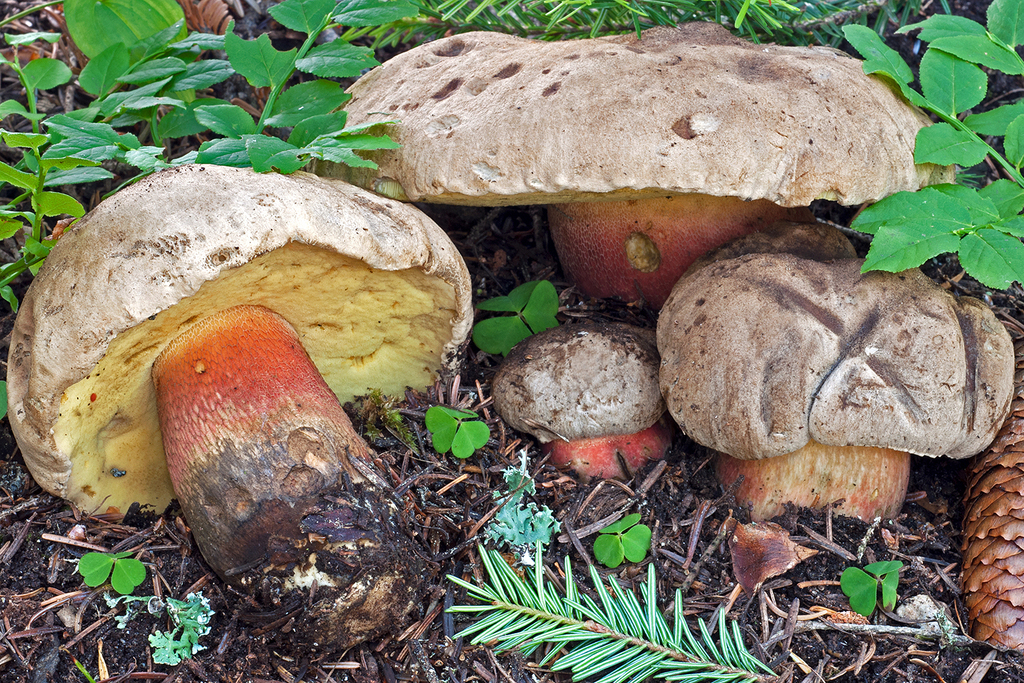
Bitter Beech Bolete
Caloboletus calopus
Caloboletus calopus, commonly known as the bitter bolete, bitter beech bolete or scarlet-stemmed bolete, is a species of fungus in the bolete family. Christiaan Persoon first described Boletus calopus in 1801. Modern molecular phylogenetics showed that it was only distantly related to the type species of Boletus and required placement in a new genus; Caloboletus was erected in 2014, with C. calopus designated as the type species.
The stout fruit bodies are attractively coloured, with a beige to olive cap up to 15 cm (6 in) across, yellow pores, and a reddish stipe up to 15 cm (6 in) long and 5 cm (2 in) wide. The pale yellow flesh stains blue when broken or bruised. Its red stipe distinguishes it from Boletus edulis.
From the article Caloboletus calopus on Wikipedia (CC BY-SA), quoted section by section
Description
Up to 15 centimetres (6 in) or rarely 20 cm (8 in) in diameter, the cap is beige to olive and initially almost globular before opening out to a hemispherical and then convex shape. The surface of the cap is smooth or has minute hairs, and sometimes develops cracks with age. The cap cuticle hangs over the cap margin. The pore surface is initially pale yellow before deepening to an olive-yellow in maturity, and quickly turns blue when it is injured. The pores, numbering one or two per millimetre, are circular when young but become more angular as the mushroom ages. The tubes are up to 2 cm (0.8 in) deep. The attractively coloured stipe is typically yellow above to pink-red below, with a straw-coloured network (reticulation) near the top or over the upper half; occasionally the entire stipe is reddish. It measures 7–15 cm (2.8–5.9 in) long by 2–5 cm (0.8–2.0 in) thick, and is either fairly equal in width throughout, or thicker towards the base. Sometimes, the reddish stipe colour of mature mushrooms or harvested specimens that are a few days old disappears completely, and is replaced with ochre-brown tones. The pale yellow flesh stains blue when broken, the discolouration spreading out from the damaged area. Its smell can be strong, and has been likened to ink. The spore print is olive to olive-brown. The spores are smooth and elliptical, measuring 13–19 by 5–6 μm. …
Range & habitat
An ectomycorrhizal species, Caloboletus calopus grows in coniferous and deciduous woodland, often at higher altitudes, especially under beech and oak. Fruit bodies occur singly or in large groups. The species grows on chalky ground from July to December, in Northern Europe, and North America's Pacific Northwest and Michigan. In North America, its range extends south to Mexico. Variety frustosus is known from California and the Rocky Mountains of Idaho. In 1968, after comparing European and North American collections, Miller and Watling suggested that the typical form of C. calopus does not occur in the United States. Similar comparisons by other authors have led them to the opposite conclusion, and the species has since been included in several North American field guides. The bolete has been recorded from the Black Sea region in Turkey, from under Populus ciliata and Abies pindrow in Rawalpindi and Nathia Gali in Pakistan, Yunnan Province in China, Korea, and Taiwan.
Wikipedia: “Distribution and habitat”
At the table
Although an attractive-looking bolete, the species is not considered edible on account of its very bitter taste, which does not disappear upon cooking. There are reports of it being eaten in far eastern Russia and Ukraine.
Wikipedia: “Edibility”
Where it lives
Recorded sightings
—
geo-referenced records in GBIF, from museums, herbaria and field observers.
Drag the globe to turn it. Dots are where records exist, not a range map; darker means more records.
In the stacks
Searching the stacks…
Every page naming Caloboletus calopus in the Biodiversity Heritage Library →
This page is assembled live from iNaturalist, GBIF, Wikipedia, the Source Library and the Internet Archive. It is not yet part of the hand-edited codex. iNaturalist taxon 701434.