- Animals
- ›Arthropods
- ›Hexapods
- ›Insects
- ›Winged and Once-winged Insects
- ›Grasshoppers, Crickets, and Katydids
- ›Katydids, Crickets, and Allies
- ›Katydids, wētā, and allies
- ›Tettigonioidea
- ›Katydids
- ›Long-legged Katydids
- ›Mecopodini
- ›Arachnacris
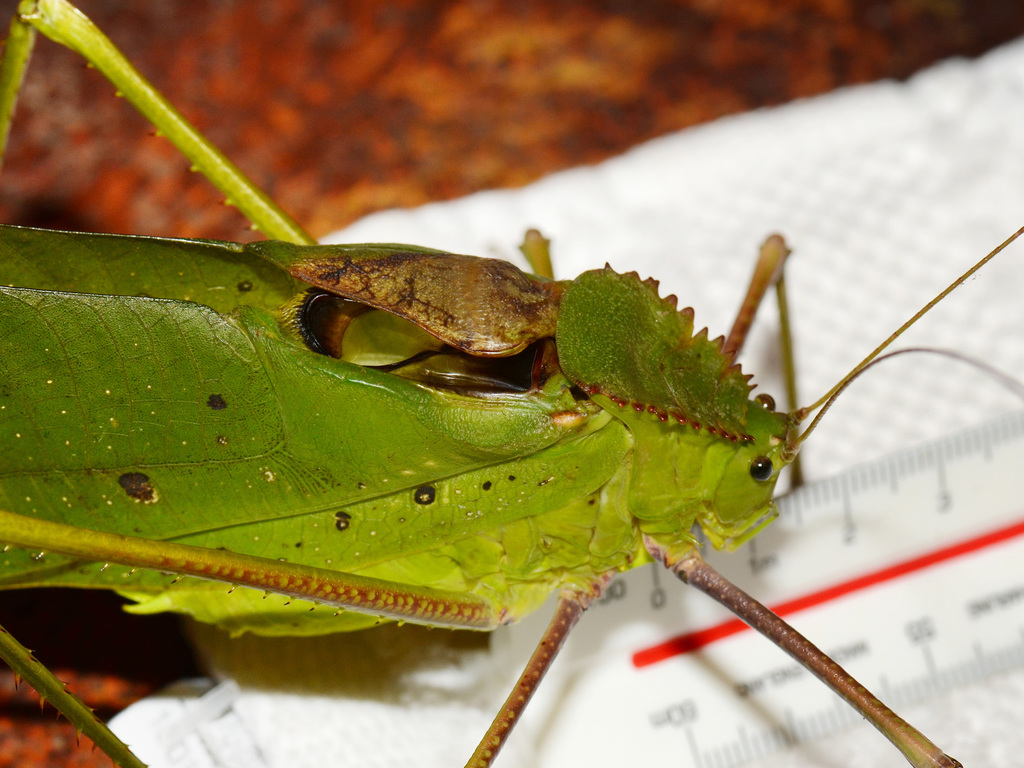
Malayan leaf katydid
Arachnacris corporalis
Arachnacris corporalis, the giant Malaysian katydid, giant long-legged katydid or giant katydid (not to be confused with Stilpnochlora couloniana, a species native to the United States), is a large species of bush cricket or katydid that is native to Malaysia. It is the largest species of katydid in the world.
From the article Arachnacris corporalis on Wikipedia (CC BY-SA), quoted section by section
Description
The giant Malaysian katydid is a large green insect that is, on average, about 15 centimeters long. They have long, thin legs, like most katydids, with the hind legs being longer than the front two pairs of legs. They have long, leaf-like wings that help them stay camouflaged from predators, as they typically reside in trees and don't move very much. As they age, their coloration mimics a leaf, and the tips of their wings become brown to resemble the way that leaves rot. The amount of brown on their wings can be used as a method to determine the age of the katydid, with more brown meaning an older age. Like all katydids, they make a loud chirping sound by scraping a toothed stridulatory file found near the base of one wing against a scraper located on the opposite wing. They use this sound as a defense mechanism and to attract mates.
Sexual dimorphism. Adult males and females of the species are easily distinguished, as females have a green pronotum and males have a brown pronotum, which is the triangular segment at the dorsal base of their wings.
What it does
Females have an ovipositor, which they use to lay their eggs in moss or rotting wood. When they reach their adult stage, they start out bright green and, as they get older, the tips of their wings turn brown, leading to a larger brown patch the older the katydid is. They live for about 6 months in their adult stage.
Wikipedia: “Life cycle and reproduction”
Listen
Looking for field recordings…
Where it lives
Recorded sightings
—
geo-referenced records in GBIF, from museums, herbaria and field observers.
Drag the globe to turn it. Dots are where records exist, not a range map; darker means more records.
In the stacks
Searching the stacks…
Every page naming Arachnacris corporalis in the Biodiversity Heritage Library →
This page is assembled live from iNaturalist, GBIF, Wikipedia, the Source Library and the Internet Archive. It is not yet part of the hand-edited codex. iNaturalist taxon 701908.