- Plants
- ›Vascular Plants
- ›flowering plants
- ›Dicots
- ›Woodsorrels, Quandongs, and Allies
- ›quandong family
- ›Aristotelia
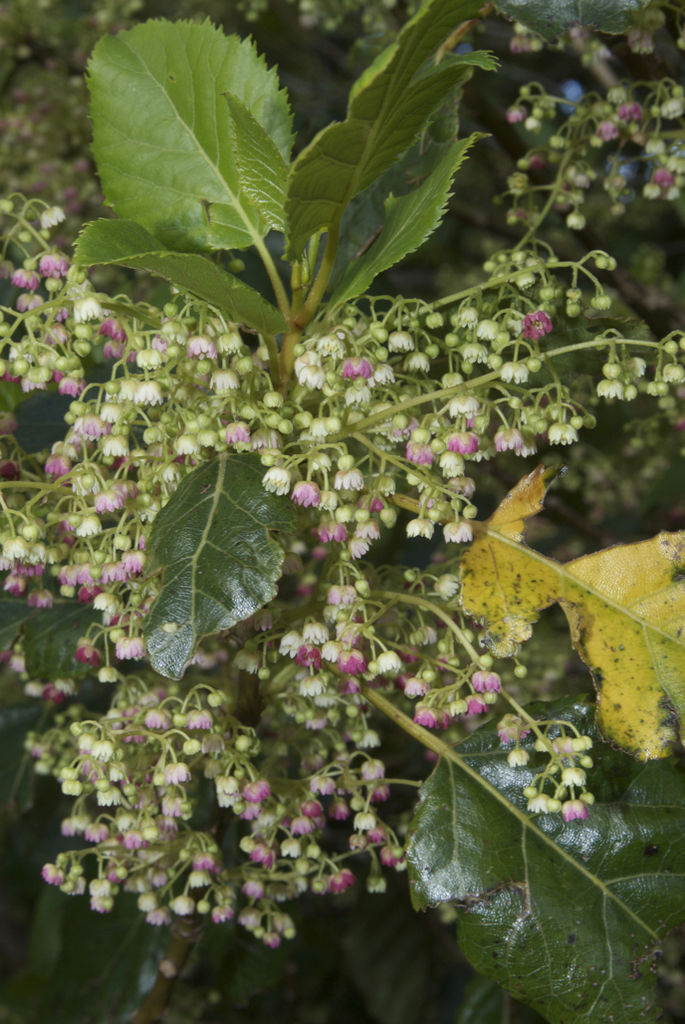
Wineberry
Aristotelia serrata
Aristotelia serrata, commonly known as wineberry and makomako, is a species of small tree in the family Elaeocarpaceae. It is a fast-growing dioecious tree which can be semideciduous. It is endemic to New Zealand. Its range mainly covers the North, South, and Stewart Islands. A. serrata is typically found in lowland to montane environments, and the plant can freely colonise disturbed areas. The tree can reach up to 10 metres (30 feet) tall, with a trunk diameter of up to 30 cm (12 in). The bark is grey or pale brown and smooth.
Aristotelia serrata was first described by the German botanists Georg and Johann Foster in 1776 as Dicera serrata, but Walter Oliver gave its current binomial name in 1921. Flowering occurs from September to December, with fruits ripening in summer. A. serrata's flowers change from a white-pink colour to a dark red colour, possibly to better adapt them for pollinators. The fruits are dispersed by fruit-eating animals (fruigivores), such as birds. The conservation status of A. serrata was assessed in 2023 in the New Zealand Threat Classification System as "Not Threatened".
From the article Aristotelia serrata on Wikipedia (CC BY-SA), quoted section by section
Description
Aristotelia serrata (wineberry) is a dioecious species of small tree up to about 10 metres (30 feet) tall, with a trunk up to 30 cm (10 in) in diameter. The smooth bark is grey or pale brown in colour, with flat lenticels. Branchlets are light to dark red in colour. Leaves are typically arranged oppositely or nearly so. The petioles are slender, greenish or pinkish in colour, and are up to 50 mm long. The laminae (leaf blades) are thin, smooth, 5 cm–12 cm × 4 cm–8 cm (2 in–5 in × 2 in–3 in) long, broad-ovate, and sharply serrated. The upper surface of the leaves is light or dark green in colour, and the undersides are paler. A. serrata can be semideciduous, meaning they partially lose their leaves in winter. A. serrata has been described as "fast-growing" and "short-lived". The inflorescences (flower clusters) are found in panicles which are 6–10 cm (2–4 in) long. Flowering occurs from September to December. Flowers are 4–6 mm in diameter, and the panicles are 6–10 cm (2.4–3.9 in) long, or, on pedicels, are 5–10 mm long. The sepals are about 3 mm long and pink in colour. The petals are about 9 mm long, and white, light pink to red in colour. The stamens are numerous. Fruiting occurs from November to January. Fruits are fleshy berries, globe-shaped, bright red to black in colour, and 5 × 4 mm long. The seeds are 1.9–3.1 mm long. A. …
Range & habitat
Aristotelia serrata is endemic to New Zealand. It is a common species, A. serrata is found throughout the country, but is less common in drier areas. Its range mainly covers the North, South, and Stewart Islands. The New Zealand botanist Thomas Kirk called it "one of the commonest plants in the colony" in his 1889 revision The Forest Flora of New Zealand. Its 2023 conservation status in the New Zealand Threat Classification System was "Not Threatened". Its assessment in the IUCN Red List in 2025 was "Least Concern", and its population trend was evaluated as "Unknown".
Habitat. Aristotelia serrata is typically found in lowland to montane environments. It reaches 1,050 m (3,000 ft) above sea level at maximum elevation. A. serrata exhibits colonial characteristics, being able to colonise disturbed sites, especially after forest clearance, fire, tree fall, and storm damage. A. serrata is commonly found on fertile, well-drained soils of young terraces and alluvial fans, as well as on recently disturbed areas and older terraces.
Wikipedia: “Distribution”
What it does
Aristotelia serrata's fruits are dispersed by fruit-eating animals (frugivores), such as birds. Burrows (1995) recorded that A. serrata fruits were consumed by native silvereyes (Zosterops lateralis), kererū (Hemiphaga novaeseelandiae), and New Zealand bellbirds (Anthornis melanura). Several other birds, including the kākā (Nestor meridionalis) and tūī (Prosthemadera novaeseelandiae) have also been recorded feeding on the fruit. Aristotelia serrata plays host to the endemic moths Aenetus virescens and Declana floccosa, and also the beetle species Oemona hirta. Paradoxaphis aristoteliae, a species of aphid, can also be hosted on A. serrata. The leaves contain large amounts of phenols which make them attractive to introduced possums. The leaves are also eaten by cattle, deer, and goats. A. serrata can tolerate areas with low soil moisture. The tree is dioecious, meaning individual plants are either male or female. Pollination is likely achieved by birds and insects. The flowers do not have a scent and are about the same size in both sexes. Flowers of A. serrata change colours from a white-pink colour to a dark red colour, possibly to better adapt them for pollinators. The nectar from the flowers is consumed by stitchbirds (Notiomystis cincta), and the pollen is consumed by native weevils.
Wikipedia: “Ecology”
In human culture
The etymology of A. serrata's genus name, Aristotelia, is named after the Greek philosopher Aristotle. The specific epithet (second part of the scientific name), serrata, means saw-toothed. The species is commonly known as wineberry, makomako, and mako. The Māori name mako is shared with the name that some islands in the Pacific use for trees in the order Malvales.
Wikipedia: “Etymology”
Where it lives
Recorded sightings
—
geo-referenced records in GBIF, from museums, herbaria and field observers.
Drag the globe to turn it. Dots are where records exist, not a range map; darker means more records.
In the stacks
Searching the stacks…
Every page naming Aristotelia serrata in the Biodiversity Heritage Library →
This page is assembled live from iNaturalist, GBIF, Wikipedia, the Source Library and the Internet Archive. It is not yet part of the hand-edited codex. iNaturalist taxon 70230.