- Plants
- ›Vascular Plants
- ›flowering plants
- ›Dicots
- ›Gentians, Dogbanes, Madders, and Allies
- ›madder family
- ›Rubioideae
- ›Anthospermeae
- ›Coprosminae
- ›Coprosma
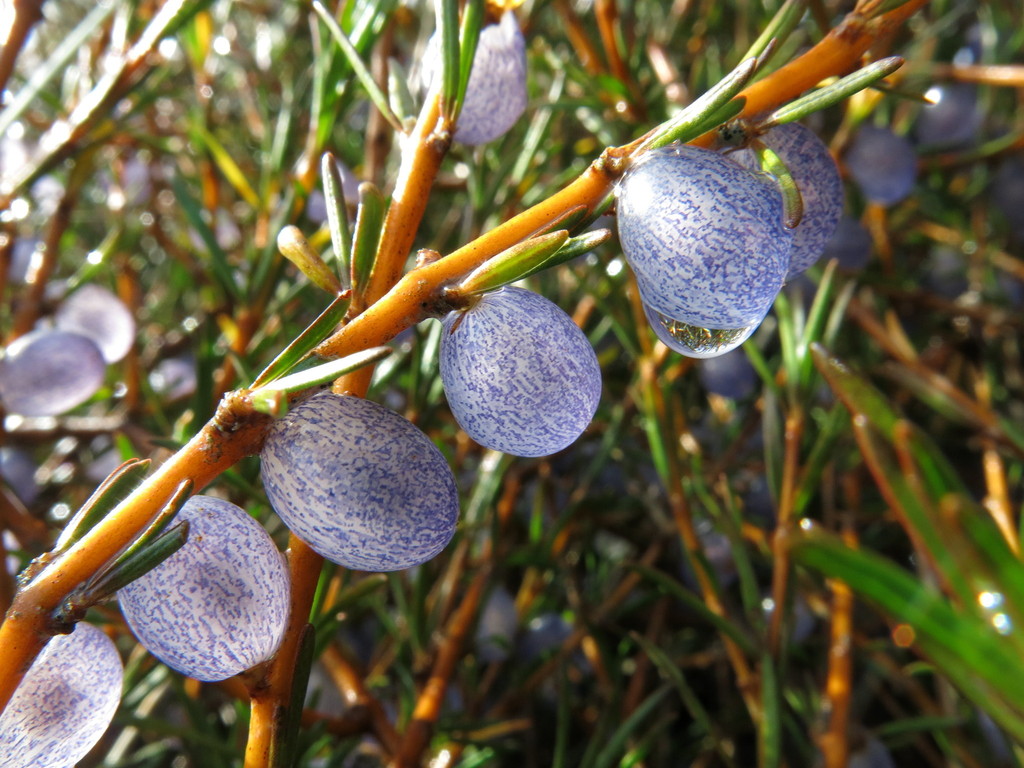
Sand Coprosma
Coprosma acerosa
Coprosma acerosa, commonly called sand coprosma, is a shrub that is native to New Zealand. It is a coastal plant found on the landward side of sand dunes. C. acerosa is a low, spreading shrub with yellow-brownish leaves, red bark and blue fruit.
It is declining over large parts of its original range due to competition from marram grass.
From the article Coprosma acerosa on Wikipedia (CC BY-SA), quoted section by section
Description
Low-growing, with slender flexible, sprawling to prostrate, interlacing branches and branchlets, forming a ± cushionlike mass up to c. 2 m. diam., occ. up to 2m. tall. Branchlets ∞ with yellowish brown bark, pubescent when young. Lvs in opp. Pairs or fascicles, on yellowish petioles. Stipules rounded-obtuse to broadly triangular, ± pubescent, ciliolate. Lamina coriac., yellowish green, linear obtuse, 7-12 × 1-1·5- (2) mm. Midrib alone evident. Fls solitary, terminal on short branchlets. ♂ with calyx 0 or vestigial; corolla funnelform, lobes ovate-oblong, subacute, ± = tube. ♀ with acute, narrow-triangular calyx-teeth; corolla funnelform, lobes narrow-oblong, obtuse. Drupe translucent, very pale to pale blue, often with darker flecks, globose, c. 7 mm. diam.
== References ==
Where it lives
Recorded sightings
—
geo-referenced records in GBIF, from museums, herbaria and field observers.
Drag the globe to turn it. Dots are where records exist, not a range map; darker means more records.
In the stacks
Searching the stacks…
Every page naming Coprosma acerosa in the Biodiversity Heritage Library →
This page is assembled live from iNaturalist, GBIF, Wikipedia, the Source Library and the Internet Archive. It is not yet part of the hand-edited codex. iNaturalist taxon 70251.