- Plants
- ›Vascular Plants
- ›flowering plants
- ›Dicots
- ›Heathers, Balsams, Primroses, and Allies
- ›primrose family
- ›Cape Myrtle subfamily
- ›Myrsine
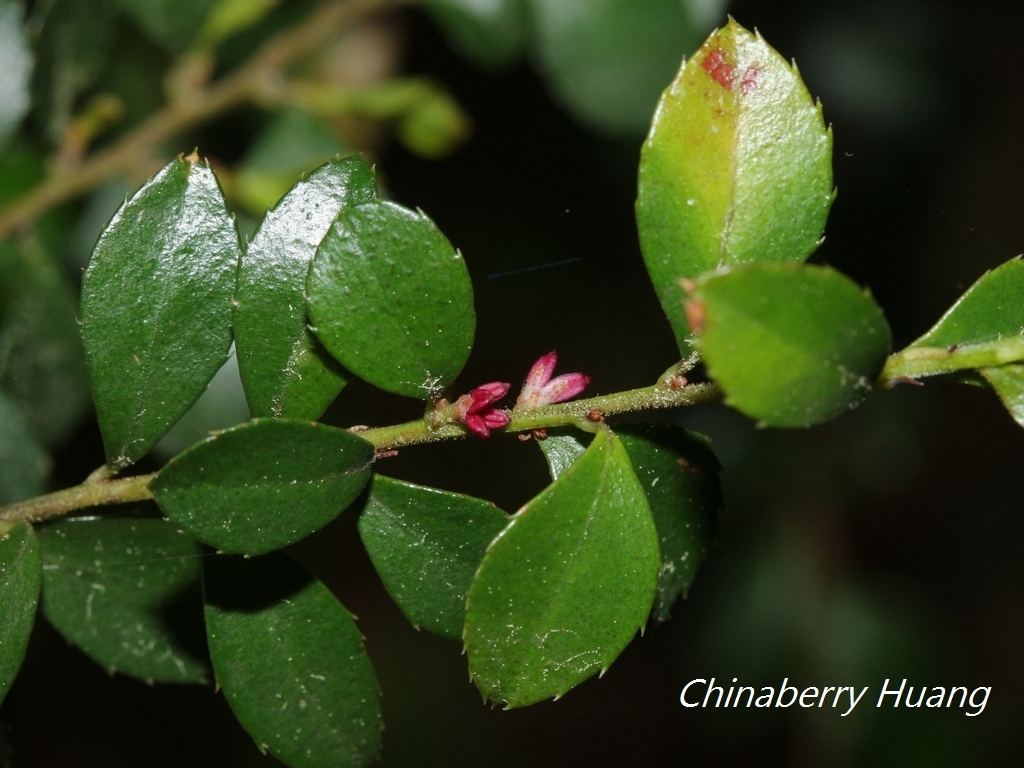
African Boxwood
Myrsine africana
Myrsine africana (also called Cape myrtle, African boxwood or thakisa) is a species of shrub in the Primulaceae family. It is indigenous to Macaronesia, Africa and South Asia. It typically has dense, dark-green to red foliage and produces tiny bright purple berries.
From the article Myrsine africana on Wikipedia (CC BY-SA), quoted section by section
Description
The shrub can achieve heights of over 2 metres (6.6 ft) and may be dense if pruned or grown in strong sunlight. The fine-toothed leaves are at first deep red, but on maturity become glossy and dark green. The cream-coloured flowers appear in spring, with the male flowers boasting red anthers. Separate shrubs produce either male or female flowers, with the female plants also producing small purple berries. The foliage is dense, and dark-green to red in color. The hardy plant is long-lived. M. africana sends up occasional shoots from its root system that go on to form new plants. It propagates easily from seed.
At the table
Parts of the plant are used in milk and meat-based soups by the Batemi and Masai people of Africa, which is thought to reduce cholesterol levels in tribes that consume large amounts of meat. The flowers are also eaten. A powder derived from the plant's leaves is called katam (كتم), used to dye hair since ancient times. Cape myrtle is increasingly popular for topiaries and small hedges, as it can so readily be pruned and shaped.
Wikipedia: “Uses”
Where it lives
Recorded sightings
—
geo-referenced records in GBIF, from museums, herbaria and field observers.
Drag the globe to turn it. Dots are where records exist, not a range map; darker means more records.
In the stacks
Searching the stacks…
Every page naming Myrsine africana in the Biodiversity Heritage Library →
This page is assembled live from iNaturalist, GBIF, Wikipedia, the Source Library and the Internet Archive. It is not yet part of the hand-edited codex. iNaturalist taxon 70260.