- Plants
- ›Vascular Plants
- ›flowering plants
- ›monocots
- ›Spiderworts and Allies
- ›Bloodroots
- ›Haemodoroideae
- ›Bloodroots, Redroots & relatives
- ›Haemodorum
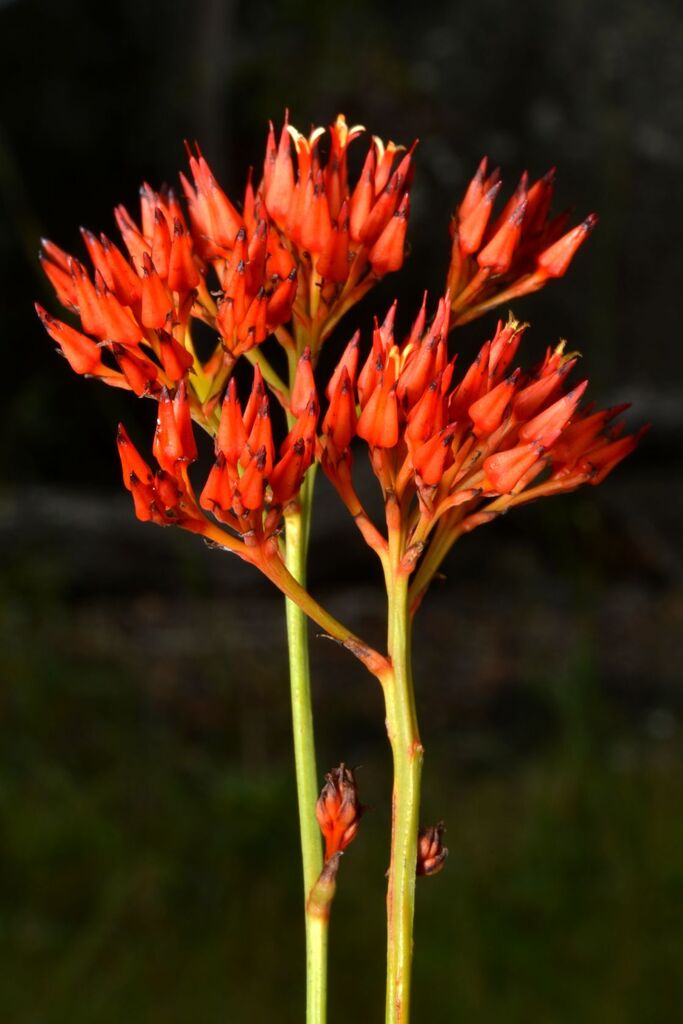
scarlet bloodroot
Haemodorum coccineum
Haemodorum coccineum (bunyagutjagutja, bloodroot, menang, scarlet bloodroot, red root) is a flowering plant in the same family as kangaroo paw.
From the article Haemodorum coccineum on Wikipedia (CC BY-SA), quoted section by section
Description
A perennial herb to one meter high. Although it is not grass, it has a grass-like appearance, with strap-like, narrow, leathery leaves arising from the base of the plant. Flowering usually occurs between November and March, during the Top End wet season, however flowers have been observed as early as October and as late as May. The flowers are deep-red or orange red and occur in dense clusters on long stiff stalks, which also arise from the base of the plant. Fruit develop between November and March, and can linger until May. The fruit are red to black, fleshy capsules with three lobes. The mature fruit release a red-purple juice when crushed.
Range & habitat
Found in the Top End of the Northern Territory, Northern Queensland and Papua New Guinea. Occurs in open woodland habitats on gravelly or shallow lateritic soils and sandstone.
Wikipedia: “Distribution and habitat”
At the table
Suitable as a bedding or edging plant in native gardens.
The fruits can be used in floral arrangements.
Some sources report Indigenous Australians used the plant to treat snake-bite, and the dry stalks were used as fire-sticks.
Wikipedia: “Other uses”
How it is grown
Haemodorum coccineum can be propagated from seed. Vegetative propagation can be achieved by dividing the bulbous root. Plants prefer a well-drained sandy or gravelly soil and full sun. In the dry season the plant will usually die back, leaving the underground rootstock to regenerate later in the year.
Wikipedia: “Propagation and cultivation”
Where it lives
Recorded sightings
—
geo-referenced records in GBIF, from museums, herbaria and field observers.
Drag the globe to turn it. Dots are where records exist, not a range map; darker means more records.
In the stacks
Searching the stacks…
Every page naming Haemodorum coccineum in the Biodiversity Heritage Library →
This page is assembled live from iNaturalist, GBIF, Wikipedia, the Source Library and the Internet Archive. It is not yet part of the hand-edited codex. iNaturalist taxon 703190.