- Animals
- ›Arthropods
- ›Crustaceans
- ›Typical Crustaceans
- ›Malacostracans
- ›Decapods, Isopods, and allies
- ›Decapods and Krill
- ›Decapods
- ›Crabs, Lobsters, Shrimps, and Allies
- ›True Crabs
- ›Eubrachyuran Crabs
- ›Heterotrematan Crabs
- ›Xanthoid Crabs
- ›Round Crabs
- ›Zosiminae
- ›Lophozozymus
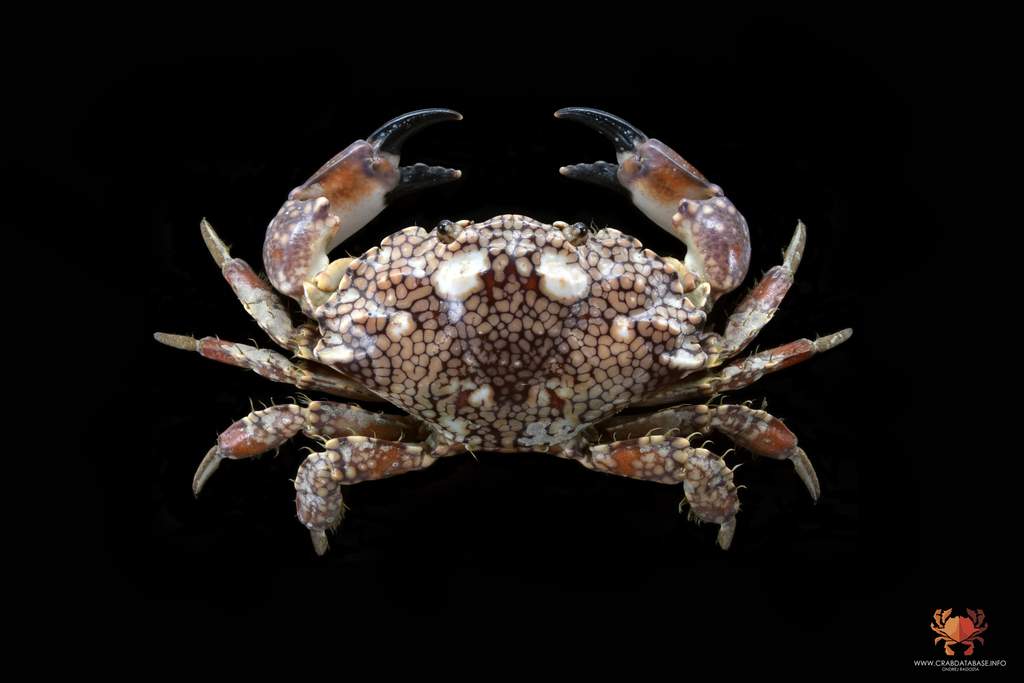
Mosaic Reef Crab
Lophozozymus pictor
Lophozozymus pictor, the mosaic reef crab is a species of crab in the family Xanthidae.
From the article Lophozozymus pictor on Wikipedia (CC BY-SA), quoted section by section
Description
The word "pictor" in Latin means painter. Its appearance is a body of 8–10 cm (3.1–3.9 in), somewhat fan-shaped and usually red to orange with strikingly mosaic-like patterns of large white spots. Its pincers are short, both about equal size, with black tips. It has walking legs that are hairy with pointed tips.
Wikipedia: “Description and etymology”
Range & habitat
Lophozozymus pictor is found in China, Indonesia, Japan, Philippines, Singapore, Thailand, Vietnam, Australia, and French Polynesia. In the Philippines, this is known as Calintugas. It lives along the coral areas of Batangas, Mindoro, Sorsogon, Negros Oriental, and Samar.
Wikipedia: “Distribution and ecology”
Toxicity
This is known to be one of the most poisonous crabs in the world. Its neurotoxin is not denatured by heat even when cooked.
== References ==
Where it lives
Recorded sightings
—
geo-referenced records in GBIF, from museums, herbaria and field observers.
Drag the globe to turn it. Dots are where records exist, not a range map; darker means more records.
In the stacks
Searching the stacks…
Every page naming Lophozozymus pictor in the Biodiversity Heritage Library →
This page is assembled live from iNaturalist, GBIF, Wikipedia, the Source Library and the Internet Archive. It is not yet part of the hand-edited codex. iNaturalist taxon 703495.