- Plants
- ›Vascular Plants
- ›flowering plants
- ›Dicots
- ›Buttercups, Poppies, and Allies
- ›buttercup family
- ›Columbines and Meadow-Rues
- ›Aquilegia
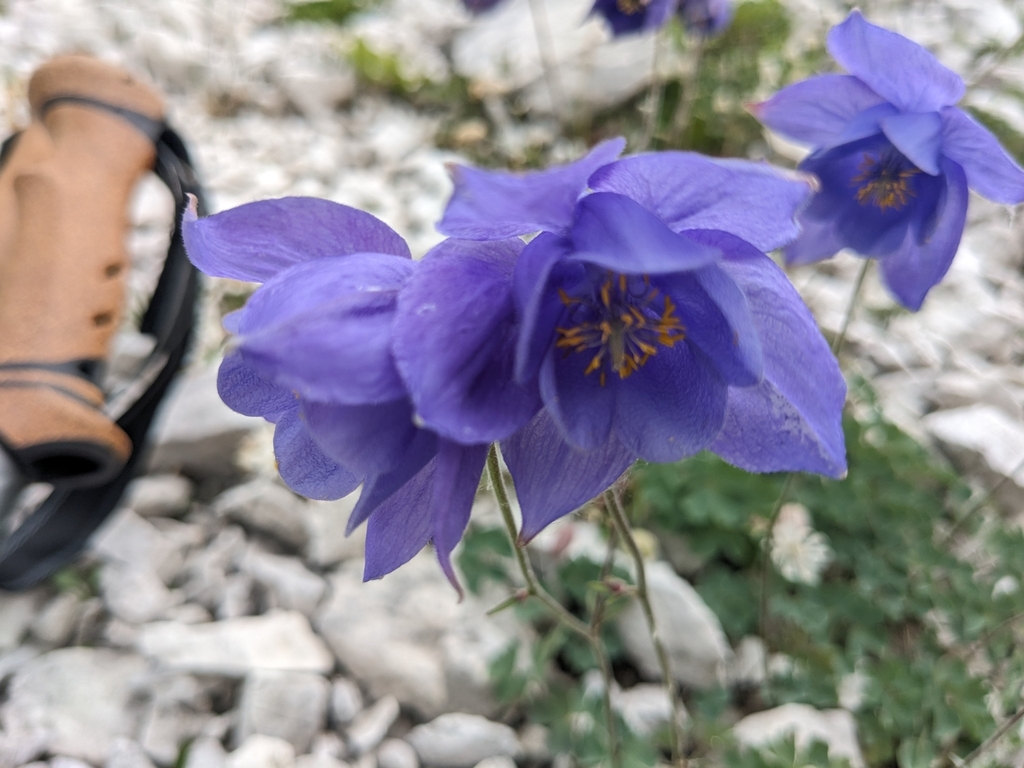
Aquilegia iulia
Aquilegia iulia, known as the Julian columbine, is a perennial flowering plant in the family Ranunculaceae, endemic to Slovenia.
From the article Aquilegia iulia on Wikipedia (CC BY-SA), quoted section by section
Description
Aquilegia iulia is a perennial herbaceous plant with smooth or sparsely hairy and leafy stems. The leaves are smooth, long-stalked, and ternate or biternate. The flowers are either solitary or form bract-like inflorescences, and are large (up to 66 mm (2.6 in) across) and blue-violet. The sepals are egg-shaped or pointed oval-shaped, up to 33 mm (1.3 in) long and 18 mm (0.7 in) wide, and downy on the undersides and edges. The petals of the primary flowers are the same size as the sepals, while the nectar spurs are shorter and straight or slightly curved. The stamens do not protrude beyond the petals, and form a spread-out shape. The anthers are yellow and the follicles are small.
Range & habitat
Aquilegia iulia is endemic to the Julian Alps in northwestern Slovenia, growing on a wide ridge east of the mountain Krn and on the Trnovo Forest Plateau. It grows on calcareous rocky slopes and rock crevices at altitudes of 400–1,350 m (1,310–4,430 ft). It is also found in black pine and Scots pine forests, larch forests, beech forests, alpine meadows, and occasionally in gravel river beds of the Trebušica and Belca rivers.
Wikipedia: “Distribution and habitat”
What it does
Aquilegia iulia is a diagnostic species for the following plant communities:
Thlaspietea rotundifolii, along with the limestone fern Gymnocarpium robertianum, Adenostyles glabra, and hawkweed Hieracium bifidum Primulo carniolicae-Potentilletum clusianae, along with the cinquefoil Potentilla clusiana, Carniolan primrose Primula carniolica, Carex firma sedge, earleaf bellflower Campanula cochleariifolia, Rhodothamnus chamaecistus, Hladnikia pastinacifolia, and hawkweed Hieracium pillosum It is also found in the Amelanchiero ovalis-Pinetum mugo dwarf mountain pine scrub plant community, where it grows in association with round-leaved wintergreen Pyrola rotundifolia, bitter willow Salix eleagnos, carniolan masterwort Astrantia carniolica, Trisetum argenteum oatgrass, Zois' bellflower Campanula zoysii and the lady's-slipper orchid Cypripedium calceolus. Hybrid specimens transitional between A. iulia and A. einseleana have been observed in gravel river beds, an occasional habitat of both species.
Wikipedia: “Ecology”
In human culture
The type specimen, identified at the time as A. kitaibelii, was collected in August 1920 in the Julian Alps by the Austrian-Italian botanist Carlo de Marchesetti. It was described as a separate species in its own right by the Italian botanist Enio Nardi in 2011.
Wikipedia: “Taxonomic history”
Where it lives
Recorded sightings
—
geo-referenced records in GBIF, from museums, herbaria and field observers.
Drag the globe to turn it. Dots are where records exist, not a range map; darker means more records.
In the stacks
Searching the stacks…
Every page naming Aquilegia iulia in the Biodiversity Heritage Library →
This page is assembled live from iNaturalist, GBIF, Wikipedia, the Source Library and the Internet Archive. It is not yet part of the hand-edited codex. iNaturalist taxon 705700.