- Plants
- ›Vascular Plants
- ›flowering plants
- ›monocots
- ›lilies, supplejacks, and allies
- ›Peruvian Lily family
- ›Luzuriaga
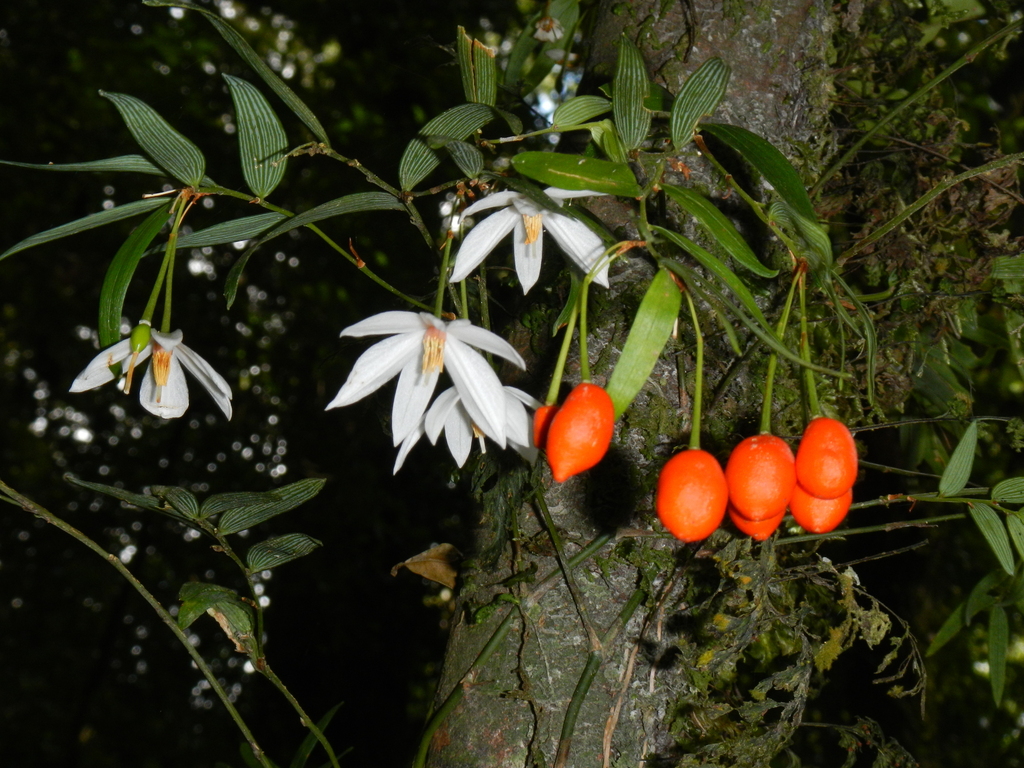
Luzuriaga radicans
Luzuriaga radicans (common name quilineja) is a species of flowering plant in the genus Luzuriaga of the family Alstroemeriaceae (Inca-lilies), part of the monocot order Liliales. It is native to Chile and Argentina.
From the article Luzuriaga radicans on Wikipedia (CC BY-SA), quoted section by section
Description
Luzuriaga radicans is an evergreen climbing plant, whose fine roots adhere to the trunks of trees. The leaves are alternate, distal and with an entire border, oblong-lanceolate in shape, the acute tip ending abruptly. They are light green in color, and from 1–4 cm in length and 0.3–1 cm wide, with 9–13 white lines on the undersurface. The flowers are hermaphroditic, 1 cm in length and either single or forming an inflorescence with 2–4 flowers. The six white tepals are uneven in size. There are six stamens, and the style, which is longer than the stamens, ends in a tri-lobed stigma. The fruit is a smooth, globose berry, red-orange in color and 0.8–1 cm in diameter, with up to twelve flattened seeds about 4 mm in length.
Range & habitat
Luzuriaga radicans is native to South Central to South Chile and South Argentina. In Chile, it grows from Colchagua to Aisén provinces (regions VI–XI), where it prefers a shady humid environment with constant rainfall under dense vegetation cover. In coastal areas it grows up to 500 m, while in coastal mountain areas its range is 500–2000 m. It also occurs at low altitudes in interior valleys.
Wikipedia: “Distribution and habitat”
What it does
The plant thrives in humid environments and can grow either in water or with its roots in water, including marshes, bogs, and the shores of lakes and rivers.
Wikipedia: “Ecology”
At the table
The plant is valued as an ornamental, while the stems are used in the manufacture of household utensils and handicrafts, including basketry and brooms. Historically it was also used for fences and ropes, but now it is mainly used for artisanal crafts. The fruit is edible and eaten raw, and was a traditional food, but has fallen out of use.
Wikipedia: “Uses”
How it is grown
Cultivation is difficult. After the vine has been removed from the tree, it takes about 5 years to regrow.
Wikipedia: “Cultivation”
In human culture
The epithet radicans (Latin: with rooting stems), refers to the characteristic climbing roots.
Wikipedia: “Etymology”
Where it lives
Recorded sightings
—
geo-referenced records in GBIF, from museums, herbaria and field observers.
Drag the globe to turn it. Dots are where records exist, not a range map; darker means more records.
In the stacks
Searching the stacks…
Every page naming Luzuriaga radicans in the Biodiversity Heritage Library →
This page is assembled live from iNaturalist, GBIF, Wikipedia, the Source Library and the Internet Archive. It is not yet part of the hand-edited codex. iNaturalist taxon 705981.