- Plants
- ›Vascular Plants
- ›flowering plants
- ›Dicots
- ›Soapberries, Cashews, Mahoganies, and Allies
- ›Quassia Family
- ›Picrasma
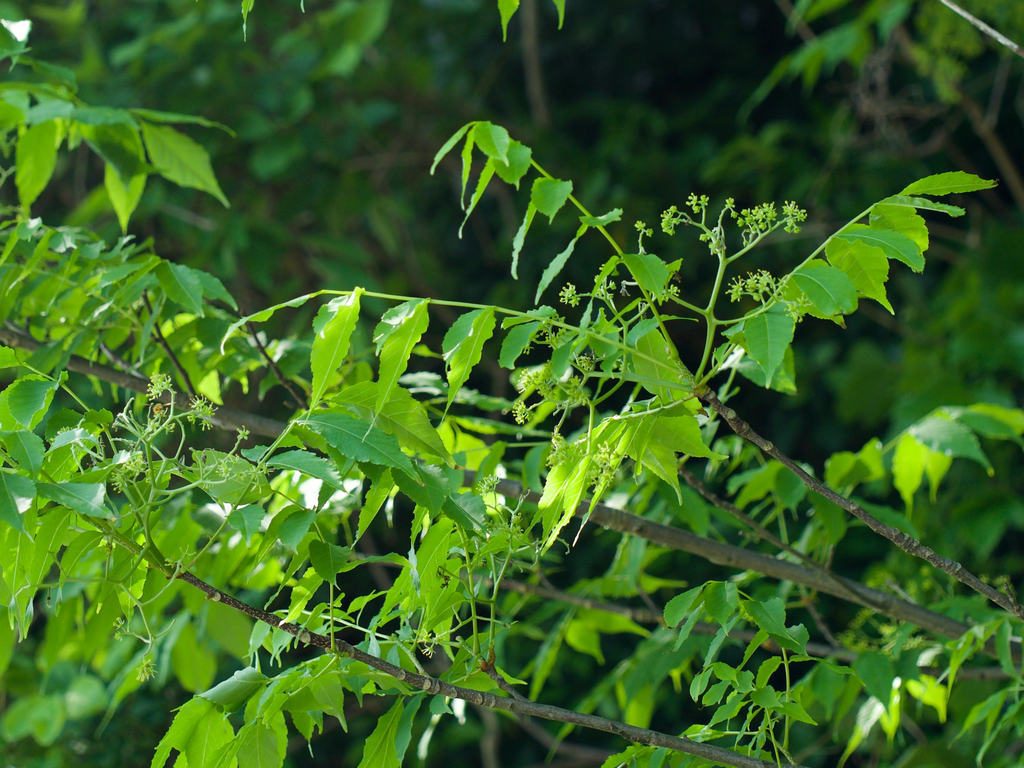
Picrasma quassioides
Picrasma quassioides (picrasma; Chinese: 苦樹 ku shu, Japanese: ニガキ nigaki "bitterwood"; also India quassia, quassia wood, shurni, quassia-wood, or quassiawood; syn. P. ailanthioides) is a species of Picrasma native to temperate regions of southern Asia, from the northeast of Pakistan east along the Himalaya and through East Asia from southern, central and eastern China to Taiwan, Japan and Korea.
It is a deciduous shrub or small tree growing to 10–15 m (rarely 20 m) tall with a trunk up to 50 cm diameter. The bark is smooth and dark grey-brown. The leaves are 15–40 cm long, pinnate, with 7–15 leaflets 2.5–10 cm long and 1.5–4.5 cm broad, with a coarsely and irregularly toothed margin. The flowers are green to yellow-green with four or five sepals and petals, produced in cymes 8–15 cm long in mid to late spring. The fruit is an ovoid to globose, red to black drupe 6–7 mm diameter.
From the article Picrasma quassioides on Wikipedia (CC BY-SA), quoted section by section
At the table
The bark is used in herbal medicine as a bitter flavouring and antibacterial agent. Extracts from the wood are also used as a natural insecticide in organic farming. It is occasionally grown as an ornamental tree in Europe and North America, valued for its bright orange to red autumn colour.
== References ==
Wikipedia: “Cultivation and uses”
Where it lives
Recorded sightings
—
geo-referenced records in GBIF, from museums, herbaria and field observers.
Drag the globe to turn it. Dots are where records exist, not a range map; darker means more records.
In the stacks
Searching the stacks…
Every page naming Picrasma quassioides in the Biodiversity Heritage Library →
This page is assembled live from iNaturalist, GBIF, Wikipedia, the Source Library and the Internet Archive. It is not yet part of the hand-edited codex. iNaturalist taxon 707271.