- Plants
- ›Vascular Plants
- ›flowering plants
- ›monocots
- ›screwpines, stemona, and allies
- ›screwpine family
- ›Benstonea
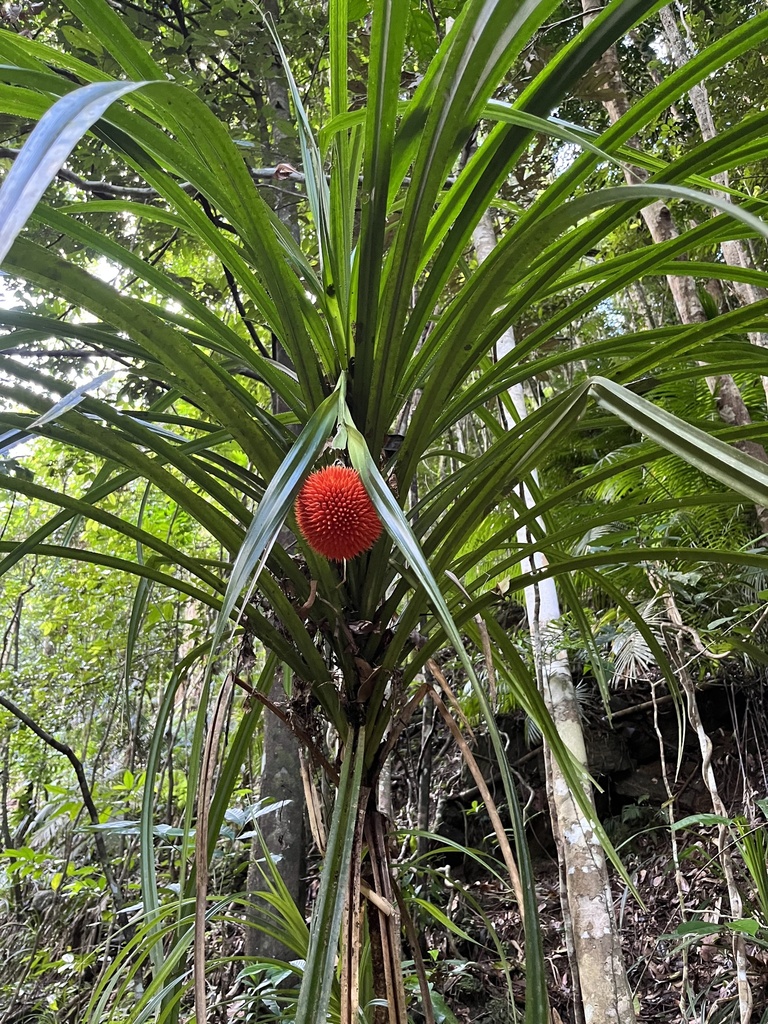
Scrub Breadfruit
Benstonea monticola
Benstonea monticola, commonly known as scrub breadfruit or urchin-fruited pandan, is a plant in the family Pandanaceae which is endemic to rainforested parts of north east Queensland, Australia.
From the article Benstonea monticola on Wikipedia (CC BY-SA), quoted section by section
Description
The scrub breadfruit is an evergreen shrub or small tree usually growing to between 3 and 6 m (9.8 and 19.7 ft) high, and rarely to 10 m (33 ft). It produces multiple stems which are weak and become decumbent with age, i.e. they lean to one side and eventually lie on the ground with just the growing tip erect. The stems measure around 5 cm (2.0 in) in diameter, and prop roots (found in many species of Pandanaceae) are absent. The leaves are tightly clustered on the growing tip of the stem and are arranged spirally. They are very long and narrow, measuring up to 2.5 m (8 ft 2 in) long by 5 cm (2.0 in) wide, and are ascendant to arching. They are dark green above and a lighter green below, and are pleated such that they have an M-shaped cross-section. Small spines are present on the leaf margins (edges) and the underside of the midrib. This species is dioecious, meaning that functionally female and functionally male flowers are borne on separate plants. The inflorescence is a terminal spike, enclosed by large creamy-white bracts. The fruit is a multiple fruit, in other words it is a single body consisting of the merged maturing ovaries of a cluster of flowers (cf. aggregate fruit). …
Range & habitat
The scrub breadfruit naturally occurs from the area of Cedar Bay (now part of Ngalba Bulal National Park), southward along the coast as far as Hinchinbrook Island, and inland to the Atherton Tablelands. It favours rainforest habitats and is found from sea level to around 800 m (2,600 ft).
Wikipedia: “Distribution and habitat”
What it does
Benstonea monticola, along with Pandanus tectorius and Pandanus solms-laubachii, is a host plant for the peppermint stick insect (Megacrania batesii), which shelters in the central hollow of the leaves and feeds on them. The fruits are eaten by cassowaries (Casuarius casuarius) and giant white-tailed rats (Uromys caudimaculatus).
Wikipedia: “Ecology”
In human culture
The species epithet monticola is derived from the Latin words mons (mountain) and -cola (inhabitor), meaning "mountain dweller". The common name "scrub breadfruit" is a reference to the superficial similarity of the fruit to the more well-known breadfruit.
Wikipedia: “Etymology”
Where it lives
Recorded sightings
—
geo-referenced records in GBIF, from museums, herbaria and field observers.
Drag the globe to turn it. Dots are where records exist, not a range map; darker means more records.
In the stacks
Searching the stacks…
Every page naming Benstonea monticola in the Biodiversity Heritage Library →
This page is assembled live from iNaturalist, GBIF, Wikipedia, the Source Library and the Internet Archive. It is not yet part of the hand-edited codex. iNaturalist taxon 709398.