- Plants
- ›Vascular Plants
- ›flowering plants
- ›Dicots
- ›saxifrages, stonecrops, and allies
- ›stonecrop family
- ›Sempervivoideae
- ›Semperviveae
- ›Petrosedum
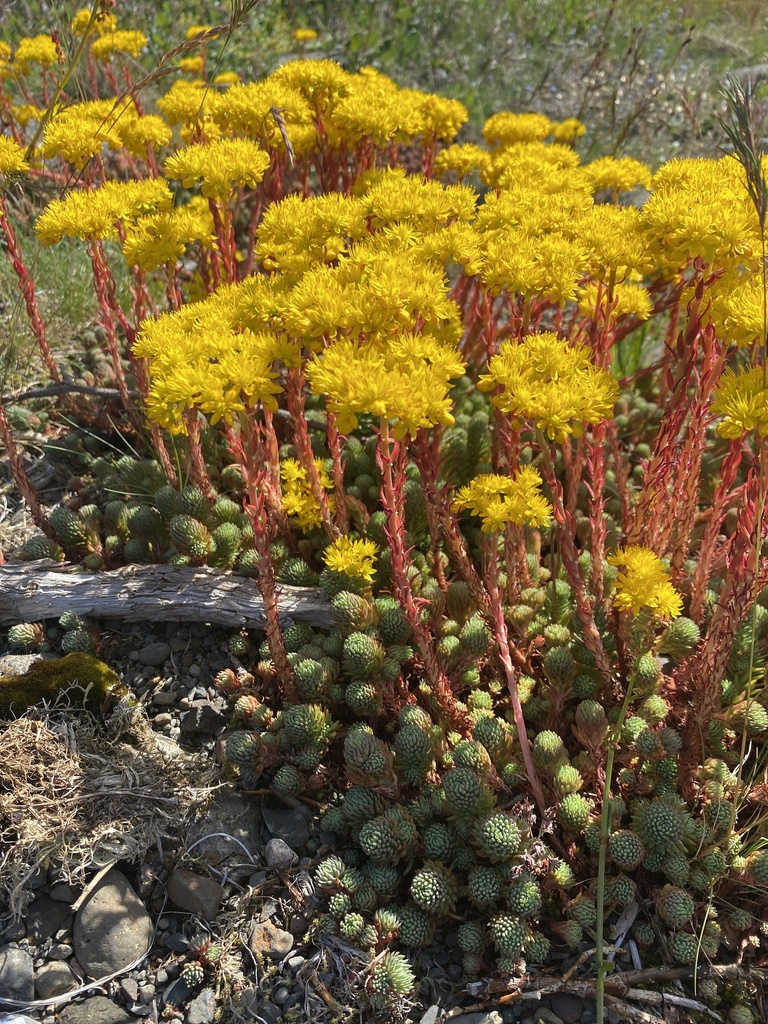
Rock Stonecrop
Petrosedum forsterianum
Petrosedum forsterianum, the rock stonecrop or Welsh stonecrop, is a species of flowering plant in the family Crassulaceae. It is a mat-forming, evergreen stonecrop native to northwestern and southwestern Europe and northern Africa. It may be grown as an ornamental plant or consumed.
From the article Petrosedum forsterianum on Wikipedia (CC BY-SA), quoted section by section
Description
Petrosedum forsterianum has two types of shoots: creeping, non-flowering ones that take root as they spread, and upright, flowering stems. The non-flowering shoots have tightly packed, scale-like leaves clustered at their tips, giving them a cone-like appearance. These leaves are linear in shape, slightly rounded or somewhat flattened, with a small spur at the base. They are typically green or bluish-green, measuring 10–15 mm, and remain on the plant even after dying, turning brown over time. The British population is distinguished by a compact and slow-growing rather than creeping habit, whereas the North African plants have distinctly bluish-purple foliage. The species is evergreen.
When in bloom, the flowering stems of Petrosedum forsterianum stand upright, reaching 10–40 cm (4–16 in). The flowers are arranged in branching clusters (corymbs), with each branch curving downward while in bud before straightening as they open. The flowers usually have five to seven, sometimes up to nine, bright yellow petals that spread outward. The sepals, small leaf-like structures at the flower's base, are triangular with a pointed tip and grow up to 3 mm long. The stamens, which produce pollen, are also yellow. The peak of the flowering season is in early summer. …
Range & habitat
The natural range of Petrosedum forsterianum includes England, Wales, Ireland, France, Germany, Spain, and Portugal (including the Azores), as well as Morocco. It thrives in rocky habitats, forming dense, low-growing mats. It is often found in the shaded edges of glades. It is common in the shade of shrubs, which initially serve as nurse plants and then provide partial shade for mature specimens.
Wikipedia: “Distribution”
Where it lives
Recorded sightings
—
geo-referenced records in GBIF, from museums, herbaria and field observers.
Drag the globe to turn it. Dots are where records exist, not a range map; darker means more records.
In the stacks
Searching the stacks…
Every page naming Petrosedum forsterianum in the Biodiversity Heritage Library →
This page is assembled live from iNaturalist, GBIF, Wikipedia, the Source Library and the Internet Archive. It is not yet part of the hand-edited codex. iNaturalist taxon 710296.