- Plants
- ›Vascular Plants
- ›flowering plants
- ›Dicots
- ›canellas, winter's-bark, and allies
- ›winter's-bark family
- ›Pseudowintera
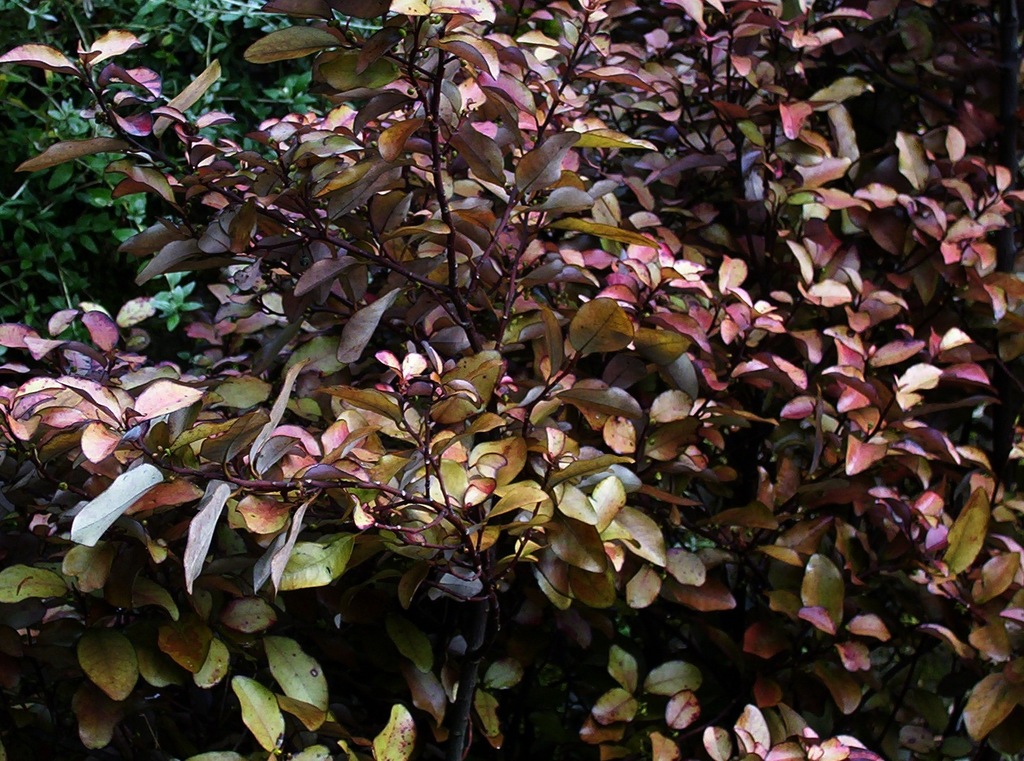
Mountain Horopito
Pseudowintera colorata
Pseudowintera colorata, also known as mountain horopito or pepperwood, is a species of woody evergreen flowering trees and shrubs, part of family Winteraceae. The species is endemic to New Zealand. All Winteraceae are magnoliids, associated with the humid Antarctic flora of the Southern Hemisphere.
From the article Pseudowintera colorata on Wikipedia (CC BY-SA), quoted section by section
Description
Pseudowintera colorata, or mountain horopito, is an evergreen shrub or small tree (1–2.5 m) commonly called pepperwood because its leaves have a hot taste. It is also known as the New Zealand pepper tree, winter's bark, or red horopito. It is so named because early taxonomists recognized the similarity between horopito and the South American Drimys winteri that provided the herbal remedy "winter's bark." They are both members of the family Winteraceae, which are mainly found on the landmasses that once made up the great southern continent of Gondwana – South America, Australia, New Zealand and New Guinea. Its yellowish-green leaves are blotched with red, with new leaves in the spring being bright red. It is distributed within lowland forests up to higher montane forests from 36° 30' South as far southward as Stewart Island / Rakiura, and as far north as the Waitakere Ranges. A characteristic plant association for P. colorata is within the Westland podocarp forests, where alliant understory plants such as Rumohra adiantiformis, Ascarina lucida, Neopanax colensoi, Raukaua edgerleyi, and Blechnum discolor are found. The reproductive parts of the family Winteraceae are primitive, reflecting their origin among the first flowering plants. It is unusual in that its flowers come directly off the older stems rather than from among the leaves. …
At the table
Pseudowintera colorata is grown as a spice, as an ornamental, and as a traditional medicinal plant.
Traditional medicine. Horopito has long been used by the indigenous Māori population of New Zealand both internally and externally for many purposes. As far back as 1848, Horopito is documented in the treatment of skin diseases such as ringworm, or venereal diseases. "The leaves and tender branches of this shrub are bruised and steeped in water, and the lotion used for ringworm; or the bruised leaves are used as a poultice for chafing of the skin, or to heal wounds, bruises or cuts". Infection due to Candida albicans (Māori – Haha, Haka) is documented as once being a major cause of death of Māori babies, due to their being fed an "unsatisfactory diet." The juice of Horopito leaves was placed straight in the mouth, or leaves of Horopito were steeped in water to extract the juice and this decoction was to treat what we now understand as candidiasis (oral thrush). Early European settlers to New Zealand also used horopito for medicinal purposes. For internal use, leaves were either chewed or prepared as tea. …
Wikipedia: “Uses”
Where it lives
Recorded sightings
—
geo-referenced records in GBIF, from museums, herbaria and field observers.
Drag the globe to turn it. Dots are where records exist, not a range map; darker means more records.
In the stacks
Searching the stacks…
Every page naming Pseudowintera colorata in the Biodiversity Heritage Library →
This page is assembled live from iNaturalist, GBIF, Wikipedia, the Source Library and the Internet Archive. It is not yet part of the hand-edited codex. iNaturalist taxon 71054.