- Animals
- ›Arthropods
- ›Crustaceans
- ›Typical Crustaceans
- ›Malacostracans
- ›Decapods, Isopods, and allies
- ›Decapods and Krill
- ›Decapods
- ›Crabs, Lobsters, Shrimps, and Allies
- ›Crayfishes and Lobsters
- ›Northern Hemisphere Crayfishes
- ›Astacid Crayfishes
- ›Pacifastacus
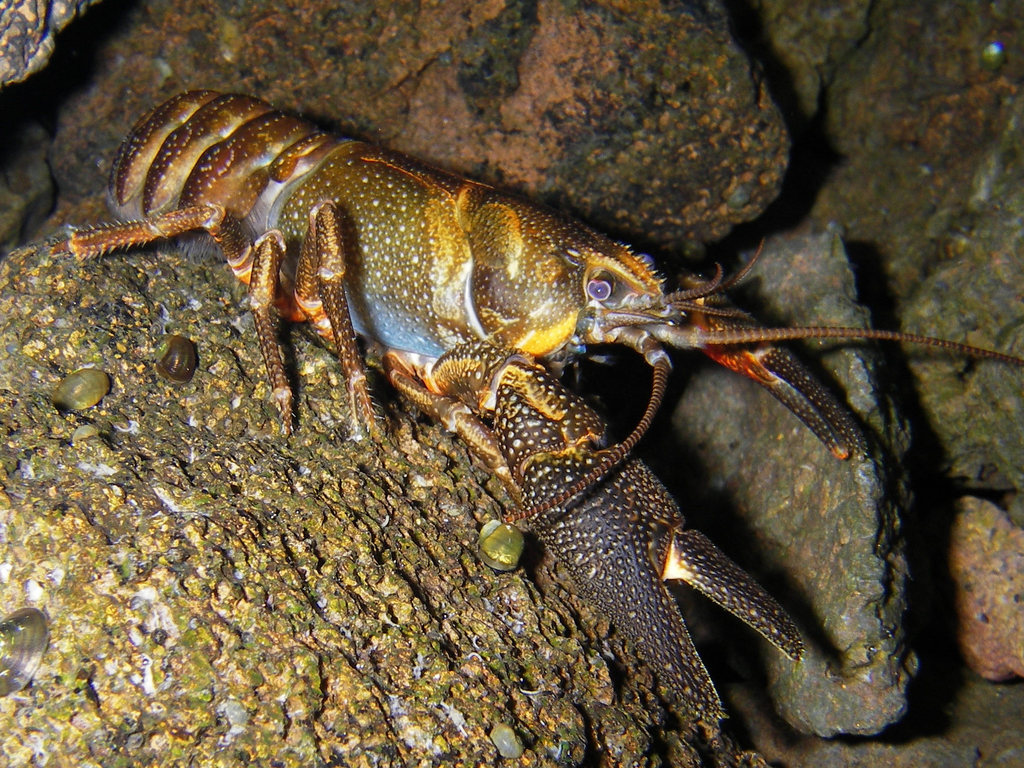
Shasta Crayfish
Pacifastacus fortis
Pacifastacus fortis (known as the Shasta crayfish or placid crayfish) is an endangered crayfish species endemic to Shasta County, California, where it is found and first described in 1914, only in isolated spots along the Pit River and Fall River Mills. It is estimated that there are a total of roughly 4000 of the species still alive today. The exact subpopulations for the Shasta crayfish were discovered in 2004 through a genetic study that determined three different genetic clusters: Crystal Lake, the Big Lake group (which includes Big Lake Springs, JeShe, Lava, and Spring Creeks), and Thousand Springs.
From the article Pacifastacus fortis on Wikipedia (CC BY-SA), quoted section by section
Description
P. fortis is thick and stocky, with relatively heavy chelae. It is usually dark brown dorsally with bright orange areas on its underside. These colors aid in camouflage in its habitat. It grows about 2-4 inches long. It lives in cold, clear, rocky areas of the mountain rivers, and feeds on microbes, algae, and small animals like snails. The animal requires a constant, steady, and untainted flow of fresh water to survive. P. fortis have 5 pairs of legs. With regards to life span, P. fortis tends to endure a life span of between 10 and 15 years on average. Females meet their reproductive maturity at the age of five, and after which reproduce once per year. In October, females typically produce anywhere from 10 to 70 eggs per year, with the older more mature females producing the most eggs and the younger females producing at the lower end. By May, most eggs will have hatched and the babies stay attached to their mother for a short duration before separating and becoming a free-willed organism. P. fortis is nocturnal and remain idle behind cover for the majority of the day. They begin to leave their cover only when it is night and light is scarce. …
Wikipedia: “Description and ecology”
At the table
Pacifastacus fortis is listed as a critically endangered species on the IUCN Red List, and an endangered species under the Endangered Species Act. Numerous factors play a role in the endangerment of P. fortis. Within California, some minor factors include but are not limited to illness and invasive predators. However, human intervention affects the species at a much greater proportion. Urbanization, pollution, and other forms of intervention often affect the surroundings of P. fortis, ultimately resulting in significant habitat loss and consequently, a significant decrease in population. It has always had a very small native range, and that range has been significantly fragmented by such human activities as damming, mining, and agriculture. The Pit River Fish Hatchery was closed to protect this species. Other nonnative invasive crayfish species such as Pacifastacus leniusculus and Orconectes virilis, as well as water impoundment and diversion have contributed to the continuing decline of P. fortis. Chemicals from agriculture have also washed into streams, and groundwater has been pumped to the point of lowering the water table, further decreasing the numbers of P. fortis over the last three decades. …
Wikipedia: “Causes of endangerment”
Where it lives
Recorded sightings
—
geo-referenced records in GBIF, from museums, herbaria and field observers.
Drag the globe to turn it. Dots are where records exist, not a range map; darker means more records.
In the stacks
Searching the stacks…
Every page naming Pacifastacus fortis in the Biodiversity Heritage Library →
This page is assembled live from iNaturalist, GBIF, Wikipedia, the Source Library and the Internet Archive. It is not yet part of the hand-edited codex. iNaturalist taxon 71071.