- Plants
- ›Vascular Plants
- ›flowering plants
- ›Dicots
- ›Sunflowers, Bellflowers, Fanflowers, and Allies
- ›Sunflowers, Daisies, Asters, and Allies
- ›chicories, dandelions, and allies
- ›Lettuce, Chicory, Dandelion and Salsify Tribe
- ›hawkweeds
- ›Pilosella
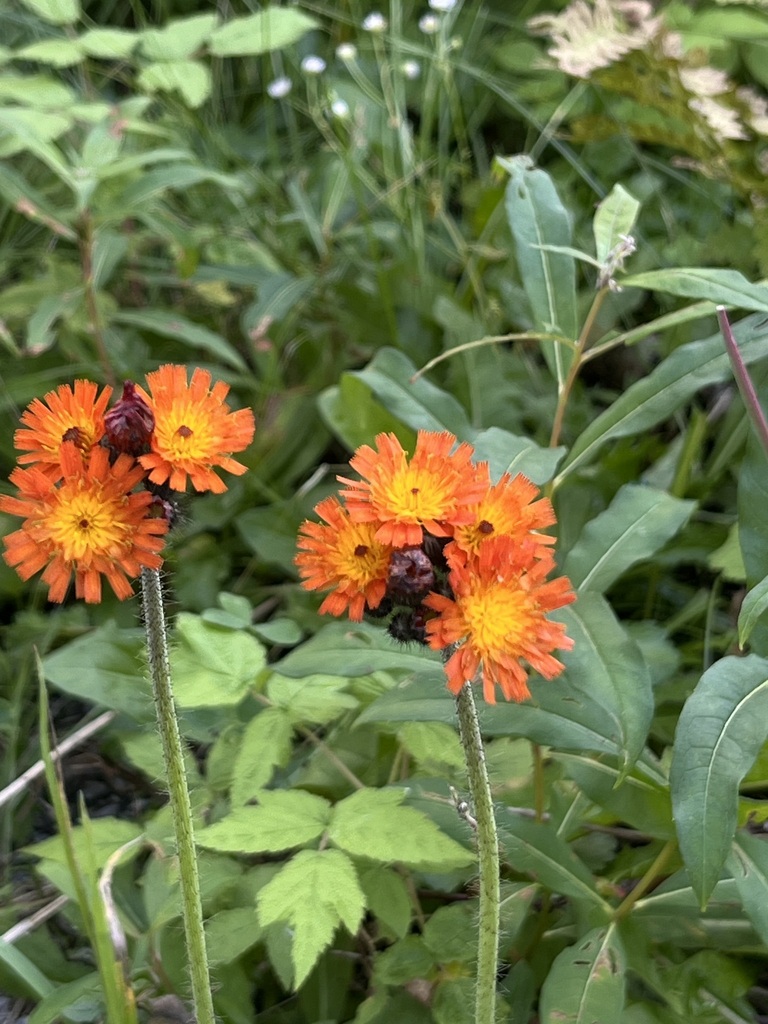
orange hawkweed
Pilosella aurantiaca
Pilosella aurantiaca (fox-and-cubs, orange hawkweed, devil's paintbrush, and historically grim-the-collier) is a perennial flowering plant in the family Asteraceae. It is native to mountainous regions of Europe and has been widely introduced elsewhere, where it is invasive in parts of North America, New Zealand, and Australia.
From the article Pilosella aurantiaca on Wikipedia (CC BY-SA), quoted section by section
Description
It is a low-growing plant with shallow fibrous roots and a basal rosette of elliptical to lanceolate leaves 5–20 centimetres (2.0–7.9 in) long and 1–3 centimetres (0.39–1.18 in) broad. All parts of the plant exude a milky juice. The flowering stem is usually leafless or with just one or two small leaves. The stem and leaves are covered with short stiff hairs (trichomes), usually blackish in color. The stems may reach a height of 60 centimetres (24 in) and have 2–25 capitula (flowerheads), each 1–2+1⁄2 cm diameter, bundled together at the end of short pedicels. The flowers are orange, almost red, which is virtually invisible to bees, yet they also reflect ultraviolet light, increasing their conspicuousness to pollinators. The flowers are visited by various insects, including many species of bees, butterflies, pollinating flies. The flowers themselves come in a range of colors from a deep rust-orange to a pure yellow and often show striking gradients of color. …
Range & habitat
Pilosella aurantiaca is native to parts of Europe (central, eastern, northern, southeastern and southwestern). It is widely naturalized elsewhere, including other parts of Europe such as Great Britain and Ireland, Central Asia, Canada, many states in the United States, Japan and New South Wales.
Wikipedia: “Distribution”
In medicine
Fox and cubs has a long history of use in the folk medicine of Europe, in which it has been used in preparations believed to benefit a variety of diseases, including respiratory infections, digestive problems, and skin conditions. The leaves have also been used to prepare a tisane believed to have tranquilising and sleep-inducing properties. Herbal teas prepared from the leaves and flowers are credited with having diuretic, anti-inflammatory, and antioxidant properties. The plant itself is believed to have some value in the treatment of cancer and has also been employed as a natural remedy for the control of blood sugar levels and the treatment of high blood pressure.
Wikipedia: “Use in folk medicine”
How it is grown
P. aurantiaca is widely grown as an ornamental plant in gardens for its very decorative flowers. It is often used in wildflower gardens because its bright orange flowers are highly attractive to a wide array of pollinators.
Wikipedia: “Use in horticulture”
In human culture
Although not native to the British Isles, P. aurantiaca was introduced there at least as early as sixteenth century, as is evidenced by the English common name grim-the-collier, which is that of a folkloric figure of uncertain origin who features in a once-familiar proverb and subsequently in no fewer than three early modern English plays. In one of these he is actually named in the title: "Grim the Collier of Croydon; or, The Devil and his Dame: with the Devil and Saint Dunston". The name Grim was originally a by-name of the Germanic deity Odin/Woden, which came later to be associated, in mediaeval mystery plays with sooty devils blackened by the fires of hell. The term collier can designate not only a coal miner or coal merchant but also a charcoal-burner or charcoal merchant and the town of Croydon in Surrey was formerly noted for the number of its charcoal-burners. The reason for the application of the name of this folk villain to Pilosella aurantiaca is that it has a sooty appearance due the distinctive black hairs in which the flower heads are covered. The proverb linking colliers to the Devil and his fiery abode runs thus: 'like will to like, quoth the devil to the collier' i.e. the Devil and the collier are natural companions thanks to their shared black and sooty appearance. …
Wikipedia: “In myth and folklore”
Where it lives
Recorded sightings
—
geo-referenced records in GBIF, from museums, herbaria and field observers.
Drag the globe to turn it. Dots are where records exist, not a range map; darker means more records.
In the stacks
Searching the stacks…
Every page naming Pilosella aurantiaca in the Biodiversity Heritage Library →
This page is assembled live from iNaturalist, GBIF, Wikipedia, the Source Library and the Internet Archive. It is not yet part of the hand-edited codex. iNaturalist taxon 711103.