- Plants
- ›Vascular Plants
- ›flowering plants
- ›Dicots
- ›Heathers, Balsams, Primroses, and Allies
- ›heath family
- ›madrones, bearberries, and allies
- ›Arctostaphylos
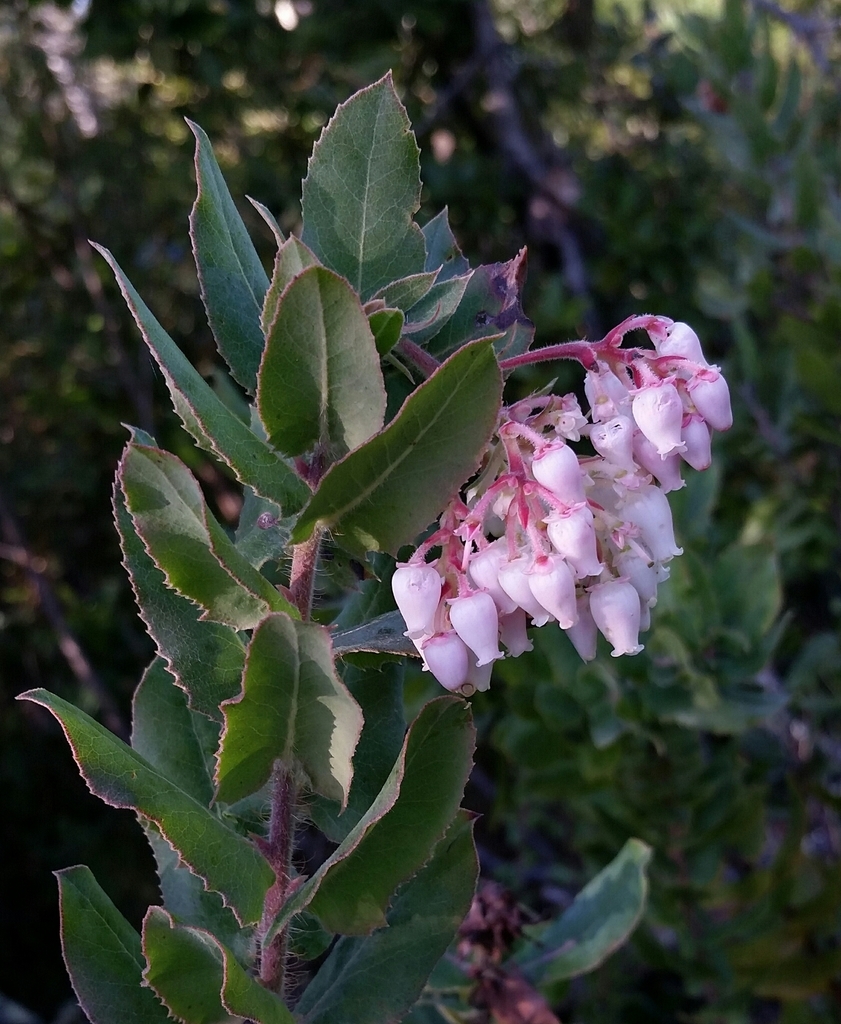
Santa Cruz Manzanita
Arctostaphylos andersonii
Arctostaphylos andersonii, the Santa Cruz manzanita, is a species of Arctostaphylos, limited in geography to the Santa Cruz Mountains of California. It grows in openings in redwood forests, usually below 700 meters (2300 feet) elevation.
From the article Arctostaphylos andersonii on Wikipedia (CC BY-SA), quoted section by section
Description
Arctostaphylos andersonii is a woody shrub 2–5 m high, which can resemble a small tree. The 4–7 cm smooth leaf blades have serrated edges and deeply lobed bases. It flowers February through May. The fruit is small (2–8 mm) and sticky. The Santa Cruz manzanita has no basal burl for regrowth and must propagate by seed. Some populations closer to the Bonny Doon region are highly glaucous (the leaves produce a white, powdery substance on the surface) whereas others are not. The chromosome count is 2n=26. This species is often confused with A. regismontana, A. pallida, and A. pajaroensis, but can be easily identified by geography.
Range & habitat
This species is limited in geography to the Santa Cruz Mountains of California. It grows in openings in redwood forests, usually below 700 meters (2300 feet) elevation. It was named after Charles Lewis Anderson by Asa Gray.
Wikipedia: “Distribution”
Where it lives
Recorded sightings
—
geo-referenced records in GBIF, from museums, herbaria and field observers.
Drag the globe to turn it. Dots are where records exist, not a range map; darker means more records.
In the stacks
Searching the stacks…
Every page naming Arctostaphylos andersonii in the Biodiversity Heritage Library →
This page is assembled live from iNaturalist, GBIF, Wikipedia, the Source Library and the Internet Archive. It is not yet part of the hand-edited codex. iNaturalist taxon 71123.