- Animals
- ›Arthropods
- ›Hexapods
- ›Insects
- ›Winged and Once-winged Insects
- ›Flies
- ›Nematoceran Flies
- ›Gnats and Allies
- ›Fungus Gnats and Gall Midges
- ›Gall and Forest Midges
- ›Gall Midges
- ›Lasiopteridi
- ›Dasineurini
- ›Iteomyia
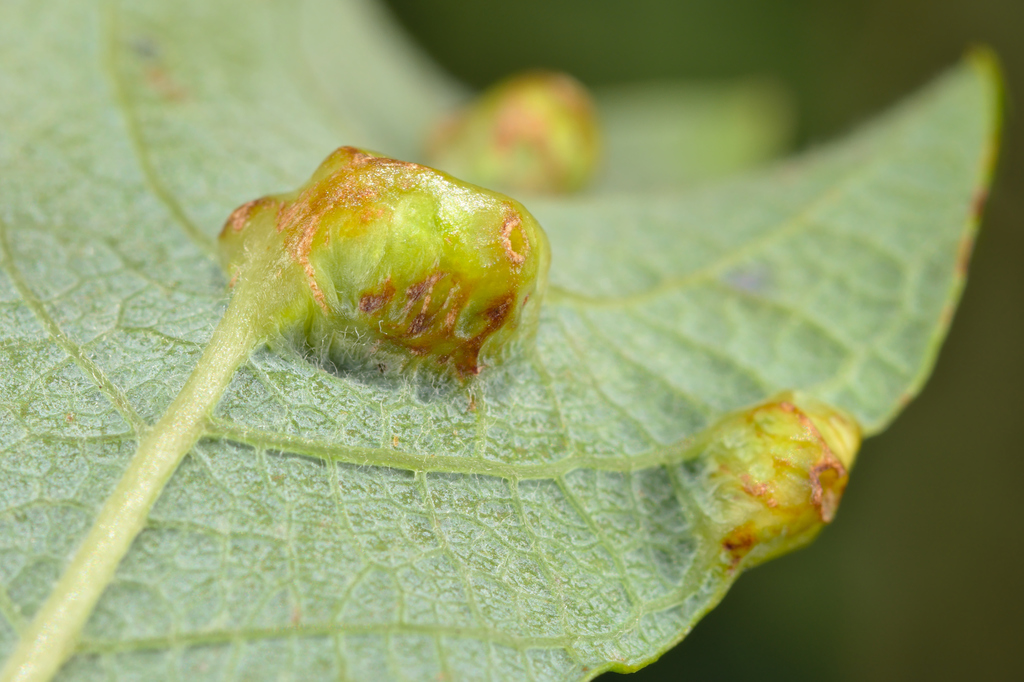
Iteomyia major
Iteomyia major is a gall midge which forms galls on willows (Salix species). It was first described by Jean-Jacques Kieffer in 1889.
From the article Iteomyia major on Wikipedia (CC BY-SA), quoted section by section
Description
The gall is a coalesced group of 2–10 hard round galls, on the midrib or side vein and are equally prominent on either side of the leaf. Each gall has a single larva, initially white and later orange or red. There is a single generation each year and pupation takes place in the soil. Females prefer to lay their eggs on the ″broad-leaf willows″ and the galls are found on sallows, or their hybrids, which include bay willow (S. pentandra), bitter willow (S. elaeagnos), dark-leaved willow (S. myrsinifolia), eared willow (S. aurita), goat willow (S. caprea), gray willow (S. glauca), grey willow (S. cinerea), purple willow (S. purpurea), tea-leaved willow (S. phylicifolia) and woolly willow (S. lanata).
Similar species. Iteomyia capreae galls are small, hard, green pouches, up to 4 mm in diameter and, as they mature, have a reddish or purplish tinge. They are not as prominent on the lower leaf surface, having red-rimmed conical pores.
Wikipedia: “Description of the gall”
Listen
Looking for field recordings…
Where it lives
Recorded sightings
—
geo-referenced records in GBIF, from museums, herbaria and field observers.
Drag the globe to turn it. Dots are where records exist, not a range map; darker means more records.
In the stacks
Searching the stacks…
Every page naming Iteomyia major in the Biodiversity Heritage Library →
This page is assembled live from iNaturalist, GBIF, Wikipedia, the Source Library and the Internet Archive. It is not yet part of the hand-edited codex. iNaturalist taxon 716989.