- Animals
- ›Chordates
- ›Vertebrates
- ›Birds
- ›Cranes, Rails, and Allies
- ›Rails, Gallinules, and Coots
- ›Amaurornis
On eBird ↗
Pale-vented Bush-hen
Live sightings near you, the range map, bar charts of when it is seen, and Macaulay Library photos and recordings.
Pale-vented Bush-hen
Amaurornis moluccana
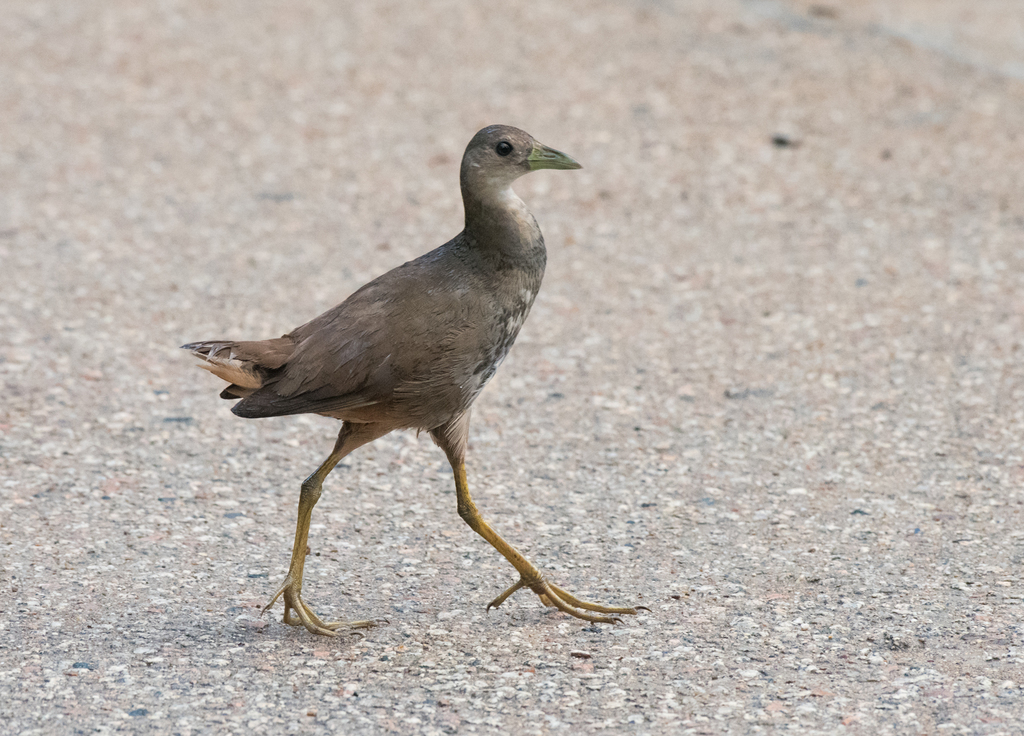
The pale-vented bush-hen or rufous-tailed bush-hen (Amaurornis moluccana) is a medium sized waterbird, mainly blue-grey with a buff vent and undertail. It is found in Australia, the Moluccan Islands, New Guinea, the Bismarck Archipelago and the Solomon Islands. Its natural habitat is subtropical or tropical moist lowland forests.
From the article Pale-vented bush-hen on Wikipedia (CC BY-SA), quoted section by section
Description
The pale-vented bush-hen is medium sized with a body length between 25 and 30 cm (9.8 and 11.8 in), wing length of 140 to 155 mm (5.5 to 6.1 in), bill length of 28 to 33 mm (1.1 to 1.3 in) and weighing between 150 and 210 grams (5.3 and 7.4 oz). It has a dull gray-blue body, brown wings and tail. Its eponymous pale coloured vent and undertail are variously described as buff-ruffous, rufous-brown, buff or reddish-brown. The bill is distinctive being lime green with an orange red frontal shield when breeding and duller green with no red when not breeding. The legs are olive-yellow and the eye dark. There is no apparent difference between sexes. Juveniles are paler in colour.
What it does
The pale-vented bush-hen is a shy and secretive bird best seen at dawn, dusk or when overcast. It is found in low, dense vegetation on the edge of water courses or wetlands. The bird is best detected by its loud, distinctive calls which include clucks and clicks, shrieks or wails. The bird is found in Australia, the Moluccan Islands, New Guinea, the Bismarck Archipelago and the Solomon Islands. In Australia it is found mostly in coastal and subcoastal regions from the Top End of the Northern Territory and Cape York Peninsula south through eastern Queensland to north-eastern NSW. They appear to be scarce in the Top End of the Northern Territory and in the Kimberly region of Western Australia. The IUCN Red List identifies its conservation status as Least Concern. Its conservation status in New South Wales is listed as Vulnerable, in the Northern Territory as Near Threatened and in Queensland as Least Concern.
== References ==
Wikipedia: “Behaviour and ecology”
Listen
Looking for field recordings…
Where it lives
Recorded sightings
—
geo-referenced records in GBIF, from museums, herbaria and field observers.
Drag the globe to turn it. Dots are where records exist, not a range map; darker means more records.
In the stacks
Searching the stacks…
Every page naming Amaurornis moluccana in the Biodiversity Heritage Library →
This page is assembled live from iNaturalist, GBIF, Wikipedia, the Source Library and the Internet Archive. It is not yet part of the hand-edited codex. iNaturalist taxon 72490.